AUD/USD stabilizes above 200-day SMA as Iran strike contained, Powell testimony in focus
- AUD/USD reclaims the 200-day Simple Moving Average at 0.6422 after early weakness tied to Iran–US tensions.
- AUD/USD steadies despite the launch of Iranian missiles at US bases in Qatar.
- Attention turns to monetary policy as Fed Chair Jerome Powell prepares to address Congress.


The Australian Dollar (AUD) is holding steady against the United States Dollar (USD) on Monday after markets absorbed fresh geopolitical tensions involving Iran. Risk sentiment briefly deteriorated following Tehran’s missile launch toward United States military bases in Qatar. However, media versions that all projectiles were intercepted and caused no casualties quickly calmed markets.
With immediate threats fading, traders refocused on economic fundamentals, lifting AUD/USD back above its 200-day Simple Moving Average (SMA). Attention now shifts to Tuesday’s Congressional testimony by Federal Reserve Chair Jerome Powell, which could clarify the central bank’s outlook on inflation, growth, and geopolitical risk.
Supporting the US Dollar on Monday was stronger-than-expected data from the United States, as indicated by the S&P Global Purchasing Managers’ Index (PMI) for June. The Manufacturing PMI held at 52, beating forecasts of 51, while the Services PMI dipped slightly to 53.1 from 53.7—but remains in expansion territory. The data pointed to ongoing resilience in the US economy and helped anchor Treasury yields.
Australia’s own PMI release, published on Sunday evening, failed to generate a meaningful reaction in the AUD. Markets remained far more focused on geopolitical headlines and evolving expectations around US monetary policy. The Federal Reserve’s latest Summary of Economic Projections signaled two rate cuts this year. However, should Powell adopt a more cautious or hawkish tone, it may delay easing expectations and weigh further on AUD/USD. Given its close ties to global trade and commodity demand—particularly from China—the Australian Dollar remains exposed to both geopolitical risk and shifts in external demand conditions.
AUD/USD technical analysis
AUD/USD is attempting to stabilize above the 200-day Simple Moving Average (SMA) at 0.6422 after briefly breaching the lower bound of a rising wedge pattern.
The pair also found support near the 50.0% Fibonacci retracement level of the decline from September to April at 0.6428.
AUD/USD daily chart
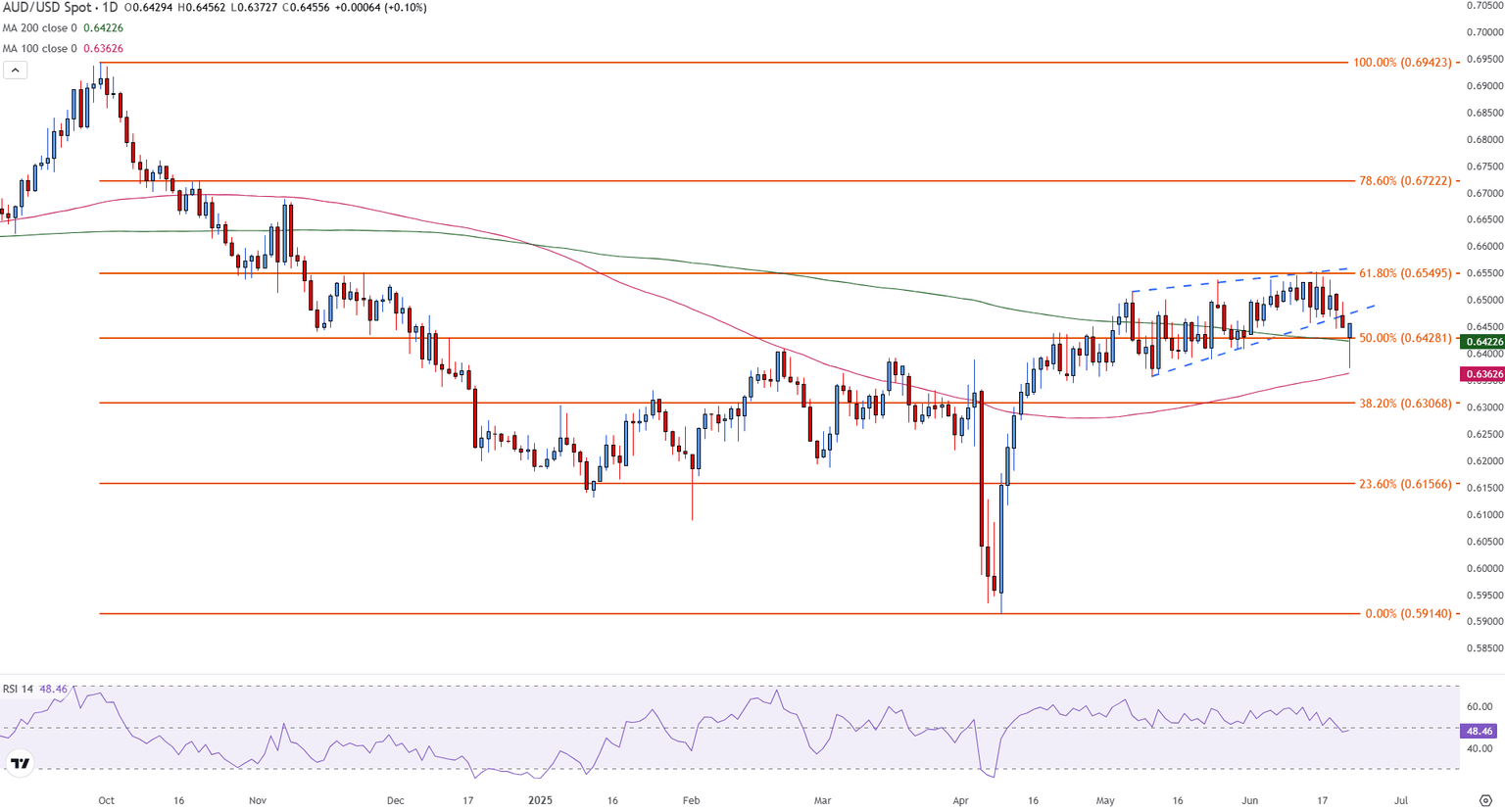
Immediate resistance is located at 0.6450, aligning with wedge resistance and a recent intraday high. A break above this level could open the path to 0.6549, the 67.8% Fibonacci retracement, followed by 0.6722 as a potential medium-term upside target aligned with the 78.6% retracement level. On the downside, support remains firm at 0.6422, followed by the 100-day SMA at 0.6362 and the 38.2% Fibonacci level at 0.6306.
The Relative Strength Index (RSI) hovers near 48, indicating that momentum is approaching the neutral zone. A firm daily close above 0.6450 would favor further upside, while a failure to hold above 0.6422 may expose AUD/USD to fresh losses, targeting 0.6360.
Australian Dollar FAQs
One of the most significant factors for the Australian Dollar (AUD) is the level of interest rates set by the Reserve Bank of Australia (RBA). Because Australia is a resource-rich country another key driver is the price of its biggest export, Iron Ore. The health of the Chinese economy, its largest trading partner, is a factor, as well as inflation in Australia, its growth rate and Trade Balance. Market sentiment – whether investors are taking on more risky assets (risk-on) or seeking safe-havens (risk-off) – is also a factor, with risk-on positive for AUD.
The Reserve Bank of Australia (RBA) influences the Australian Dollar (AUD) by setting the level of interest rates that Australian banks can lend to each other. This influences the level of interest rates in the economy as a whole. The main goal of the RBA is to maintain a stable inflation rate of 2-3% by adjusting interest rates up or down. Relatively high interest rates compared to other major central banks support the AUD, and the opposite for relatively low. The RBA can also use quantitative easing and tightening to influence credit conditions, with the former AUD-negative and the latter AUD-positive.
China is Australia’s largest trading partner so the health of the Chinese economy is a major influence on the value of the Australian Dollar (AUD). When the Chinese economy is doing well it purchases more raw materials, goods and services from Australia, lifting demand for the AUD, and pushing up its value. The opposite is the case when the Chinese economy is not growing as fast as expected. Positive or negative surprises in Chinese growth data, therefore, often have a direct impact on the Australian Dollar and its pairs.
Iron Ore is Australia’s largest export, accounting for $118 billion a year according to data from 2021, with China as its primary destination. The price of Iron Ore, therefore, can be a driver of the Australian Dollar. Generally, if the price of Iron Ore rises, AUD also goes up, as aggregate demand for the currency increases. The opposite is the case if the price of Iron Ore falls. Higher Iron Ore prices also tend to result in a greater likelihood of a positive Trade Balance for Australia, which is also positive of the AUD.
The Trade Balance, which is the difference between what a country earns from its exports versus what it pays for its imports, is another factor that can influence the value of the Australian Dollar. If Australia produces highly sought after exports, then its currency will gain in value purely from the surplus demand created from foreign buyers seeking to purchase its exports versus what it spends to purchase imports. Therefore, a positive net Trade Balance strengthens the AUD, with the opposite effect if the Trade Balance is negative.
Author
Tammy Da Costa, CFTe®
FXStreet
Tammy is an economist and market analyst with a deep passion for financial markets, particularly commodities and geopolitics.