|

AUD/USD - risk reversals flat lined, yield differential hovers near 4-month low

  • AUD/USD risk reversals show lack of bias in the options market.
  • 10Y AU-US yield spread/differential shows signs of life, but still hovers near 4-month low.

Risk reversals
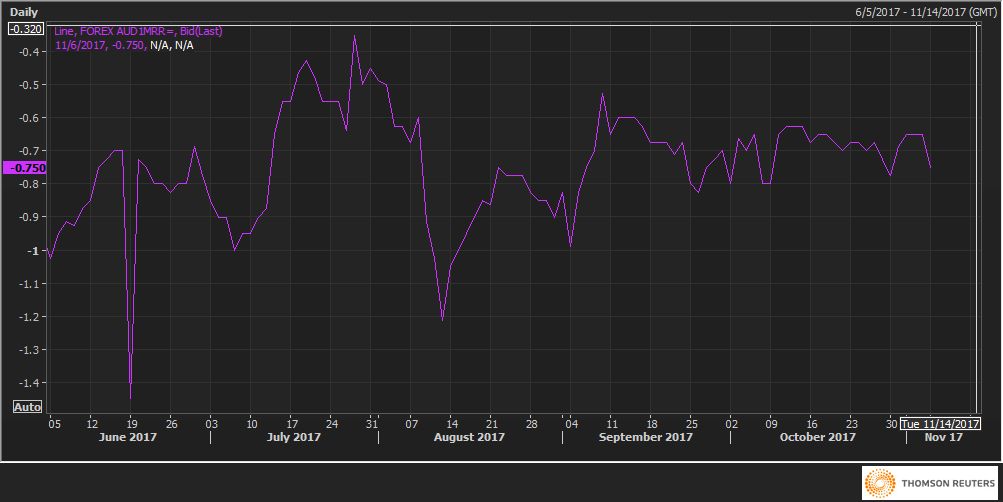
The AUD/USD one-month 25 delta risk reversal continues to move sideways in the range of -0.60 to 0.80. The consolidation seen on the above chart shows a lack of bias or indecision in the options market.

Yield differential
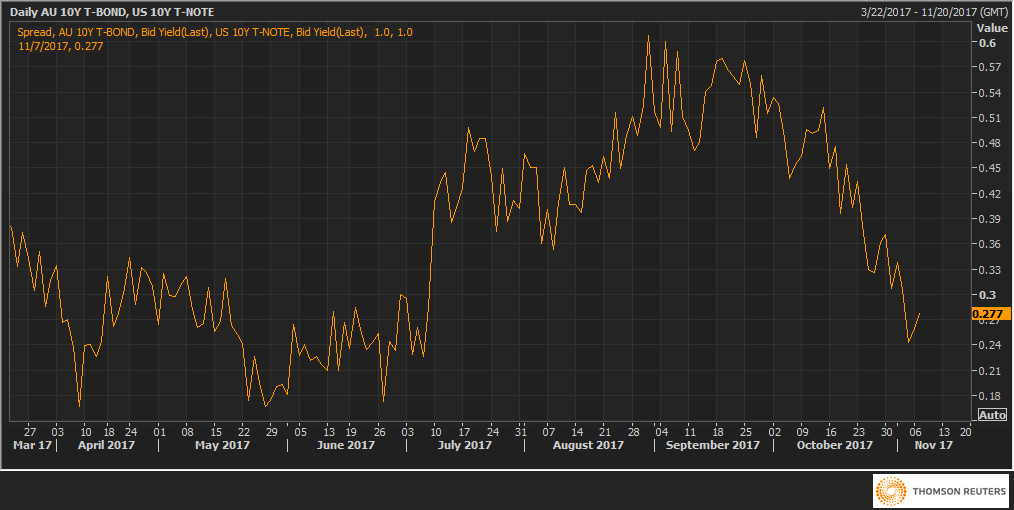
  • The 10-year yield spread hit a 4-month low of 24.3 basis points on Friday and currently stands at 27.7 basis points.
  • A slight recovery, though encouraging, has failed so far to lift the AUD/USD pair above the 200-day MA level of 0.7697.

RBA has more reason to be cautious than optimistic

Kathy Lien from BK Asset Management writes, "having traded in a relatively tight range over the past week, AUD/USD is prime for a breakout and according to the table below, the central bank has more reason to be cautious than optimistic.  Although retail sales stabilized after falling in September, zero growth in demand means spending is weak. Labor market activity and the annualized pace of inflation has also deteriorated on the back of softer manufacturing, service and construction sector activity, giving the RBA very little reason to alter their bias. The good news is that consumer and business confidence is up and the currency is down. But In the context of rising U.S. rates, the RBA doesn't need to be all that cautious for AUD/USD to fall yet given how much it has declined over the past 2 months (nearly 5 cents), a tinge of optimism would send AUD/USD towards 0.7750 quickly."

Author

Omkar Godbole

Omkar Godbole

FXStreet Contributor

Omkar Godbole, editor and analyst, joined FXStreet after four years as a research analyst at several Indian brokerage companies.


More from Omkar Godbole
Share:

Editor's Picks

GBP/USD clings to small gains near 1.3450 after UK jobs data

GBP/USD trades in positive territory at around 1.3450 in the European session on Tuesday. The UK ILO Unemployment Rate remained at 4.9% in the three months to May, compared with expectations of 5%, but failed to provide any impetus to the British Pound's renewed uptick. Traders stay cautious amid US-Iran uncertainty and the UK political transition.

EUR/USD keeps range above 1.1400 after German ZEW

EUR/USD struggles to find direction and fluctuates in a narrow channel above 1.1400 on Tuesday, as the US Dollar (USD) stabilizes following Monday's rebound. The uncertainty around the US-Iran conflict limits the pair's upside but traders refrain from taking large positions ahead of the European Central Bank policy announcements on Thursday, which could drive the Euro's near-term valuation.

Gold extends recovery toward $4,100

Gold gains traction following Monday's choppy action and advances toward $4,100 on Tuesday. However, the uncertainty surrounding the conflict in the Middle East and growing expectations for a hawkish Federal Reserve policy outlook could make it difficult for the precious metal to gather bullish momentum in the near term.

Bitcoin extends advance as ETF inflows, Iran war mediators' proposal lift risk mood

Bitcoin extends its gains, trading above $65,800 after closing above the key technical hurdle the previous day. The bullish price action is further supported by the return of institutional demand, with spot Exchange Traded Funds continuing their inflows on Monday. In addition, the renewed hopes for peace between the US and Iran have lifted risk sentiment, providing an additional tailwind for the Crypto King.

Buy the dip on the Dow Jones and S&P? Forex Trading Gold descending triangle

Trading during a war, a pandemic, during trade disputes, and other geopolitical events, especially when some major players are sociopathic, can be quite challenging. The Iran war is no exception. The Iran war is no exception.

US Dollar mid-year outlook: Exceptional currency, exceptional risks?
The US Dollar enters the second half of 2026 in a markedly different position from a year ago. The King currency has recovered, reflecting persistent US inflation, changing expectations for Fed policy, geopolitical tensions and renewed demand for defensive assets.