AUD/USD retreats despite Australian budget surplus, as traders eye US CPI
- AUD/USD unmoved by Australia’s projected A$4.2 billion surplus for 2022/2023.
- US Treasury Secretary Janet Yellen warns of “tremendously adverse effects” if the government runs out of cash by June 1.
- Upcoming US CPI data may impact AUD/USD; further evidence of high inflation could lead to more losses in the pair.

AUD/USD reverses its Monday course after testing crucial technical indicators alongside the release of the Australian budget, which AUD/USD buyers ignored despite foreseeing a surplus. Contrarily worries about raising or suspending the US debt ceiling took center stage ahead of April’s US Consumer Price Index (CPI) report. At the time of writing, the AUD/USD is trading at 0.6765 after hitting a high of 0.6786.
AUD/USD creeps lower on US uncertainty, despite Australian budget surplus
AUD/USD buyers seem to be unimpressed by the Australian budget for 2023-2024. The Australian Federal Treasurer Jim Chaimers projects the first balanced annual budget in 15 years, anticipating a surplus of A$4.2 billion for 2022/2023. The AUD/USD hit a weekly high at 0.6803 but retraced as sellers stepped in around the 200-day EMA at 0.6788, which dragged the exchange rate toward the current price levels.
In the meantime, the US Secretary of Treasury Janet Yellen commented that the government would run out of cash by June 1, adding that it would be a “huge git” to the US economy. She said a default would have “tremendously adverse effects” on the financial markets.
Aside from this, Federal Reserve speakers led by Fed Governor Philip Jefferson and the New York Fed President John Williams crossed newswires. Jefferson spoke on the banking system, saying it was sound and resilient and that most banks raised their lending standards. He added that inflation is slowing down in an “orderly fashion,” adding that it would come down as the economy grows.
Later, NY Fed President Williams said, “We haven’t said we are done,” regarding hiking rates, and added that the Fed would be data dependent and could raise rates if needed.
Even though Williams sounded hawkish, the AUD/USD remained unfazed and has bounced off the day’s lows
Upcoming events
AUD/USD traders would get some cues on the release of April’s US Consumer Price Index (CPI), which is expected to trigger volatility in the financial markets. The CPI is estimated to remain unchanged at 5% on its annual readings, while core CPI is projected to dip from 5.6% to 5.5%. Further evidence that inflation remains higher could pave the way for further losses in the AUD/USD pair.
AUD/USD Technical Analysis
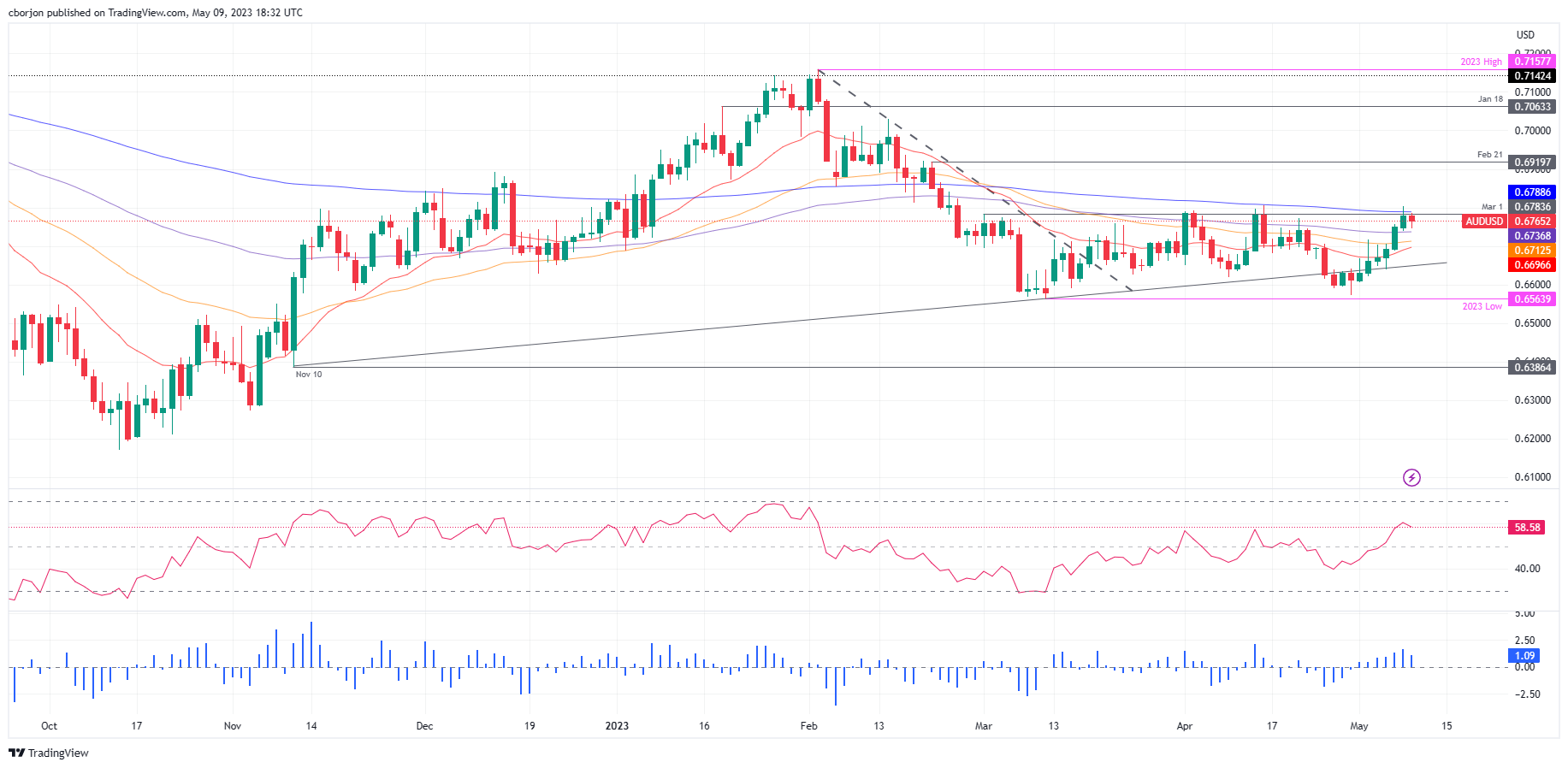
The AUD/USD is still downward biased, as the 50-day EMA crossed below the 200-day EMA since March 2023, which suggests that further downside is warranted. The aforementioned was confirmed by Tuesday’s price action, with the AUD/USD struggling to hurdle the 200-day EMA, which opened the door for a test of the 100-day EMA at 0.6736. If AUD/USD breaches the latter, its next demand area exposed would be the 50 and the 20-day EMA, each at 0.6712 and 0.6696. On the other hand, if AUD/USD surpasses the 200-day EMA, it would expose the 0.6800 handle.
Author

Christian Borjon Valencia
FXStreet
Markets analyst, news editor, and trading instructor with over 14 years of experience across FX, commodities, US equity indices, and global macro markets.