|

AUD/USD Price Analysis: Bulls attack 20-DMA to refresh intraday top but stay cautious

  • AUD/USD takes the bids while extending Friday’s corrective pullback.
  • 20-DMA guards immediate upside but 100-DMA becomes the key resistance.
  • Horizontal area from August appears a tough nut to crack for sellers.

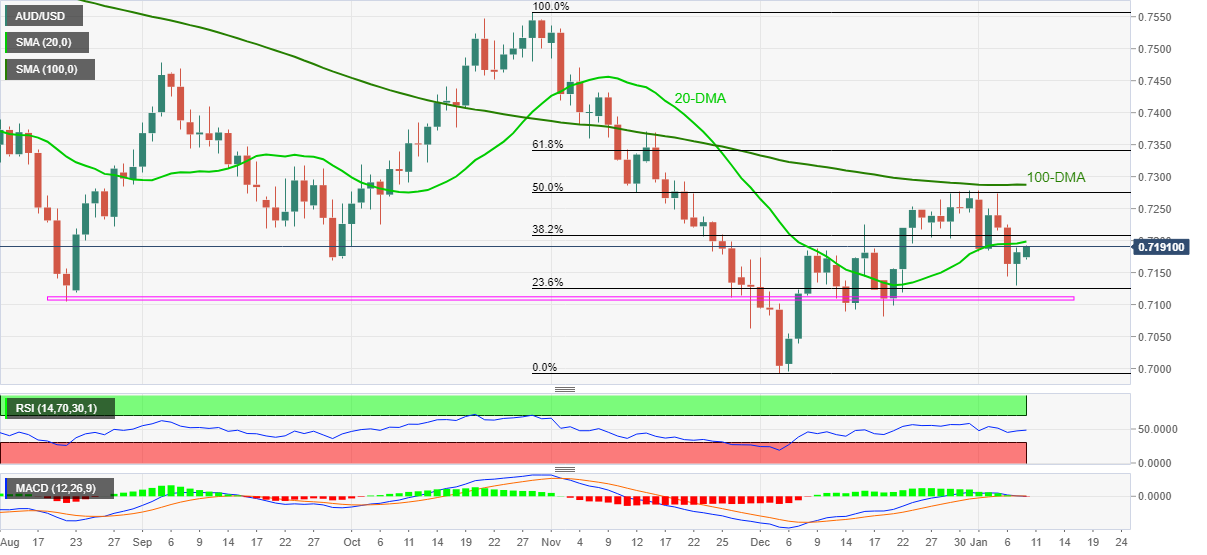
AUD/USD keeps the previous day’s recovery moves as it approaches 0.7200 threshold, up 0.11% intraday during early Monday.

The Aussie pair bounced off the 23.6% Fibonacci retracement of (Fibo.) October-December downside, around 0.7125 on Friday. However, the quote remains below stays below the 20-DMA level surrounding 0.7195, not to forget keeping the pullback from the 100-DMA. The inability to cross the key moving averages joins the receding bullish bias of the MACD and steady RSI to keep sellers hopeful.

That said, fresh downside will aim for the 23.6% Fibo. retest, around 0.7125, ahead of targeting a horizontal area from August 20 near 0.7110-05.

Additionally, the 0.7100 round figure may also test the pair bears, a break of which will direct AUD/USD sellers towards 0.7050 and then to the 0.7000 psychological magnet.

On the contrary, the 20-DMA level of 0.7195 guards the quote’s immediate upside before directing AUD/USD buyers towards the 50% Fibonacci retracement level of 0.7280.

However, the 100-DMA surrounding 0.7290 becomes a tough nut to crack for the pair bull, a break of which will not hesitate to challenge the mid-November peak of .7371.

AUD/USD: Four-hour chart
Trend: Bearish

Additional important levels

Overview
Today last price0.719
Today Daily Change0.0008
Today Daily Change %0.11%
Today daily open0.7182
 
Trends
Daily SMA200.7195
Daily SMA500.7227
Daily SMA1000.7288
Daily SMA2000.7435
 
Levels
Previous Daily High0.7189
Previous Daily Low0.713
Previous Weekly High0.7278
Previous Weekly Low0.713
Previous Monthly High0.7278
Previous Monthly Low0.6993
Daily Fibonacci 38.2%0.7166
Daily Fibonacci 61.8%0.7152
Daily Pivot Point S10.7145
Daily Pivot Point S20.7107
Daily Pivot Point S30.7085
Daily Pivot Point R10.7204
Daily Pivot Point R20.7226
Daily Pivot Point R30.7264

Author

Anil Panchal

Anil Panchal

FXStreet

Anil Panchal has nearly 15 years of experience in tracking financial markets. With a keen interest in macroeconomics, Anil aptly tracks global news/updates and stays well-informed about the global financial moves and their implications.


More from Anil Panchal
Share:

Editor's Picks

AUD/USD extends decline to fresh monthly lows below 0.7100

AUD/USD trades south of 0.7100 early in the Asian session on Thursday, as the US Dollar soared following the Federal Reserve's monetary policy announcement. The Fed delivered a 25 bps rate hike as expected, while policymakers expressed concerns about inflation leading to bets of additional hikes before year-end.

USD/JPY flirts with 156.00 after Fed's hawkish hike

USD/JPY trades at fresh weekly highs around 156.00 early on Thursday, as the US Dollar soared following the Federal Reserve's monetary policy announcement. The US central bank hiked the benchmark rate by 25 bps as expected, while Chair Kevin Warsh delivered quite hawkish comments in the press conference that followed the decision.

Gold dips towards $4,250 in the Fed's aftermath

Gold erased intraday gains and turned negative following the Federal Reserve's decision to hike rates by 25 bps as expected. The XAU/USD pair briefly surpassed the $4,360 level, now accelerating its slide towards the $4,250 price zone. Hawkish words from Chair Kevin Warsh fueled bets for additional hikes before year-end.

Fed raises 2026 interest rate forecast to 4.1%, lifts PCE inflation projections
The Federal Reserve's (Fed) latest dot plot projections, released by the Federal Open Market Committee (FOMC) on Wednesday, show policymakers now expect interest rates to stand at 4.1% by the end of 2026, up from 3.8% in June.
Fed recap: One hike down, more to come? The Fed’s new rate path says yes
The Federal Reserve (Fed) raised its Fed Fund Target Range (FFTR) range by 25 basis points to 3.75%-4.00% in a unanimous decision, saying the move would support a timelier return to its 2% inflation goal.
How Japan became the World's Banker and why that era may be ending

Japan's ultra-low interest rates helped finance trillions of dollars in global investments for more than a decade, making the Japanese Yen one of the world’s cheapest sources of funding. With the Bank of Japan expected to tighten policy again this week, that advantage may be entering a new phase. While most major economies raised interest rates, Japan remained the world's outlier.