AUD/USD finds hurdles around 0.6660 amid mixed responses on the US banking system
- AUD/USD has observed selling pressure near 0.6660 as USD Index has defended the 103.00 support.
- The street is mixed about the commentary of fewer rate hikes ahead by Federal Reserve chair Jerome Powell.
- Reserve Bank of Australia is extremely worried about persistent inflation and a softening retail demand would provide some relief.
- AUD/USD is oscillating in an Inverted Flag pattern, which signals a bearish trend-following pattern after a downside move.

AUD/USD has faced immense pressure after a gradual recovery to near 0.6660 in the early European session. The Aussie asset has sensed meaningful offers amid a recovery move by the US Dollar Index (DXY). The Australian Dollar is likely to remain in action ahead of the release of the monthly Consumer Price Index (CPI), which is scheduled for Wednesday.
S&P500 futures have made stellar gains in the morning session on Monday on hopes of expansion in liquidity assistance to small United States banks. The 500-US stocks futures basket has continued its Friday’s bullish bias, portraying significant improvement in the risk appetite of the market participants.
The US Dollar Index (DXY) is defending the 103.00 support on expectations that upbeat preliminary S&P Global PMI could fade the expectations of a termination of the rate-hiking spell by the Federal Reserve (Fed). Manufacturing PMI jumped to 49.3 vs. the consensus of 47.0 and the former release of 47.3. While Services PMI accelerated to 53.8 against the estimates of 50.5 and the prior release of 50.6.
In addition to that, the demand for US government bonds has eased marginally, which has resulted in a minor recovery in 10-year US Treasury yields above 3.38%. Meanwhile, two-year US Treasury yields that track US equities firmly have stretched their recovery above 3.38%, indicating some pressure on risk-sensitive assets ahead.
Mixed views on US banking turmoil
The street is full of terror about the economic outlook of the United States economy after the banking sector turmoil. The collapse of three mid-size US banks was sufficient to dampen the confidence of investors. Fears of banking fiasco have extended to households, which have trimmed their deposits from small US banks dramatically.
Reuters reported on Friday that the data from Federal Reserve (Fed) shows that deposits at small U.S. banks dropped by a record amount following the collapse of Silicon Valley Bank (SVB). Therefore, US authorities have come forward to widen the blanket of support to US mid-size banks by expanding the emergency liquidity facility. This has provided a small time relief, however, the situation is likely to get vulnerable further.
Speaking at the China Development Forum over the weekend, International Monetary Fund (IMF) Chief Kristalina Georgieva warned that “risks to financial stability have increased.” She further added, 2023 would be another challenging year, with global growth slowing to 2.9% due to the pandemic, the war in Ukraine, and monetary tightening.
Precautionary moves from US banks in advancing loans to households and businesses have propelled the risk of a US recession. Minneapolis Fed president Neel Kashkari cited on Sunday, “Recent stress in the banking sector and the possibility of a follow-on credit crunch brings the US closer to recession. It definitely brings us closer." It would be a tough call from the Fed to bring more interest rates if recession fears are potential.
Australian Retail Sales and Consumer Price Index to remain in the limelight
A power-pack action is expected from the Australian Dollar as the release of the monthly Retail Sales and Consumer Price Index (CPI) data will remain key event this week. Tuesday’s Retail Sales (Feb) data is expected to expand by 0.4% lower than the former expansion of 1.9%. The Reserve Bank of Australia (RBA) is extremely worried about persistent inflation and a softening retail demand would provide some relief to policymakers.
It is worth noting that the Reserve Bank of Australia provided cues about the consideration of a pause in the rate-hiking spell from its April monetary meeting after a significant decline in monthly CPI data. Reserve Bank of Australia Governor Philip Lowe has already pushed rates to 3.60%,
On Wednesday, the monthly CPI will be the key highlight. For February, the monthly figure was recorded at 7.4%.
AUD/USD technical outlook
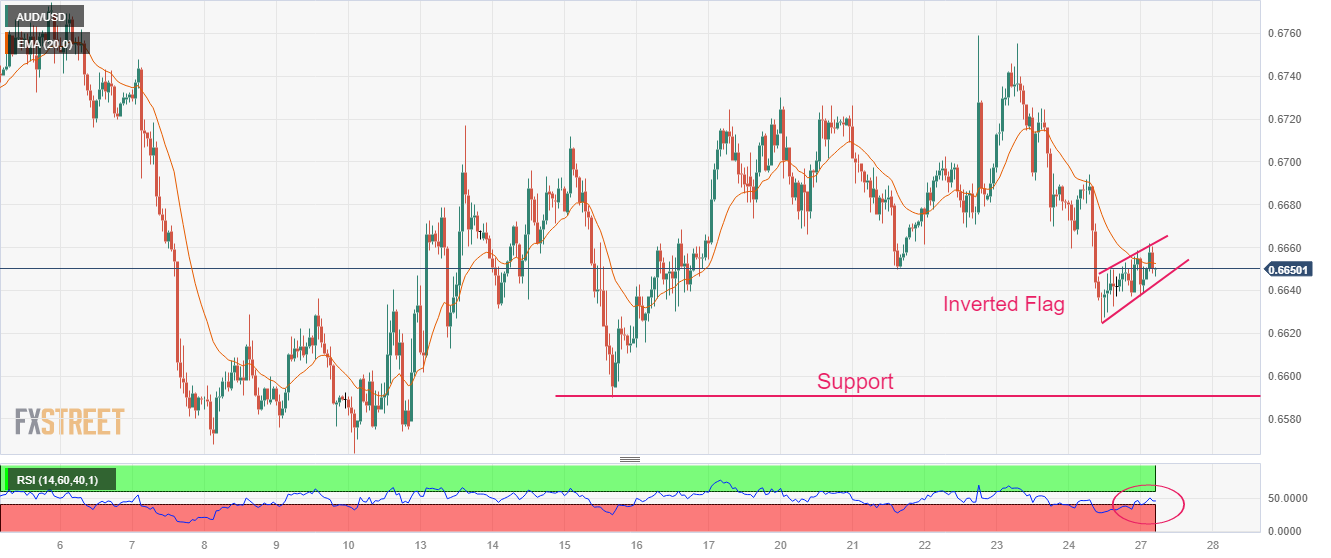
AUD/USD is auctioning in an Inverted Flag chart pattern on an hourly scale. An Inverted Flag is a trend-following pattern that displays a long consolidation that is followed by a breakdown. Usually, the consolidation phase of the chart pattern serves as an inventory adjustment in which those participants initiate shorts, which prefer to enter an auction after the establishment of a bearish bias.
The 20-period Exponential Moving Average (EMA) at 0.6600 is acting as a major barricade for the Australian Dollar.
Meanwhile, the Relative Strength Index (RSI) (14) has gradually shifted into 40.00-60.00 but looks less confident.
Author

Sagar Dua
FXStreet
Sagar Dua is associated with the financial markets from his college days. Along with pursuing post-graduation in Commerce in 2014, he started his markets training with chart analysis.