Trump demands 1% rates hours after the Fed raised them
- Trump posts that US rates should be 1% or less, hours after the Fed hiked.
- DXY holds above 100.00, with its session high already in before he posted.
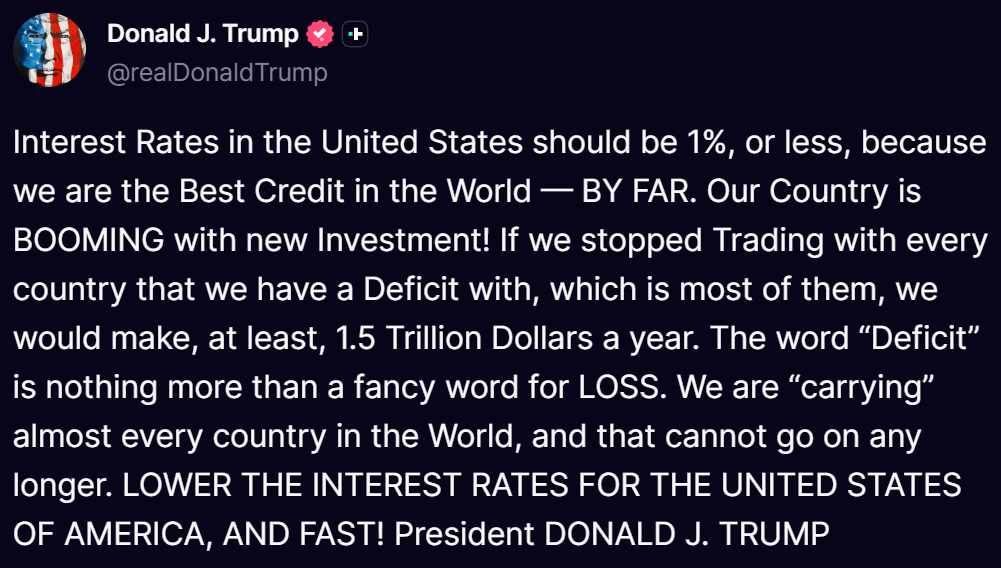
Trump posted on Wednesday that US rates should be 1% or less and that the country has the strongest credit anywhere. He also wrote that cutting off trade with every nation the US runs a deficit with would earn at least $1.5 trillion a year. The Fed had set its own rate at 3.75%-4.00% a few hours earlier, which leaves 1% twelve quarter-point cuts away. He called the deficit a loss, and it is the part of the post that reaches the Dollar Index.
Americans bought roughly $743 billion more from abroad than they sold in the twelve months to June, and that gap is how foreigners end up with the Dollars they lend back to the US Treasury. Shutting it would remove buyers from the market that sets the borrowing costs he wants lower.
The last agency to rate US debt at the top gave that up in May 2025.
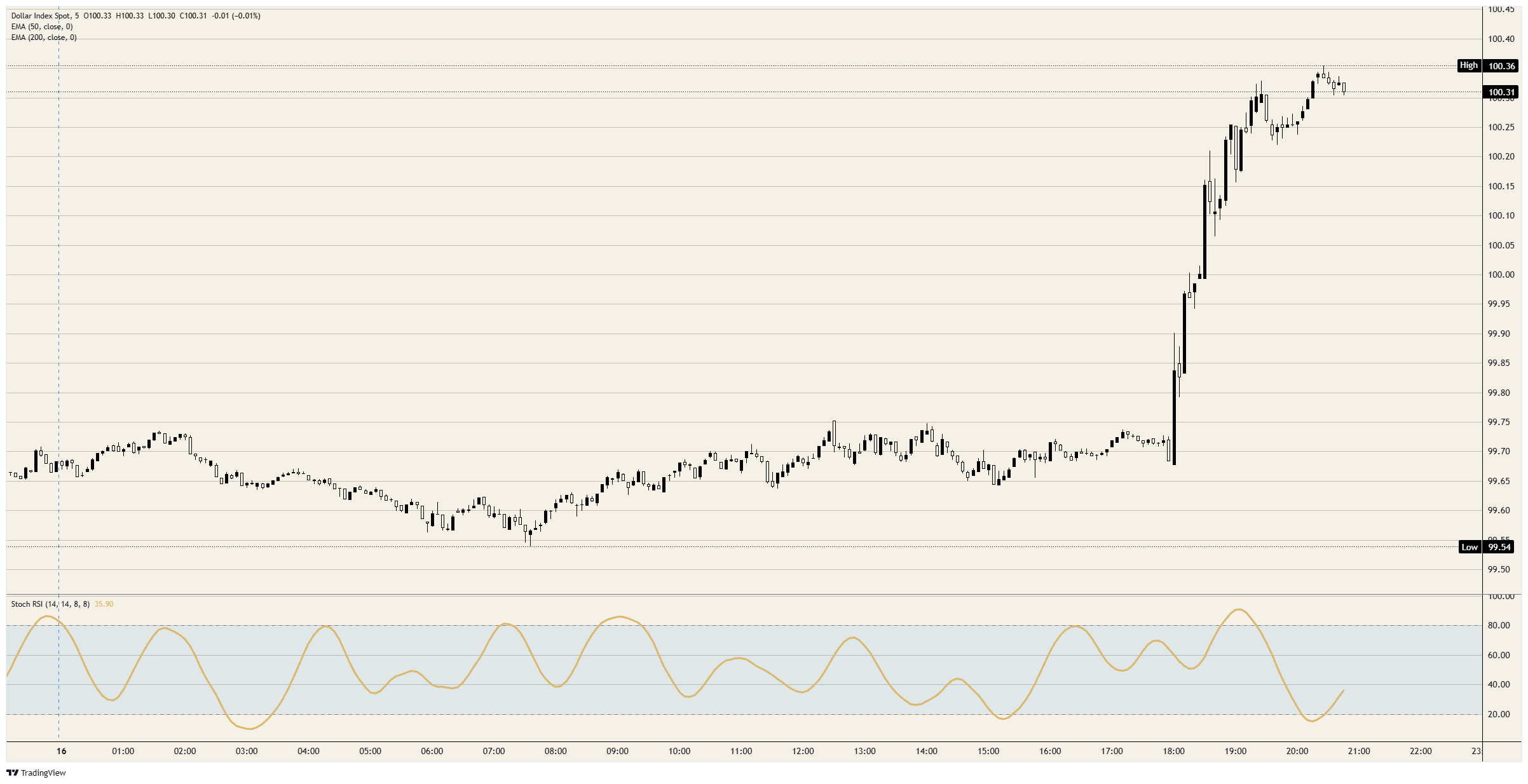
The Dollar Index had not traded above 100.00 all session before the decision, with its low near 99.50 in the European morning. It cleared 100.00 within half an hour of the release and carried on to a high short of 100.50, above everything it traded before the Fed. It holds just beneath that high.
The Stochastic Relative Strength Index (Stoch RSI), a momentum gauge, ran to the top of its band on the break, dropped to the bottom while price stayed near the high, and has turned up again. The high was in before the post, and the index has not moved since.
DXY 5-minute chart
Interest rates FAQs
Interest rates are charged by financial institutions on loans to borrowers and are paid as interest to savers and depositors. They are influenced by base lending rates, which are set by central banks in response to changes in the economy. Central banks normally have a mandate to ensure price stability, which in most cases means targeting a core inflation rate of around 2%. If inflation falls below target the central bank may cut base lending rates, with a view to stimulating lending and boosting the economy. If inflation rises substantially above 2% it normally results in the central bank raising base lending rates in an attempt to lower inflation.
Higher interest rates generally help strengthen a country’s currency as they make it a more attractive place for global investors to park their money.
Higher interest rates overall weigh on the price of Gold because they increase the opportunity cost of holding Gold instead of investing in an interest-bearing asset or placing cash in the bank. If interest rates are high that usually pushes up the price of the US Dollar (USD), and since Gold is priced in Dollars, this has the effect of lowering the price of Gold.
The Fed funds rate is the overnight rate at which US banks lend to each other. It is the oft-quoted headline rate set by the Federal Reserve at its FOMC meetings. It is set as a range, for example 4.75%-5.00%, though the upper limit (in that case 5.00%) is the quoted figure. Market expectations for future Fed funds rate are tracked by the CME FedWatch tool, which shapes how many financial markets behave in anticipation of future Federal Reserve monetary policy decisions.
Author

Joshua Gibson
FXStreet
Joshua joins the FXStreet team as an Economics and Finance double major from Vancouver Island University with twelve years' experience as an independent trader focusing on technical analysis.