|

AUD/USD falls to monthly low following US PMIs

  • On Friday's session, the AUD/USD lost more than 1% pips and poised to closed a 2.9% weekly decline
  • Negative market sentiment following mixed US PMIs from June weighs on the Aussie.
  • Lower US bond yields and losses seen on Wall Street signal flightto-safety flows.

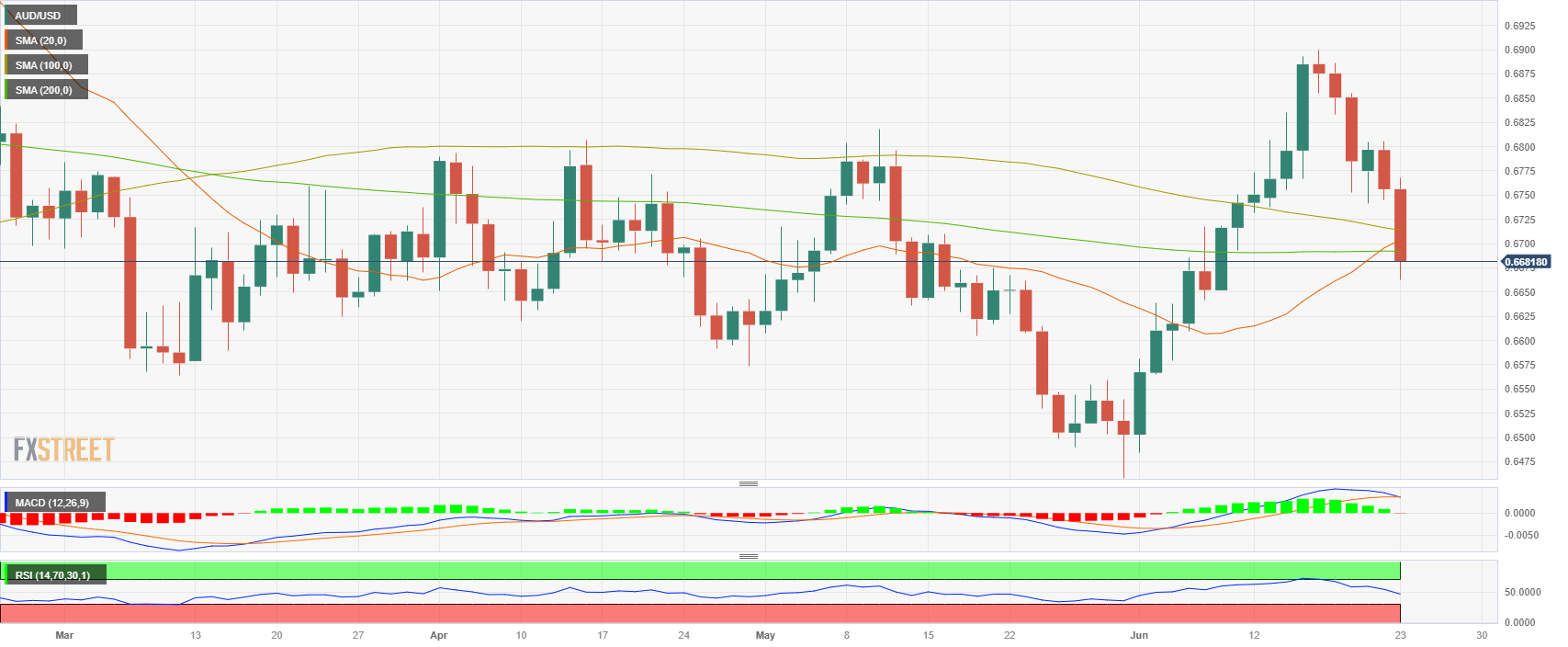
On Friday, the Aussie faced severe selling pressure and the AUD/USD fell to its lowest level since early June towards the 0.6660 area. In that sense, global economic downturn fears following weak UK and Eurozone PMIs, followed then by mixed US PMIs favored a sour market mood and hence benefited the US Dollar.

Investors assess preliminary June PMIs

On Friday, PMIs indicated mixed results for the US in the month of June, according to the S&P Global report. The Manufacturing PMI for June, fell to a five-month low, reaching 46.3, failing to live up to the expectations of 48.3. On the positive side, the Services PMI came slightly above the expectations at 54.1 vs the 54 anticipated by markets. Moreover, the Global Composite PMI dropped to 53 vs the 54.4 expected.

Adding to the negative market environment, the 10-year bond yield declined to a low of 3.70% while the 2-year yield fell to 4.70% and the 5-year to 4%, respectively. Moreover, the S&P 500 index (SPX) is seeing 0.6% losses, the Dow Jones Industrial Average (DJI) a 0.51% decline, and the Nasdaq Composite (NDX) a 0.92% loss. 

Regarding the next sessions, attention now turns to next week’s Core Personal Consumption Expenditures (PCE) and Gross Domestic Product (GDP) data from the US where investors will get a clearer outlook of the economic activity and inflation in order to start modeling their expectations towards the next Fed meeting in July. On the Australian side, the focus is the Monthly Consumer Price Index from May.

AUD/USD Levels to watch

The AUD/USD holds a bearish outlook for the short term, as per the daily chart. The Relative Strength Index (RSI) and Moving Average Convergence Divergence (MACD) both fell to negative territory, and below the 20,100 and 200-day Simple Moving Averages (SMAs). The negative outlook is also seen in the weekly chart where the pair is set to posit the largest weekly decline since March.

In case the AUD/USD loses more ground in the 0.6640 zone, the 0.6620 area and psychological mark at 0.6600 could come into play. On the flip side, the following resistances line up at the 200-day SMA at 0.6690, followed then by the 20-day SMA at 0.670 and the 100-day Simple Moving SMA at 0.6712.

AUD/USD Daily chart
AUD/USD

Overview
Today last price0.6681
Today Daily Change-0.0075
Today Daily Change %-1.11
Today daily open0.6756
 
Trends
Daily SMA200.6696
Daily SMA500.6681
Daily SMA1000.6716
Daily SMA2000.6692
 
Levels
Previous Daily High0.6806
Previous Daily Low0.6745
Previous Weekly High0.69
Previous Weekly Low0.6732
Previous Monthly High0.6818
Previous Monthly Low0.6458
Daily Fibonacci 38.2%0.6768
Daily Fibonacci 61.8%0.6783
Daily Pivot Point S10.6732
Daily Pivot Point S20.6708
Daily Pivot Point S30.667
Daily Pivot Point R10.6793
Daily Pivot Point R20.683
Daily Pivot Point R30.6855

Author

Patricio Martín

Patricio is an economist from Argentina passionate about global finance and understanding the daily movements of the markets.


More from Patricio Martín
Share:

Editor's Picks

AUD/USD consolidates above 0.7000/two-month low; bearish potential intact

The AUD/USD pair oscillates in a narrow range during the Asian session, and moves little following the release of mixed inflation figures from China. Spot prices currently trade around the 0.7025 region, nearly unchanged for the day, and remain within striking distance of a nearly two-month low set on Tuesday. Renewed hostilities between the US and Iran temper hopes for a deal to end the over three-month-old war.

Japanese Yen languishes despite wholesale inflation accelerates in May

USD/JPY flatlines after experiencing volatility, trading around 160.40 during the Asian hours on Wednesday. The pair continues to hold its ground, reflecting a struggling Japanese Yen that has failed to find support despite a massive acceleration in wholesale inflation. Driven by surging energy costs linked to the ongoing Middle East conflict, Japan’s Producer Price Index jumped 6.3% year-over-year in May. This hot printing comfortably outpaced April’s upwardly revised 5.3% figure and surpassed market consensus of 5.5%, marking the fastest pace of wholesale price growth in three years.

Gold plummets below $4,200 amid US‑Iran tensions ahead of US CPI

Gold extends the recent breakdown momentum below a technically significant 200-day Simple Moving Average (SMA) and drops to a fresh low since March 23, further below the $4,200 mark during the Asian session. Crude Oil prices rise amid renewed hostilities between the US and Iran, fueling inflation fears and bolstering bets for more hawkish central banks.

Bitcoin remains vulnerable, Ethereum weakens further, XRP signals more downside

Bitcoin, Ethereum, and Ripple remain under pressure mid-week, as the broader cryptocurrency market struggles to regain recovery momentum after last week’s massive correction. BTC struggles below $62,000, ETH continues to weaken below $1,650, while XRP’s momentum indicators remain biased toward further downside.

US CPI data set to show inflation at three-year high in May, backing Fed hawkish tilt

The US Bureau of Labor Statistics will publish the May Consumer Price Index (CPI) data on Wednesday. The report is expected to show another step up in consumer inflation, driven by the persistently high Oil prices due to the ongoing crisis in the Middle East.

The US economy defies the rules: 100 days into the Oil shock and the recession signal is still missing

More than three months after the start of the Iran war and the resulting disruption to global energy markets, the US economy continues to display remarkable resilience. The conflict has triggered a sharp rise in Oil prices, reignited inflationary pressures and fueled widespread concerns about a potential economic slowdown.














