|

AUD/NZD Price Analysis: Bearish signals deepen as Aussie struggles against Kiwi

  • AUD/NZD trades near the 1.0700 area, retreating from intraday highs ahead of the Asian session.
  • Overall bearish sentiment persists despite neutral oscillators, with all key moving averages pointing to downside pressure.
  • Support lies at 1.06949, while resistance levels are seen at 1.07691, 1.07711, and 1.08238.

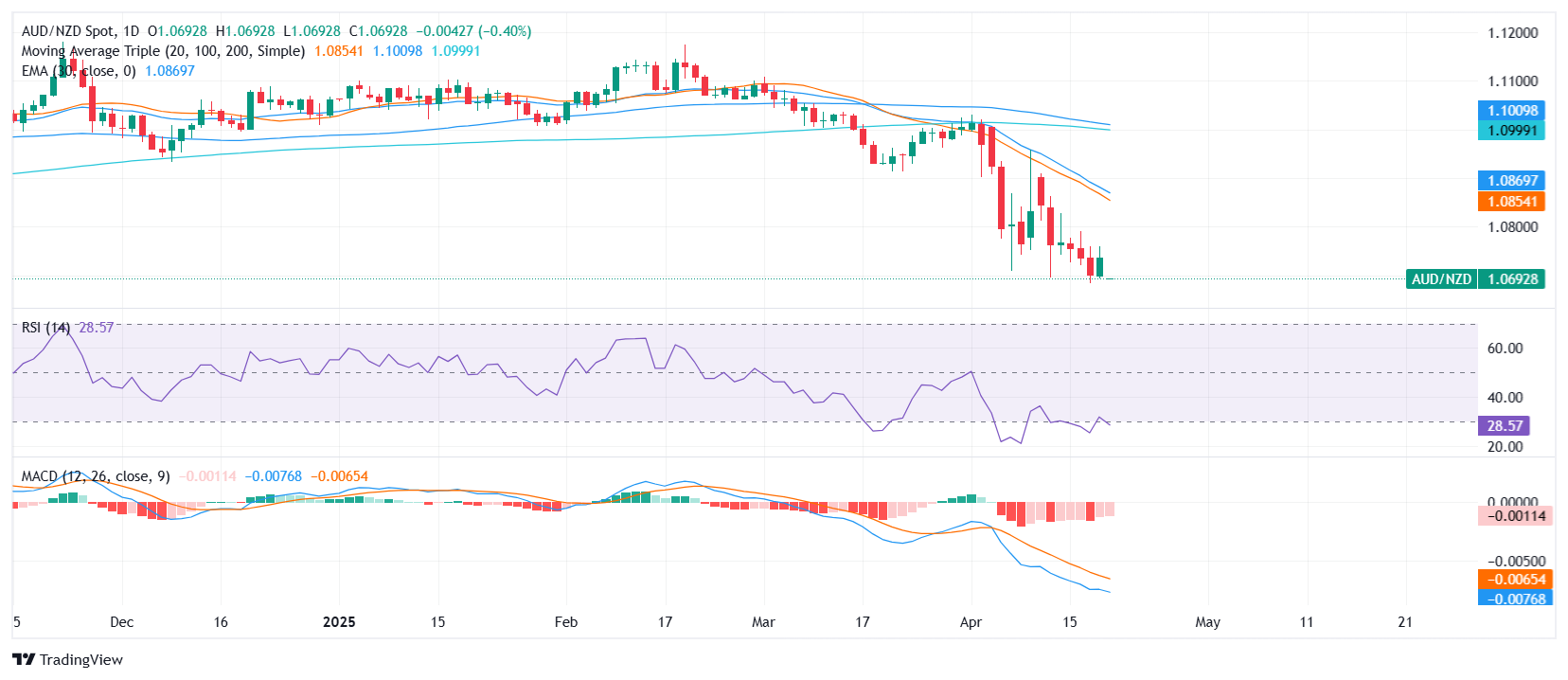
The AUD/NZD pair is exhibiting bearish signals, currently trading around 1.0700, down 0.40% today, and positioned mid-range between 1.06784 and 1.07439 during Monday’s session. The pair's inability to hold higher ground underlines the weight of selling pressure as the broader trend continues to favor the downside.

Momentum indicators provide mixed but cautious readings. The Relative Strength Index (RSI) stands at 31, close to oversold territory yet still holding a neutral bias. The Moving Average Convergence Divergence (MACD) continues to flash a sell signal, in alignment with the Awesome Oscillator at -0.0185, which also suggests downside continuation. Meanwhile, the Stochastic %K at 9.2611 remains neutral, lacking clear directional conviction.

The moving averages confirm the bearish technical structure. All key SMAs — 20-day at 1.0859, 100-day at 1.1010, and 200-day at 1.1000 — are sloping downward, along with shorter-term indicators like the 10-day EMA at 1.0769 and 10-day SMA at 1.0771, which further validate the dominant bearish bias.

Support is found at 1.06949. Resistance is capped at 1.07691, followed by 1.07711 and 1.08238. If selling continues and the pair slips below the 1.0690 zone, a fresh wave of downside could be triggered.

Daily chart
Author

Patricio Martín

Patricio is an economist from Argentina passionate about global finance and understanding the daily movements of the markets.


More from Patricio Martín
Share:

Markets move fast. We move first.

Orange Juice Newsletter brings you expert driven insights - not headlines. Every day on your inbox.

By subscribing you agree to our Terms and conditions.

Editor's Picks

EUR/USD eyes 1.1800 barrier near two-month highs

EUR/USD extends its gains for the second consecutive day on Tuesday and approaches 1.1800. On the daily chart, technical analysis indicates a persistent bullish bias, as the pair moves upward within the ascending channel pattern. Additionally, the 14-day Relative Strength Index at 68.89 reaffirms the bullish bias.

GBP/USD climbs to 1.3500 area, renews ten-week high

GBP/USD extends its weekly rally and trades at its highest level since early October near 1.3500. The US Dollar remains under persistent bearish pressure heading into the holidays, while Pound traders largely brush off the latest interest rate cut from the Bank of England.

Gold approaches $4,500 as record-setting rally continues

Gold builds on Monday's impressive gains and advances toward $4,500, setting fresh record-highs along the way. Heightened geopolitical tensions, combined with the broad-based US Dollar (USD) weakness ahead of the Q3 GDP data, help XAU/USD preserve its bullish momentum.

Uniswap holds above $6 as traders eye UNIfication vote outcome

Uniswap price holds above $6 at the time of writing on Tuesday after closing above a key resistance zone in the previous week. Traders are focusing on the highly anticipated UNIfication proposal, which is set to conclude on Thursday, and could become a key near-term catalyst. On the technical side, momentum indicators are flashing bullish signals, hinting at an upside rally.

Ten questions that matter going into 2026

2026 may be less about a neat “base case” and more about a regime shift—the market can reprice what matters most (growth, inflation, fiscal, geopolitics, concentration). The biggest trap is false comfort: the same trades can look defensive… right up until they become crowded.

XRP steadies above $1.90 support as fund inflows and retail demand rise

Ripple (XRP) is stable above support at $1.90 at the time of writing on Monday, after several attempts to break above the $2.00 hurdle failed to materialize last week. Meanwhile, institutional interest in the cross-border remittance token has remained steady.