|

AUD/NZD Price Analysis: Bearish signals emerge ahead of Asia open

  • AUD/NZD was seen trading around the 1.07 area, registering a slight decline on the day.
  • The overall technical outlook suggests a bearish bias for the currency pair.
  • Key Simple Moving Averages point to selling pressure, while the Relative Strength Index remains neutral, and the Moving Average Convergence Divergence shows a buy signal.

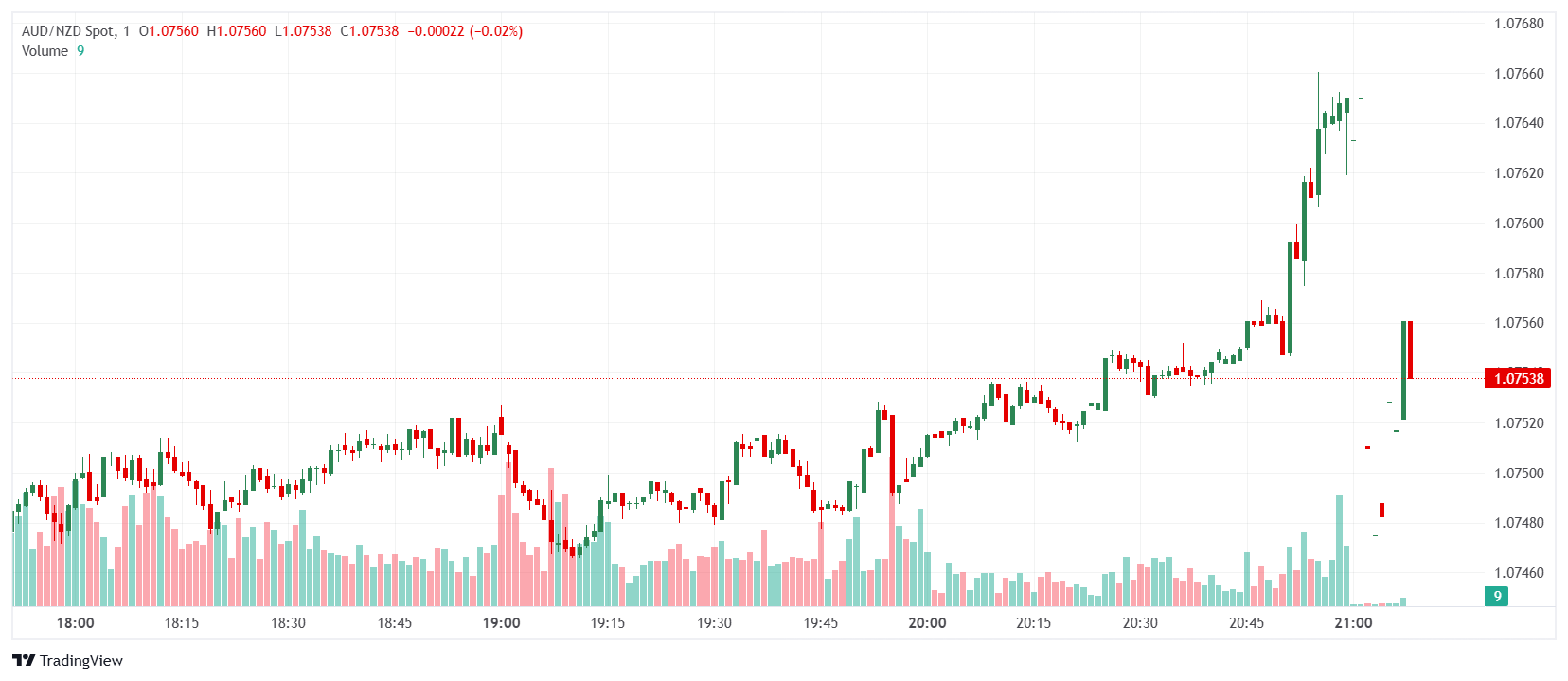
The AUD/NZD has experienced some downward pressure, hovering near the 1.07 zone on Tuesday. Despite mixed signals from some momentum indicators, the longer-term technical picture appears to favor the bears, with several moving averages reinforcing this sentiment.

The AUD/NZD pair is currently exhibiting a bearish technical bias. While the Moving Average Convergence Divergence indicator is flashing a buy signal, suggesting potential short-term upward momentum, the broader context leans negative. The Relative Strength Index sits in neutral territory around the 42 level, offering little directional conviction at present. However, both the 20-day, 100-day, and 200-day Simple Moving Averages are indicating sell positions, highlighting sustained bearish momentum over different timeframes. Similarly, the 30-day Exponential Moving Average and Simple Moving Average also point towards further declines.

Looking at potential price movements, immediate support is observed at 1.0746, followed by 1.0739 and then a lower level at 1.0717. On the upside, initial resistance can be found at 1.0774, with subsequent resistance levels at 1.0781 and 1.0786.

Daily chart
Author

Patricio Martín

Patricio is an economist from Argentina passionate about global finance and understanding the daily movements of the markets.


More from Patricio Martín
Share:

Markets move fast. We move first.

Orange Juice Newsletter brings you expert driven insights - not headlines. Every day on your inbox.

By subscribing you agree to our Terms and conditions.

Editor's Picks

EUR/USD eyes 1.1800 barrier near two-month highs

EUR/USD extends its gains for the second consecutive day on Tuesday and approaches 1.1800. On the daily chart, technical analysis indicates a persistent bullish bias, as the pair moves upward within the ascending channel pattern. Additionally, the 14-day Relative Strength Index at 68.89 reaffirms the bullish bias.

GBP/USD climbs to 1.3500 area, renews ten-week high

GBP/USD extends its weekly rally and trades at its highest level since early October near 1.3500. The US Dollar remains under persistent bearish pressure heading into the holidays, while Pound traders largely brush off the latest interest rate cut from the Bank of England.

Gold approaches $4,500 as record-setting rally continues

Gold builds on Monday's impressive gains and advances toward $4,500, setting fresh record-highs along the way. Heightened geopolitical tensions, combined with the broad-based US Dollar (USD) weakness ahead of the Q3 GDP data, help XAU/USD preserve its bullish momentum.

US GDP expected to highlight steady growth in Q3

The United States Bureau of Economic Analysis (BEA) will publish the first preliminary estimate of the third-quarter Gross Domestic Product on Tuesday, at 13:30 GMT. Analysts expect the data to show annualized growth of 3.2%, following the 3.8% expansion in the previous quarter.

Ten questions that matter going into 2026

2026 may be less about a neat “base case” and more about a regime shift—the market can reprice what matters most (growth, inflation, fiscal, geopolitics, concentration). The biggest trap is false comfort: the same trades can look defensive… right up until they become crowded.

XRP steadies above $1.90 support as fund inflows and retail demand rise

Ripple (XRP) is stable above support at $1.90 at the time of writing on Monday, after several attempts to break above the $2.00 hurdle failed to materialize last week. Meanwhile, institutional interest in the cross-border remittance token has remained steady.