|

AUD/JPY Price Analysis: Moves near 94.70 with conflicting signals limiting directional conviction

  • AUD/JPY was seen trading near the 94.70 zone on Wednesday, holding mid-range after a mild advance.
  • Momentum indicators flash mixed cues, with short-term bias tilted higher but overbought risks emerging.
  • Support lies around 94.60–94.42, while resistance caps gains near the 95.20–96.45 zone.

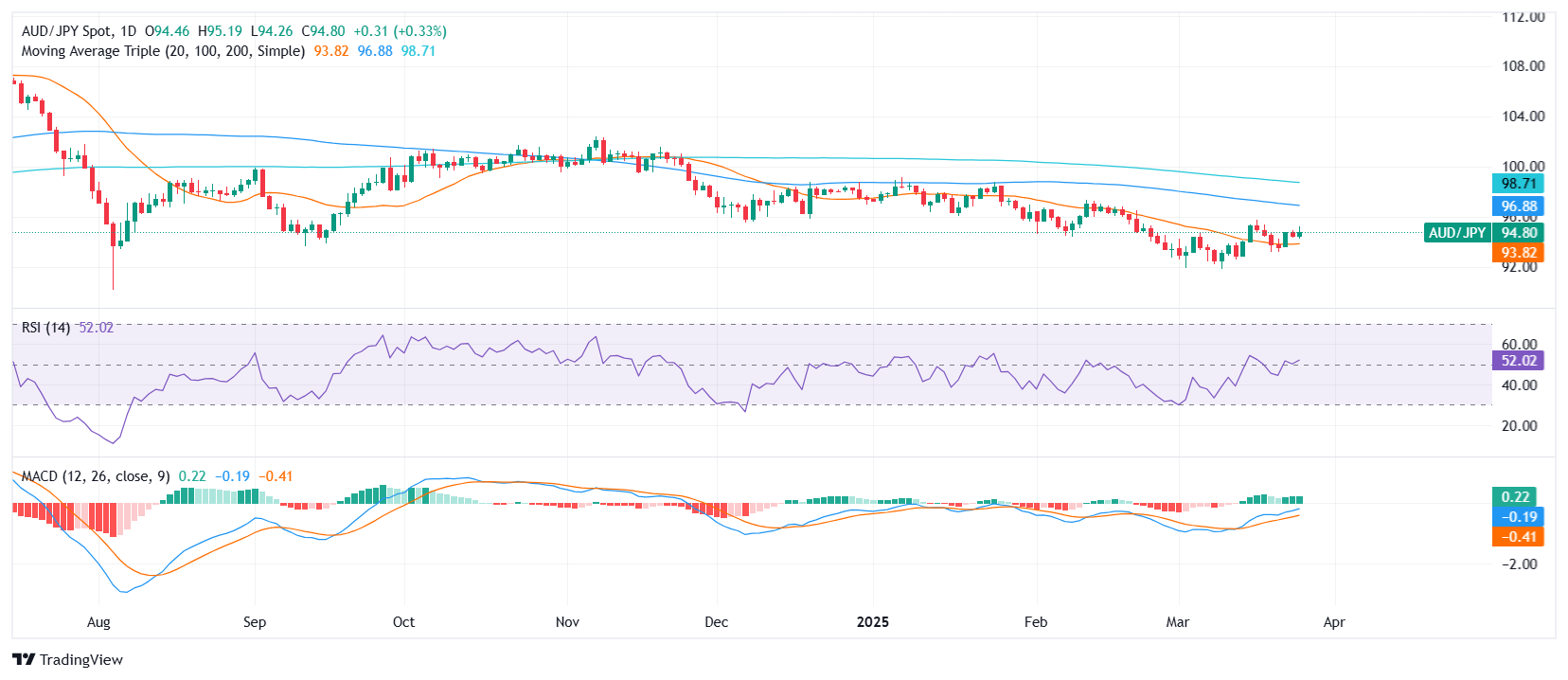
The AUD/JPY pair edged slightly higher on Wednesday’s session ahead of the Asian open, seen trading around the 94.70 area. After bouncing from earlier lows, the pair managed to extend its recovery, though intraday action remains confined within the mid-point of its daily range, with a mixed technical setup keeping broader trends in check.

From a momentum perspective, the MACD histogram signals a potential buy. Meanwhile, the Ichimoku Base Line near 94.30 maintains a neutral stance. The Relative Strength Index stands at 51 and the Stochastic oscillator at 71, both hovering in neutral territory, yet the combined RSI/Stochastic indicator printing near 85 raises early overbought warnings.

The moving average analysis shows the 20-day Simple Moving Average at 93.88, supporting upside momentum in the short term. However, longer-term pressure remains, as both the 100-day SMA at 96.98 and 200-day SMA at 98.80 continue to slope downward, suggesting that underlying bearish risk remains in play.

In terms of key levels, immediate support is seen around 94.60, followed by 94.47 and 94.42. On the flip side, resistance is expected at 95.22 and 95.36, with a break above the latter potentially opening the door for a test of 96.45.

AUD/JPY daily chart
Author

Patricio Martín

Patricio is an economist from Argentina passionate about global finance and understanding the daily movements of the markets.


More from Patricio Martín
Share:

Markets move fast. We move first.

Orange Juice Newsletter brings you expert driven insights - not headlines. Every day on your inbox.

By subscribing you agree to our Terms and conditions.

Editor's Picks

EUR/USD could test 1.1750 amid strengthening bullish bias

EUR/USD remains flat after two days of small losses, trading around 1.1740 during the Asian hours on Thursday. On the daily chart, technical analysis indicates a strengthening of a bullish bias, as the pair continues to trade within an ascending channel pattern.

GBP/USD consolidates above mid-1.3300s as traders await BoE and US CPI report

The GBP/USD pair struggles to capitalize on the overnight bounce from the 1.3310 area, or a one-week low, and oscillates in a narrow band during the Asian session on Thursday. Spot prices currently trade around the 1.3370 region, down less than 0.10% for the day, as traders opt to wait on the sidelines ahead of the key central bank event risk and US consumer inflation data.

Gold awaits weekly trading range breakout ahead of US CPI report

Gold struggles to capitalize on the previous day's move higher back closer to the $4,350 level and trades with a mild negative bias during the Asian session on Thursday. The downtick could be attributed to some profit-taking amid a US Dollar uptick, though it is likely to remain cushioned on the back of a supportive fundamental backdrop. 

Dogecoin breaks key support amid declining investor confidence

Dogecoin trades in the red on Thursday, following a 4% decline on the previous day. The DOGE supply in profit declines as large wallet investors trim their portfolios. Derivatives data shows a surge in bearish positions amid declining retail interest.

Monetary policy: Three central banks, three decisions, the same caution

While the Fed eased its monetary policy on 10 December for the third consecutive FOMC meeting, without making any guarantees about future action, the BoE, the ECB and the BoJ are holding their respective meetings this week. 

Dogecoin Price Forecast: DOGE breaks key support amid declining investor confidence

Dogecoin (DOGE) trades in the red on Thursday, following a 4% decline on the previous day. The DOGE supply in profit declines as large wallet investors trim their portfolios. Derivatives data shows a surge in bearish positions amid declining retail interest.