|

AUD/JPY Price Analysis: Downward pressures resume, pair closes its weakest week since April

  • AUD/JPY resumes decline, falling to 105.25, marking one of the lowest levels in over a month.
  • The recovery experienced on Thursday was short-lived as selling pressures resumed, augmenting the prevalent negative outlook.

In Friday's session, the AUD/JPY pair has resumed its downtrend, declining by 0.20% to reach 105.25. The resumption of this bearish trend suggests that the rebound registered previously on Thursday may have been more corrective rather than indicative of a trend reversal. This sustains the dominance of the bears and reinforces the existing negative outlook as the pair will close a 1.60% weekly loss.

The daily Relative Strength Index (RSI) for AUD/JPY currently stands at 42, slightly below Thursday's value, suggesting a continuation of the negative momentum. The similar pattern in the Moving Average Convergence Divergence (MACD) that continues to print rising red bars, suggests a continuation of the selling activity, despite the minor rebound seen previously.

AUD/JPY daily chart
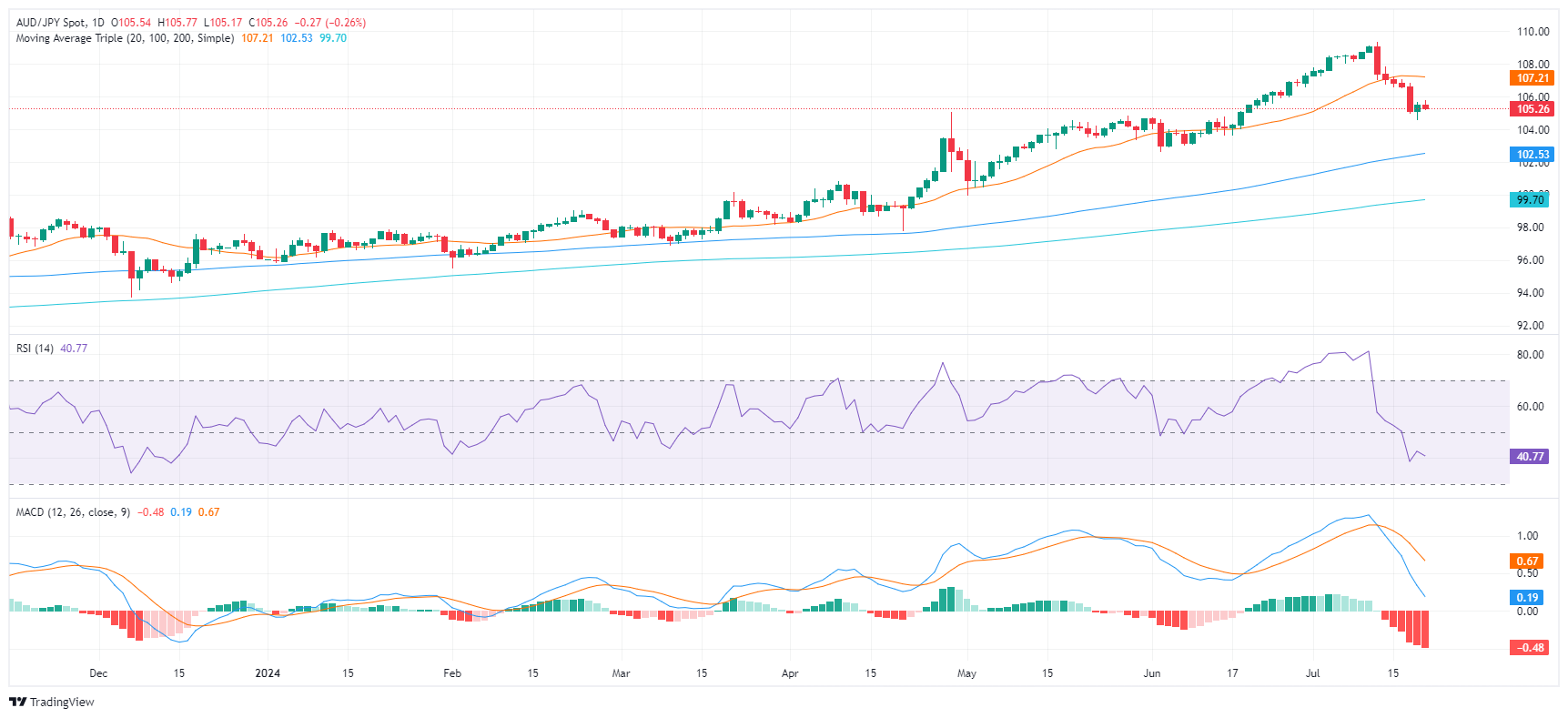
On a broader perspective, the AUD/JPY's short-term bearish trajectory seems to persist, with its price remaining below the 20-day Simple Moving Average (SMA). Looking ahead, immediate support levels appear to have formed around the 105.00 mark, which the buying pressure needs to maintain to fend off a deeper correction. To moderate further potential losses, bulls must aim for the recovery of the 106.00, and subsequently, the 106.50 mark.

Author

Patricio Martín

Patricio is an economist from Argentina passionate about global finance and understanding the daily movements of the markets.


More from Patricio Martín
Share:

Editor's Picks

AUD/USD extends the range play above 0.7200 as traders await US inflation data

AUD/USD is seen extending its consolidative price move above 0.7200 during the Asian session on Thursday amid mixed cues. Rising RBA rate-hike bets keep the Aussie close to its highest level since May 14. However, hawkish Fed expectations and escalating US-Iran tensions offer some support to the US Dollar, capping the currency pair as traders await US inflation figures.


USD/JPY consolidates around 153.50 as bears turn cautious ahead of US inflation

USD/JPY stabilizes above 153.50 during the Asian session on Thursday, but remains near a seven-month low set earlier this week as hawkish BoJ repricing continues to underpin the Japanese Yen. Meanwhile, rising September Fed rate-hike bets and escalating US-Iran tensions help ease US Dollar selling pressure, offering some support to the currency pair ahead of US inflation figures.

Gold remains weak, retargets $4,350

Gold keeps the choppy price action on Thursday, now slipping back toward the $4,350 region per troy ounce amid the robust bounce in the US Dollar as well as rising US Treasury yields across the curve, particularly following US Producer Prices and ahead of Friday’s more relevant US CPI data.

XRP slides amid a fragile crypto market structure
Ripple (XRP) falls for the second straight day, trading at $1.37 on Thursday. The broader cryptocurrency market remains fragile as investors weigh the impact of geopolitical tensions in the Middle East, which triggered persistent increases in Crude Oil prices while restricting shipping through the Straight of Hormuz and the Red Sea.
Jobs opened the door for the Fed — inflation decides whether it walks through
The latest US jobs report did not end the debate over the Federal Reserve’s (Fed) next move. It may have done something more subtle: it gave policymakers permission to keep their options open. After months of softer labour market signals, August delivered a stronger-than-expected rebound.
Venezuela’s 65-billion-barrel Oil deal could reshape America’s inflation fight
The United States (US) has secured unprecedented access to part of Venezuela’s vast Oil reserves. The timing is particularly significant as the war with Iran is disrupting Middle Eastern supplies, keeping energy prices elevated and reviving concerns about inflation.