ASX buy-now-pay-later stocks enter regulatory spotlight


From relative obscurity, buy-now-pay-later (BNPL) services have become instant superstars. As consumer preference shifts from credit cards to interest-free instalments, the market for BNPL providers also grows, attracting regulations that may curb their capabilities and the fast rate at which the sector is expanding.
It wasn't until 2015 that BNPL caught attention following the launch of Afterpay in Australia. At the height of the pandemic, the sector took off, with as many as 8.5 million customers shared between the three largest platforms — Afterpay, Zip (ASX: ZIP) and Humm (ASX: HUM), according to Savings.com.
Customer spending is also growing with A$11.9 billion recorded from Australian customers in the 2021-2022 financial year from A$5.6 billion three years earlier, according to ABC. Globally, spending is expected to further increase, with generous projections between US$650 billion and US$1 trillion by 2025, AJOT reported.
The players and coalitions
Currently, there are 19 BNPL providers in Australia that are catering to millions of customers. The largest in terms of market capitalization are Block (ASX: SQ2), Zip, Humm, Splitit (ASX: SPT), and Sezzle (ASX: SZL).
Block, formerly Square, entered Australia through its record $39 billion acquisition in 2021 of Afterpay. Now, the companies have a combined market capitalization of $59.36 billion, so much more than Afterpay's $100 million valuation when it listed on the Australian Securities Exchange in May 2016.
The company benefitted heavily from a niche it found during the pandemic. It saw its shares skyrocket, as did most of its peers. But as supply chain issues, inflation fears and worries about rising interest rates became more prevalent, confidence in BNPL companies dwindled and have their stock prices. From the chart below, we see that several of Australia's largest BNPL stocks all have fallen ~90% from their respective peaks.
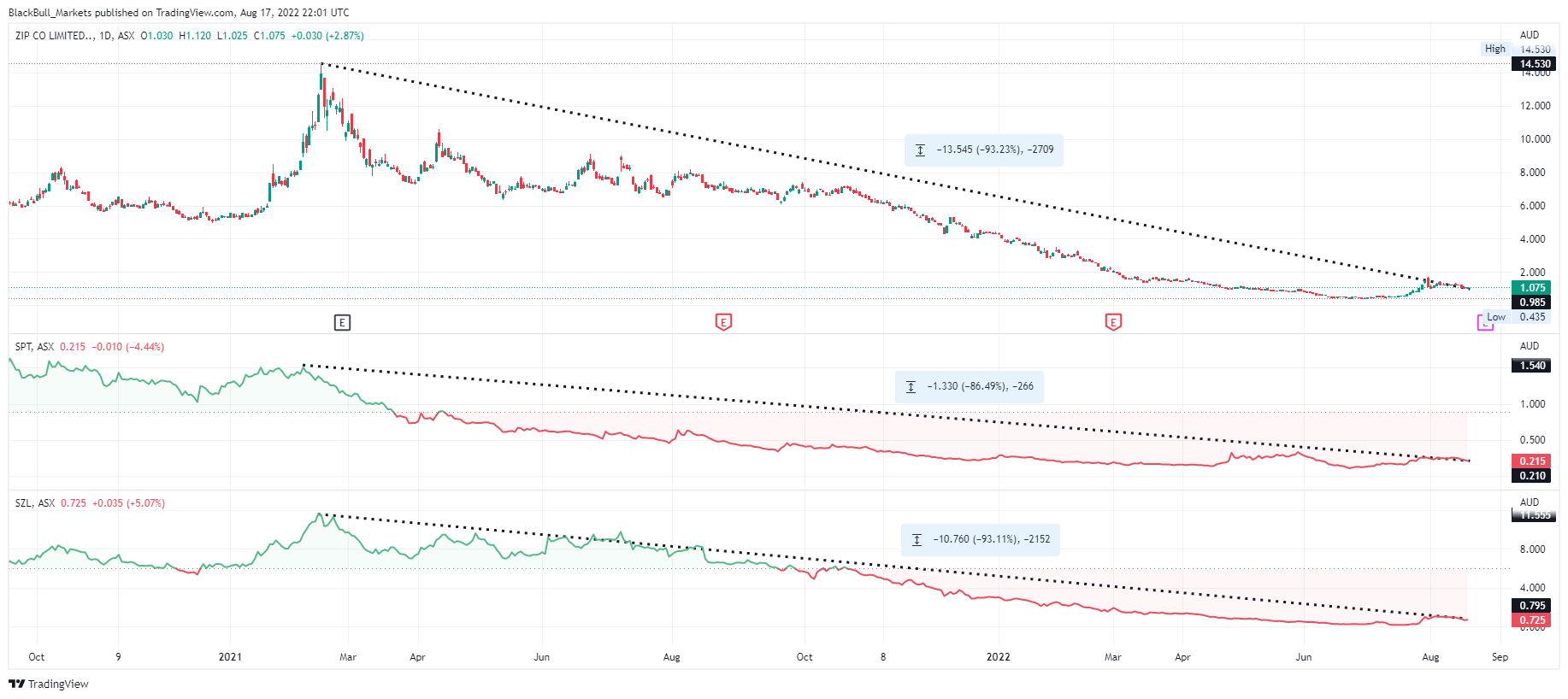
ASX: ZIP, ASX: HUM, ASX: SZL 1D
To weather these challenges, analysts expect to see more consolidations among BNPL players in Australia. S&P Global reported in April that especially for smaller players, catching up on the game would be more difficult with higher funding cost requirements and interest rates.
For the large-enough players, driving consolidation is the need to become even bigger. Such was the case for Zip when it struck a A$491 million deal to buy Sezzle in February, or when nonbank lender Latitude Group (ASX: LFS) agreed to buy Humm's consumer finance business the same month.
As the Australian BNPL sector becomes more crowded, players within the country have also started branching out such as when Afterpay bought UK-based ClearPay in 2018 or when Zip acquired New York-based QuadPay in 2020.
Regulations on the way
The thing about being in the spotlight is that it draws attention. With more eyes monitoring every action, it is only a matter of time that imperfections in the system come under scrutiny.
In June, Australian Federal Financial Services Minister Stephen Jones told ABC's 7.30 that he plans to introduce legislation for the BNPL sector within a year following industry consultations. "Let's start working on regulating [them] within the credit space. We welcome the fact that they’ve introduced a code, [and will] move to legislate it and fill any gaps," Jones noted.
Now the concern remains whether these new rules will stifle competition or harm share values along the way.
Author
Mark O’Donnell
Blackbull Markets Limited
Mark O’Donnell is a Research Analyst with BlackBull Markets in Auckland, New Zealand.