Amazon stock sinks after Iran damages three Middle East data centers
- Three AWS data centers in Middle East sustain damage from Iranian drones.
- Israel-US-Iran war continues into fourth day of conflict.
- Two data centers in UAE and one in Bahrain sustained damage.
- Amazon has told customers to migrate workflows to other regions of the globe.

Amazon (AMZN) stock opened 2% lower on Tuesday due to three of its major Middle Eastern data centers sustaining damage from Iranian drones. Two data centers in the United Arab Emirates (UAE) and one in Bahrain were damaged overnight.
Two of Amazon's three data centers in the UAE suffered direct hits from Iranian drone clusters, while a third data center in nearby Bahrain received partial damage from drones hitting nearby infrastructure.
The war launched by the US and Israel against Iran on Saturday led AMZN to close down about 0.8% on Monday. While US equities largely righted themselves by Monday's close after selling off in the morning session, Tuesday shows the NASDAQ, S&P 500 and Dow Jones all rotating over 2% lower at the open. The Korean KOSPI sank over 7% overnight, while the Euro Stoxx 50 has plummeted 3.75%. Even Gold declines 5%.
Iran's closure of the Strait of Hormuz remains intact, halting oil tankers from delivering about 20% of global crude production. The closure has also led to a spike in natural gas prices across Europe, which sources a large amount of its LNG from Qatar. At the time of writing, Oil prices have spiked another 7% on Tuesday, while European natural gas futures have shot up 30%.
Amazon suffers AWS disruption in UAE, Bahrain
Amazon becomes the first high-profile casualty of the second Iranian war of the Trump administration. The first began in June 2025 and lasted for about 12 days, but many geopolitical experts believe this wave of hostilities could last much longer. That's because the Trump administration has stated that this war features the goal of "regime change" in Iran. On Monday, President Trump said the war could last four to five weeks.
Bahrain and the UAE lie across the Persian Gulf from Iran. As allies of the US-Israel alliance that both house US military bases, both nations have been the victims of Iranian drone and air strikes in this war, now in its fourth day.
Amazon announced in a statement that "AWS Lambda, Amazon Kinesis, Amazon CloudWatch, Amazon RDS" and other services "remain degraded". Due to the bombardment, Amazon says that getting back up to speed could be a "prolonged" process.
"We strongly recommend that customers with workloads running in the Middle East take action now to migrate those workloads to [...] the United States, Europe, or Asia Pacific, as appropriate for your latency and data residency requirements," AWS said in the statement.
The security situation seems to be getting worse as Iran largely destroyed the US embassy in Saudi Arabia late Monday, and the US is evacuating large segments of its embassy staff across multiple Gulf countries.
In unrelated news, AWS announced it has purchased a satellite campus from George Washington University for $427 million in Ashburn, Virginia and will use the 120-acre site to develop a data center.
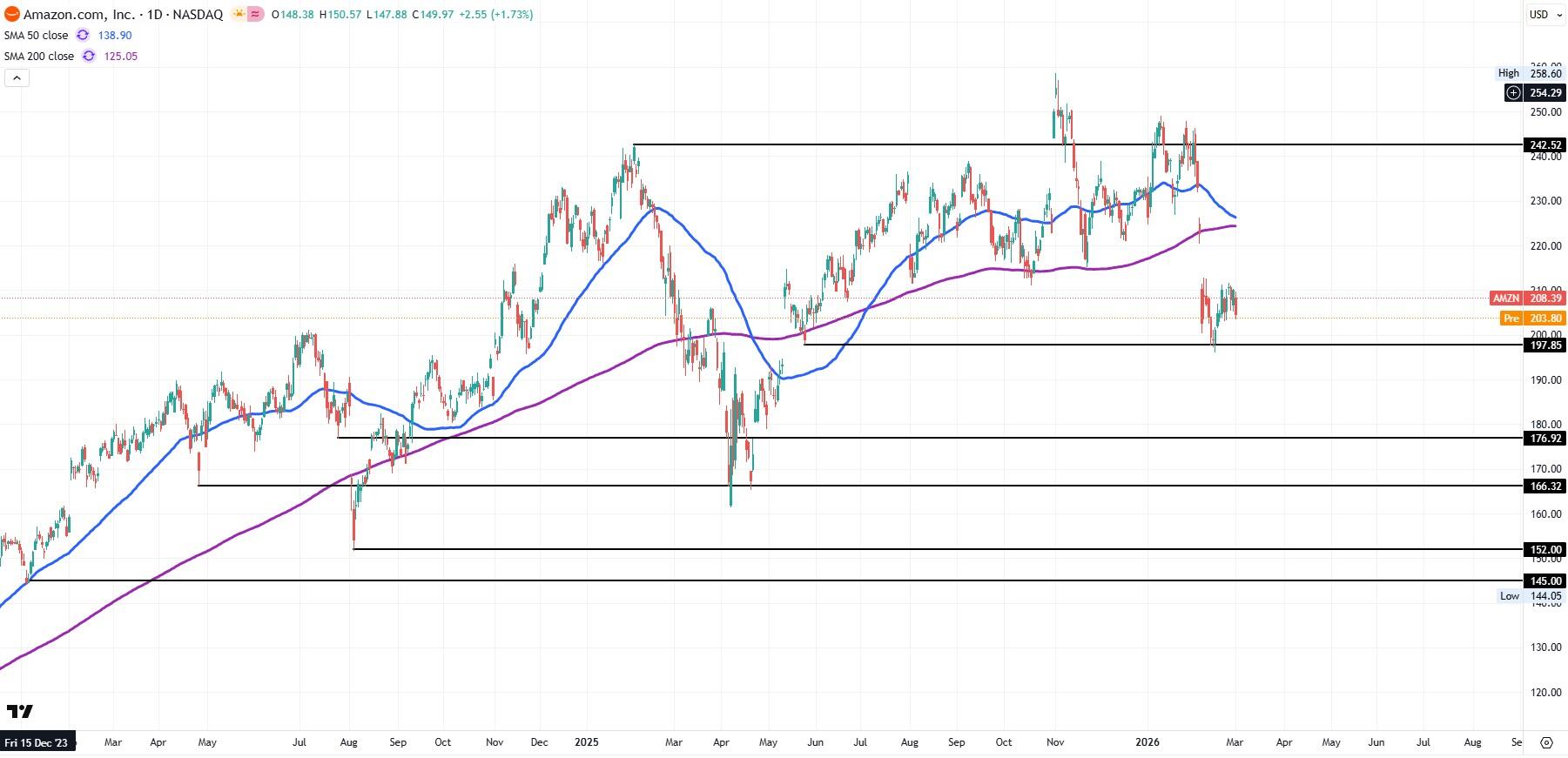
Amazon stock chart
The effect on AMZN is muted at the moment, but bears will note that shares are already trading well below the 200-day Simple Moving Average (SMA). Nearby historical support sits at $197.85 and $176.92.
Author

Clay Webster
FXStreet
Clay Webster grew up in the US outside Buffalo, New York and Lancaster, Pennsylvania. He began investing after college following the 2008 financial crisis.