Alibaba Stock News and Forecast: BABA attempts comeback on Tuesday
- Chinese covid shutdowns are hurting the Chinese economy.
- BABA shares are at a 6-year low.
- Alibaba stock dropped more than 10% on Monday.

Alibaba stock (BABA) made a mid-morning comeback on Tuesday with shares rising from a 6% sell-off to a gain of 3% just after 11:00 AM EST. BABA shares dropped to $73.28 in the first half hour on Tuesday before rallying all the way to $80.13. At the time of writing, they are back to $76, down 2%.
Shares of the ecommerce king were down 5% near $74 in Tuesday's premarket as well after losing more than 10% on Monday. US investors seemed worried over continued covid shutdowns in China that are affecting production, as well as fears that China may aid Russia's war on Ukraine and thus risk economic sanctions. US markets have rallied, however, due to falling oil prices, with the Nasdaq up nearly 2%.
Alibaba Stock News: A bad time to be a Chinese stock
China has now extended its covid clampdown to Dongguan, an important city for business, after earlier shutting down Shenzen and Shanghai due to skyrocketing Covid-19 infections. China had already lowered its projected GDP growth for 2022, and now the present shutdowns worry the market that a recession could become a reality if these shutdowns persist.
China's relationship with Russia also remains in the crosshairs. Over the weekend news emerged that Russia had asked China for military assistance with its war in Ukraine, but both powers denied there was any such conversation. The possibility that it is true has worried investors in Chinese equities since harsh Western sanctions could be spread to China as well as Russia and thus hurt corporations there.
The US National Security Advisor met with China's top diplomat in Rome on Sunday to discuss the issue. The meeting was said to be "intense". White House Press Secretary Jen Psaki told reporters, "Should [China] provide military or other assistance, that of course violates sanctions, or support the war effort, there will be significant consequences."
Last week the US Securities & Exchange Commission (SEC) announced the possible delisting of five Chinese companies that trade on US exchanges. The action has hurt all Chinese stocks since they were highlighted due to a failiure to share financial audits with the SEC. Current Chinese law forbids official audits from leaving China, which puts all Chinese equities listed in the US in danger of delisting. Additionally, DiDi Global was stopped from listing its shares in Hong Kong, which demonstrates the Chinese government's willingness to continue dealing a blow to the tech sector there.
Alibaba Stock Forecast: BABA headed toward all-time low.
Alibaba stock is now at six-year lows. On the weekly chart, investors or traders searching for support are now staring at weekly candles from late 2015 and 2016.
As FXStreet wrote last week, anywhere below $86 lacks trustworthy support until the stock drops back to its all-time low in the demand zone between $57.20 and $59.25. This region provided support to BABA in August and September of 2015 and then again in February of 2016, so it appears ot have stopping power.
Close your eyes until BABA makes it back above $86. This will push BABA out of its bearish trend. Still there is no sign of a bullish turn until $109.76 is once again conquered.
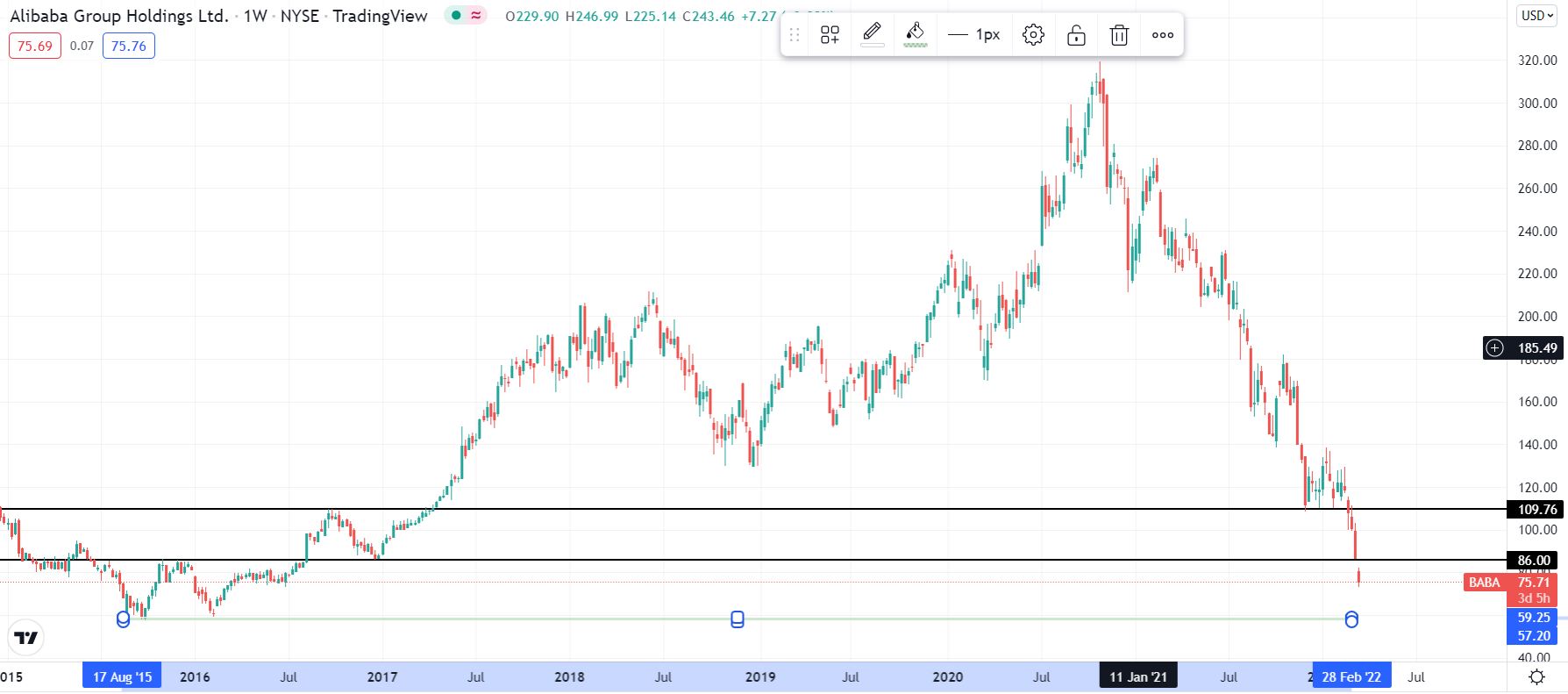
BABA 1-week chart
Premium
You have reached your limit of 3 free articles for this month.
Start your subscription and get access to all our original articles.
Author

Clay Webster
FXStreet
Clay Webster grew up in the US outside Buffalo, New York and Lancaster, Pennsylvania. He began investing after college following the 2008 financial crisis.