AI boom or bubble? Here’s an eight-point checklist to separate strength from hype


Key points:
- Strong earnings from AI leaders have not fully eased concerns about stretched valuations and execution risks.
- In our view, the next phase of the AI cycle will reward companies that can fund, scale, and monetise AI sustainably — while those relying heavily on hype or debt may face more volatility.
- Investors can use a simple checklist to navigate the noise, while recognising both the opportunities and the risks.
AI’s reality check: Why investors want proof, not promises
In our view, AI remains one of the most powerful forces reshaping markets, but the tone is changing. Strong earnings from leading chipmakers e.g., Nvidia’s Q3 FY2026 revenue grew 62% YoY (Source: Nvidia Investor Relations) reassure investors that demand is real, yet the sharp swings in market reaction show that enthusiasm now sits alongside questions around sustainability, profitability, and execution.
The broad “everything goes up” phase of the AI trade is fading. What replaces it is a more nuanced market: one that rewards fundamentals over narratives.
Investors now face a key challenge of understanding which companies have the financial and operational strength to compete through cycles. That will potentially help them to separate the durable players from those caught up in the momentum.
Below is a simplified but strategically meaningful framework that could be used to decode the AI ecosystem.
A simple eight-factor checklist to evaluate AI stocks
1. Can the company afford the AI race?
Why it matters: AI is extremely capital-intensive. Companies investing in chips, power, and data centres need financial strength to survive both growth phases and volatility.
What to look for:
- Positive and stable cash flow
- Low or manageable debt levels
- Ability to self-fund AI investments
Risks: Heavy borrowing or negative cash flow may amplify volatility.
2. Is AI already adding to revenue?
Why it matters: Investors are becoming more selective; they want to see AI adding real business value, not just product demos.
What to look for:
- AI-linked revenue mentioned in earnings
- Clear pricing for AI features
- Evidence customers are willing to pay for new capabilities
Risks: Companies that invest ahead of monetisation may face margin pressure.
3. Does the company have infrastructure advantage?
Why it matters: AI needs chips, land, power, cooling, and network bandwidth. Access to scarce infrastructure is becoming a major competitive edge.
What to look for:
- Secure chip supply (Nvidia/AMD/custom silicon)
- Capacity to expand data centres
- Plans to manage energy demand
Risks: Delays due to power shortages or supply constraints.
4. Does the company control unique data?
Why it matters: As models get more similar, proprietary data becomes the true differentiator.
What to look for:
- Large user bases
- Exclusive datasets or industry-specific data
- Strong partnerships that expand data access
Risks: Companies relying on public data face weaker defensibility.
5. Are customers staying and using more?
Why it matters: Sticky customers create recurring revenue and lower the risk of AI investments not paying off.
What to look for:
- High renewal rates
- Growing engagement or usage after AI rollouts
- Enterprise contracts with long durations
Risks: Churn or weak engagement can quickly erode the AI narrative.
6. How dependent is the company on a few large customers?
Why it matters: Many AI suppliers — especially in chips, cloud infrastructure, and data-centre services — rely heavily on a small number of hyperscalers. When 20–50% of revenue comes from one or two clients, even a slight pause in spending can create sudden earnings volatility.
What to look for:
- No single customer accounting for more than 20–30% of revenue
- Diversified demand across cloud providers, enterprises, and industries
- Clear signs that new customers are being added each quarter
- Long-term contracts that offer visibility into future spending
Risks: Revenue may fall sharply if a major customer delays capex, shifts to an in-house solution, renegotiates pricing, or reduces reliance on the company’s AI infrastructure.
7. Is management realistic about AI timelines?
Why it matters: Markets are punishing over-promising and rewarding measured execution.
What to look for:
- Clear timelines and cautious guidance
- Credible communication during earnings
- Track record of delivering what they announce
Risks: Missed timelines or shifting goalposts raise credibility concerns.
8. Is the valuation pricing in too much perfection?
Why it matters: Elevated expectations increase volatility, especially in an environment where interest rates may stay higher for longer.
What to look for:
- Valuation relative to peers
- Earnings forecasts vs. price multiples
- Market sentiment and crowding
Risks: Stocks with perfection priced in can fall sharply on small disappointments.
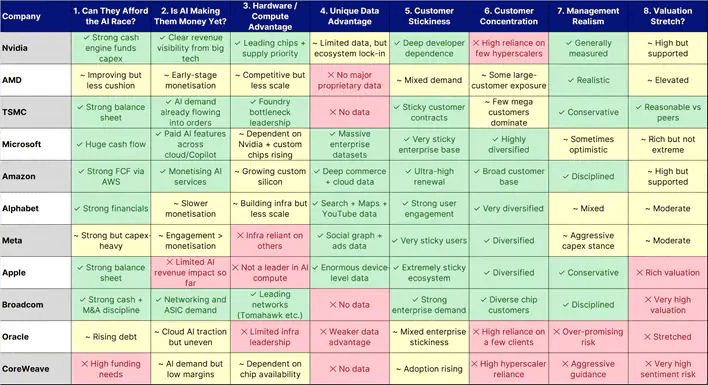
How popular AI names score across these factors
Illustrative only. Not investment advice.
Reasoning is simplified to help investors understand strengths and risks.
Final thoughts
While AI is clearly transforming industries and driving a multi-year investment cycle, in our opinion the next stage of this cycle may reward companies that balance ambition with financial strength, operational execution and diversified demand.
This 8-factor checklist gives investors a simple, structured framework to evaluate AI stocks, acknowledging both the potential upside and the meaningful risks.
Read the original analysis: AI boom or bubble? Here’s an eight-point checklist to separate strength from hype
Author
Saxo Research Team
Saxo Bank
Saxo is an award-winning investment firm trusted by 1,200,000+ clients worldwide. Saxo provides the leading online trading platform connecting investors and traders to global financial markets.