Indian Rupee fails to extend five-day winning streak against US Dollar
- The Indian Rupee faces a roadblock after hitting a fresh seven-month low against the US Dollar.
- FIIs continue to increase their stake in the Indian stock market.
- India’s HSBC Composite PMI expands at a faster pace in November.


The Indian Rupee (INR) struggles to extend the previous week’s gains against the US Dollar (USD) on Monday. The USD/INR pair regains ground after revisiting the seven-month low at 92.44 and rebounds to near 92.95.
While the Indian Rupee’s rally hits a pause, its outlook remains upbeat as the Foreign Institutional Investors’ (FII) buying into the Indian stock market is still on amid the continuation of global Artificial Intelligence (AI) rout.
So far in November, FIIs have remained net buyers on all trading days and have increased their stake worth Rs. 1,11,949.39 crore.
In addition to an improvement in India’s appeal amid the global AI sell-off, increased expectations that the Reserve Bank of India (RBI) will hike interest rates in the near term is also keep the INR underpinned against its other peers.
RBI seen tightening as inflation breaches target
Analysts at Commerzbank highlight that India’s inflation backdrop has become more challenging, noting that “inflation has breached the Reserve Bank of India’s (RBI) 6% upper threshold due to elevated cost pressures and higher food prices.” As a result, they argue that “RBI is expected to place greater attention on containing inflation risks in the coming year,” with policymakers forecast “to hike by 25 bps in December and by another 25-50 bps in H1 2027, taking the terminal repo rate to 6-6.25%.” Commerzbank adds that “higher interest rates should help anchor inflation expectations and support INR.”
India’s economic activity continues to expand
India’s HSBC Composite Purchasing Managers’ Index (PMI) data for November has come in at 56.3, higher than the October final reading of 56.2. The overall business activity advances due to strong Manufacturing PMI. The Manufacturing PMI rose to 56.0, higher than the previous release of 54.7.
Meanwhile, the service sector activity growth cooled down, with Services PMI dropped to 55.3 from 55.8 in October.
"Manufacturing activity gathered momentum, with output and new orders accelerating. The increase in new orders was driven by stronger domestic demand, while new export orders moderated a bit. Services, by contrast, saw a softer performance despite a sharp rise in new export business. Input-cost inflation stayed subdued, while output-price inflation increased modestly supporting margins," Pranjul Bhandari, Chief India Economist at HSBC, said.
Technical Analysis: USD/INR sees further downside towards 92.25
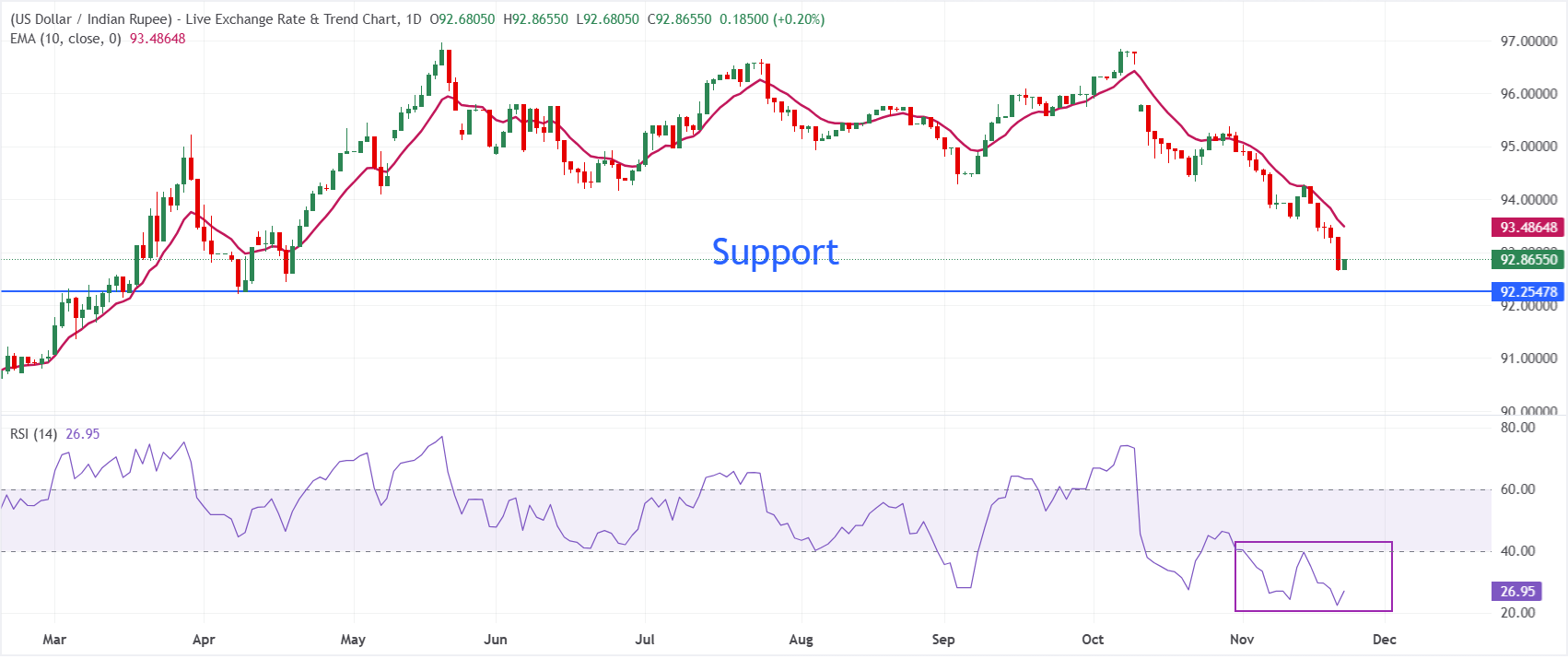
In the daily chart, USD/INR trades at 92.95, extending its decline and maintaining a clear bearish near-term bias as spot holds well below the 20-day exponential moving average (EMA) at 93.95. The gap between price and the 20-day EMA reinforces a downside-skewed structure, while the Relative Strength Index (14) at 27 signals deeply oversold conditions that could slow immediate downside momentum but have yet to trigger a meaningful rebound.
On the topside, initial resistance is located at the 20-day EMA near 93.95, and a daily close above this dynamic barrier would be needed to ease the current bearish pressure. Looking down, the major support level appears at the April 8 low of 92.22
(The technical analysis of this story was written with the help of an AI tool. Know more.)
Author
Sagar Dua
FXStreet
Sagar Dua is associated with the financial markets from his college days. Along with pursuing post-graduation in Commerce in 2014, he started his markets training with chart analysis.

















