US S&P Global PMI expected to ease in November
- US Global preliminary PMI is expected to slow slightly in November while remaining firmly in expansion territory.
- Manufacturing and services activity are forecast to moderate after robust October readings.
- Stronger-than-expected data could reinforce expectations of further Fed interest rate hikes and weigh on EUR/USD.


The United States (US) S&P Global preliminary Purchasing Managers Indices (PMIs) for November will be released on Monday at 14:45 GMT, offering fresh insight into the health of the world's largest economy as investors assess the Federal Reserve's (Fed) monetary policy outlook ahead of its December meeting.
The report includes the Manufacturing PMI, Services PMI and Composite PMI, which measure business activity across the private sector. Readings above 50 indicate expansion, while figures below that threshold signal contraction.
The November surveys come as US economic growth remains robust despite persistent inflationary pressures and tighter monetary conditions. Investors will closely monitor the figures to determine whether the slowdown observed in October continues into November and if resilient economic activity justifies further interest rate hikes.
What can we expect from the November S&P Global PMI report?
Market expectations point to a slight moderation in US private-sector activity in November, following elevated readings in October. The S&P Global Services PMI is expected to ease to 55.8 this month from 56.1 in October, while the Manufacturing PMI is forecast to decline to 54.6 from 54.9. Meanwhile, the Composite PMI stood at 55.9 in October, highlighting solid growth across the US private sector.
Despite the anticipated slowdown, both manufacturing and services activity are expected to remain comfortably above the 50 threshold, suggesting that the US economy continues to expand at a relatively healthy pace.
According to S&P Global, October's surveys showed that global economic growth remained among the strongest recorded since 2022, despite a slight loss of momentum compared to September. The November figures will help determine whether this moderation represents a temporary adjustment or the early signs of a more sustained slowdown driven by elevated interest rates and persistent inflation.
The US economy continues to outperform other major developed economies. S&P Global notes that the United States has recorded significantly stronger output and employment growth than its major peers in recent months. However, several factors could gradually weigh on this momentum. Tighter monetary policy, recent financial market volatility and economic uncertainty could discourage business investment and spending.
On the monetary policy front, financial markets anticipate another interest rate hike by the Fed in December, as persistent inflationary pressures continue to fuel expectations of further monetary tightening. However, the outlook remains unclear. US Treasury Secretary Scott Bessent recently warned that excessive monetary tightening could jeopardize economic growth. His remarks have prompted traders to scale back expectations for more aggressive interest rate hikes.
Against this backdrop, the PMI figures could play an important role in assessing the balance between economic resilience and the risks associated with an overly restrictive monetary policy.
When will the November flash US S&P Global PMIs be released, and how could they impact EUR/USD?
The S&P Global Manufacturing, Services and Composite PMIs for November will be released on Monday at 14:45 GMT. The publication could trigger volatility in the US Dollar (USD) and the EUR/USD pair as investors adjust their expectations for the Fed's December monetary policy decision.
Stronger-than-expected readings, particularly in the services sector, could confirm the resilience of the US economy and reinforce odds of further interest rate hikes. Such a scenario would likely support US Treasury yields and the Greenback, potentially weighing on EUR/USD.
Conversely, a sharper-than-anticipated slowdown could raise concerns about the US economic outlook. Disappointing PMI readings, accompanied by weaker employment conditions or easing price pressures, could encourage investors to scale back expectations for further monetary tightening, putting downward pressure on the US Dollar and supporting EUR/USD.
If the figures broadly match market consensus, the impact on Forex could remain relatively limited, given that manufacturing and services activity are already forecast to ease slightly while remaining firmly in expansion territory.
Ahead of the Fed’s December meeting, investors will focus on whether the US economy maintains sufficient momentum to withstand further rate hikes. Stronger-than-expected business activity could reinforce chances of a hawkish Fed, while a more pronounced slowdown could cast doubt on the need for additional monetary tightening and weigh on the US Dollar.
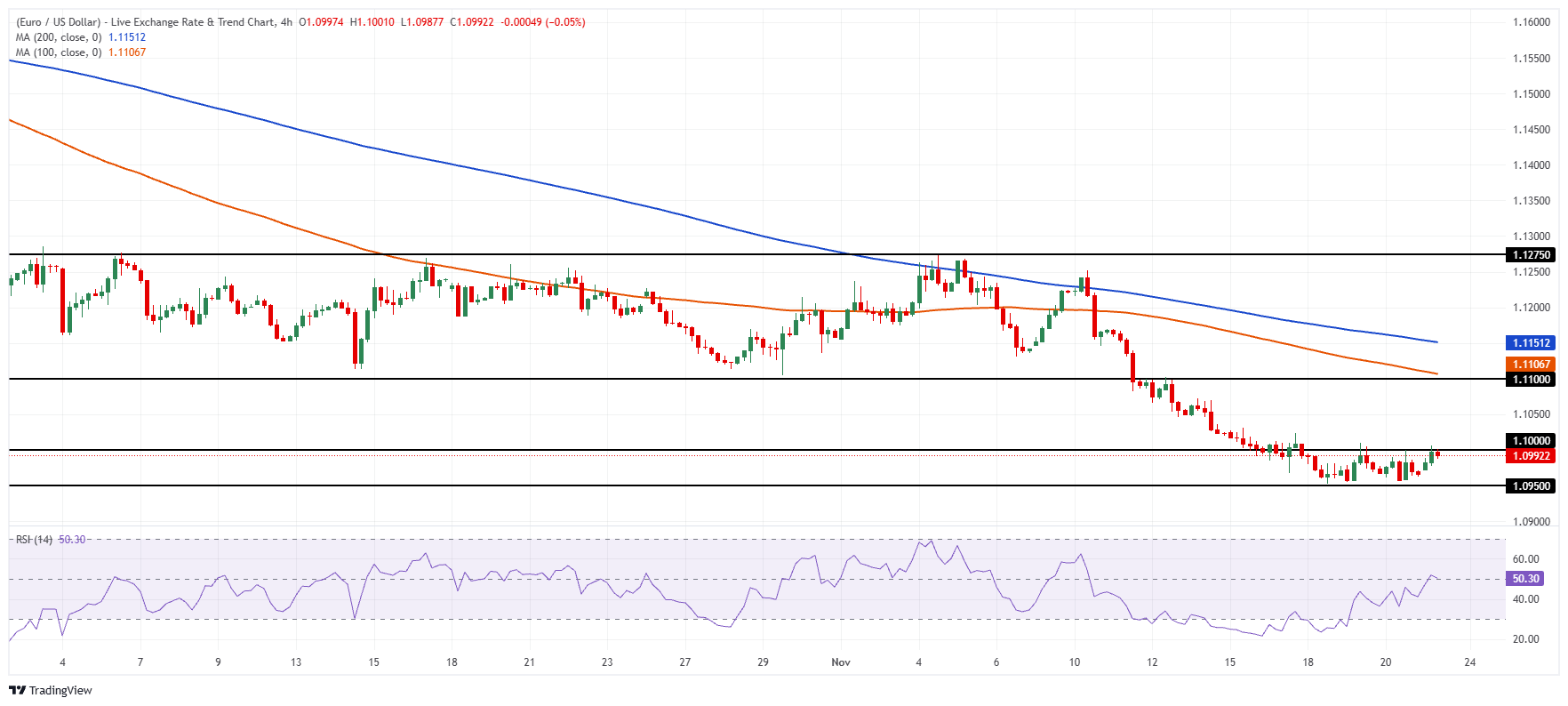
EUR/USD remains under bearish pressure on the 4-hour chart, trading just below the psychological resistance level of 1.1000. The pair is attempting to stabilize after its recent decline, but the broader bearish outlook remains intact as the price continues to trade below the 100-period Simple Moving Average (SMA) at 1.1107 and the 200-period SMA at 1.1151.
The immediate resistance stands at 1.1000, which previously acted as support before the recent bearish breakdown. A sustained recovery above this level could pave the way for a rebound toward 1.1100, followed by the 100-period SMA at 1.1107. Further upside would face resistance at the 200-period SMA near 1.1151.
On the downside, initial support is located at 1.0950, which has recently contained selling pressure. A break below this level could revive bearish momentum and expose the psychological level of 1.0900.
Meanwhile, the Relative Strength Index (RSI) has recovered to around 50, suggesting that bearish momentum is easing. However, a sustained move above 1.1000 remains necessary to confirm a more convincing recovery, while the broader outlook continues to favor sellers below the key moving averages.
Economic Indicator
S&P Global Manufacturing PMI
The S&P Global Manufacturing Purchasing Managers Index (PMI), released on a monthly basis, is a leading indicator gauging business activity in the US manufacturing sector. The data is derived from surveys of senior executives at private-sector companies from the manufacturing sector. Survey responses reflect the change, if any, in the current month compared to the previous month and can anticipate changing trends in official data series such as Gross Domestic Product (GDP), industrial production, employment and inflation. A reading above 50 indicates that the manufacturing economy is generally expanding, a bullish sign for the US Dollar (USD). Meanwhile, a reading below 50 signals that activity in the manufacturing sector is generally declining, which is seen as bearish for USD.
Read more.Next release: Mon Nov 23, 2026 14:45 (Prel)
Frequency: Monthly
Consensus: 54.6
Previous: 54.9
Source: S&P Global
Author
FXStreet Team
FXStreet
Composed of a group of economic journalists and FX experts, the FXStreet content team produces and oversees all content published on FXStreet. It provides a purely journalistic approach to the Forex market.

















