Indian Rupee extends last week’s outperformance into the new week
- The Indian Rupee gains against the US Dollar at the start of the week.
- Sell-off in US AI-related stocks continues to weigh on the US Dollar.
- The RBI announces that it will infuse up to 1 trillion rupees through variable rate repo operation.

The Indian Rupee (INR) extends its positive momentum after last week’s outperformance against the US Dollar (USD) on Monday. The USD/INR pair declines to near 94.80 as continuous sell-off in United States (US) Artificial Intelligence (AI)-related stocks is keeping the US Dollar under pressure.
As of writing, the US Dollar Index (DXY), which gauges the Greenback’s value against six major currencies, is almost flat at around 101.80, but is close to its over two-week low of 101.57 posted on Friday.
Dollar softens as AI debt jitters reshape safe-haven dynamics
Analysts at ING argue that the latest moves in foreign exchange offer “a preview of how currencies will perform during a big AI correction.” They note that, rather than rallying as a traditional safe haven, “those currencies most linked to AI chip shipments, such as the Taiwanese dollar and the Korean won,” coming under the heaviest pressure. ING adds that investors are likely to “keep an eye on the debt of the big AI issuers today, and any further sell-off could weigh on the dollar.”
The ongoing weakness in the US Dollar amid correction in AI stocks has forced market experts to reprice US Dollar’s outlook.
Strategists at Scotiabank highlight that the US Dollar’s recent downturn has gathered momentum, describing DXY price action as “clearly bearish with an acceleration of the bearish reversal from Wednesday’s local peak.” They note that “the break below 102 is extending,” adding that they “see little in terms of support ahead of 101,” underscoring the vulnerability of the index as it grinds lower toward that next technical floor.
Meanwhile, the Indian Rupee continues to gain strength from Reserve Bank of India’s (RBI) liquidity infusions and new measures announced this month.
According to a Reuters report, the Indian central bank will conduct a seven-day variable rate repo operation to infuse liquidity on Monday, the Reserve Bank of India said. The RBI will infuse up to 1 trillion rupees ($10.53 billion) through the operation, which traders said is aimed at helping lenders tide over tax outflows amid tighter daily cash reserve requirements.
This month, the RBI announced various measures to curb the US Dollar’s demand, which led to a sharp rally in the Indian currency last week.
Analysts at Societe Generale said in a note that these measures include “the reintroduction of a dedicated oil import window, tighter restrictions on corporate hedging, limits on uncovered FX transactions, a ban on rebooking cancelled derivatives, and fresh open market operation (OMO) bond sales,” underscoring the central bank’s determination to stabilise the currency through both FX-market tools and balance-sheet operations.
Technical Analysis: USD/INR sees more downside towards 94.15
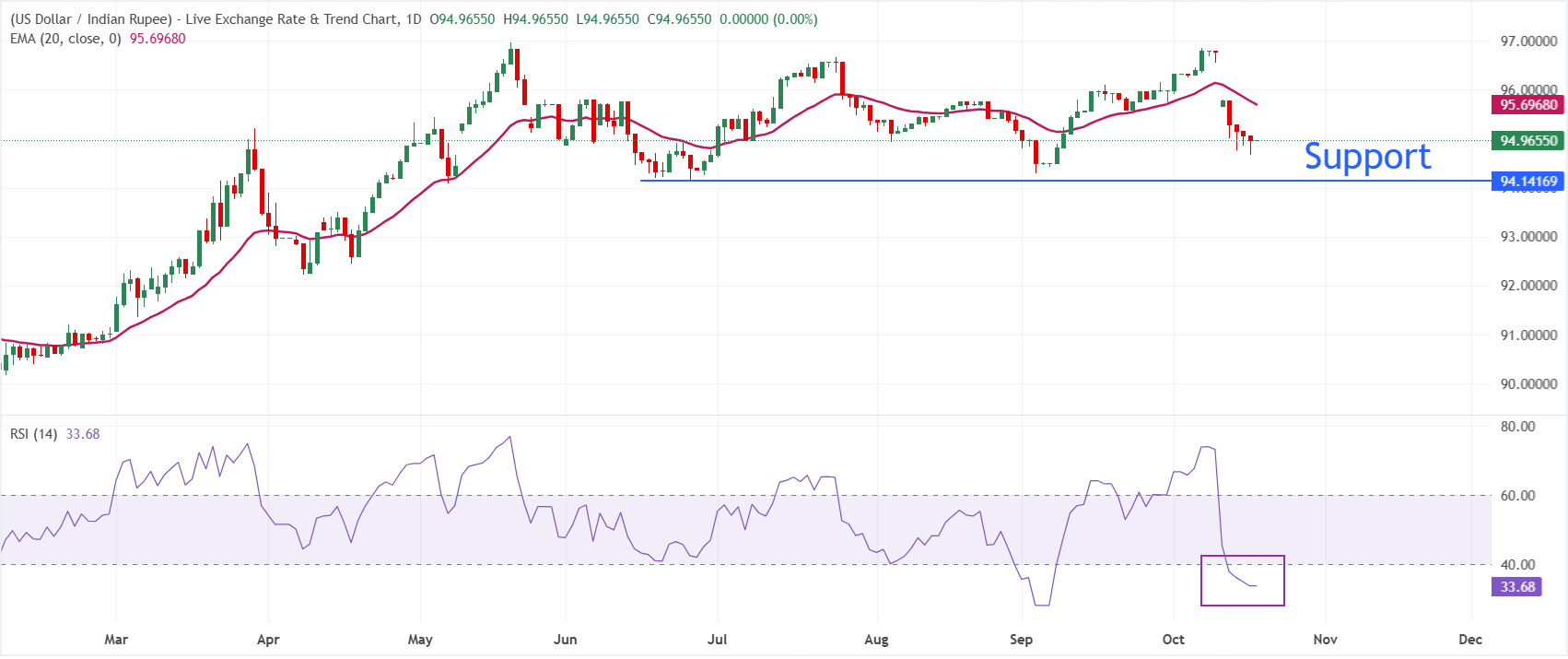
In the daily chart, USD/INR trades at 94.96, extending a bearish tone as spot holds below the 20-period exponential moving average (EMA) at 95.70, which now acts as the first meaningful topside barrier. The Relative Strength Index (RSI) sits near 34 in negative territory, hinting that downside momentum persists but is approaching oversold conditions that could slow the recent decline rather than reverse it outright.
On the topside, immediate resistance is located at the 20-day EMA around 95.70, and sellers are likely to defend this level while it caps corrective rebounds. Looking down, the June 25 low at 94.15 is the key support level.
(The technical analysis of this story was written with the help of an AI tool. Know more.)
Fed FAQs
Monetary policy in the US is shaped by the Federal Reserve (Fed). The Fed has two mandates: to achieve price stability and foster full employment. Its primary tool to achieve these goals is by adjusting interest rates. When prices are rising too quickly and inflation is above the Fed’s 2% target, it raises interest rates, increasing borrowing costs throughout the economy. This results in a stronger US Dollar (USD) as it makes the US a more attractive place for international investors to park their money. When inflation falls below 2% or the Unemployment Rate is too high, the Fed may lower interest rates to encourage borrowing, which weighs on the Greenback.
The Federal Reserve (Fed) holds eight policy meetings a year, where the Federal Open Market Committee (FOMC) assesses economic conditions and makes monetary policy decisions. The FOMC is attended by twelve Fed officials – the seven members of the Board of Governors, the president of the Federal Reserve Bank of New York, and four of the remaining eleven regional Reserve Bank presidents, who serve one-year terms on a rotating basis.
In extreme situations, the Federal Reserve may resort to a policy named Quantitative Easing (QE). QE is the process by which the Fed substantially increases the flow of credit in a stuck financial system. It is a non-standard policy measure used during crises or when inflation is extremely low. It was the Fed’s weapon of choice during the Great Financial Crisis in 2008. It involves the Fed printing more Dollars and using them to buy high grade bonds from financial institutions. QE usually weakens the US Dollar.
Quantitative tightening (QT) is the reverse process of QE, whereby the Federal Reserve stops buying bonds from financial institutions and does not reinvest the principal from the bonds it holds maturing, to purchase new bonds. It is usually positive for the value of the US Dollar.
Author

Sagar Dua
FXStreet
Sagar Dua is associated with the financial markets from his college days. Along with pursuing post-graduation in Commerce in 2014, he started his markets training with chart analysis.