In today’s difficult and especially unpredictable trading environment, one of the best tools to help you find exit and entry signals might incorporate a practical Fibonacci retracement strategy in conjunction with other widely used technical indicators such as support and resistance levels, MACD and momentum indicators such as RSI.

Fibonacci retracement works well using MACD because the parameters of market swings can be pre-set with the moment indicator (MACD) confirming a reversal in the trend.

Take for example the USD/JPY chart below:
USDJPY

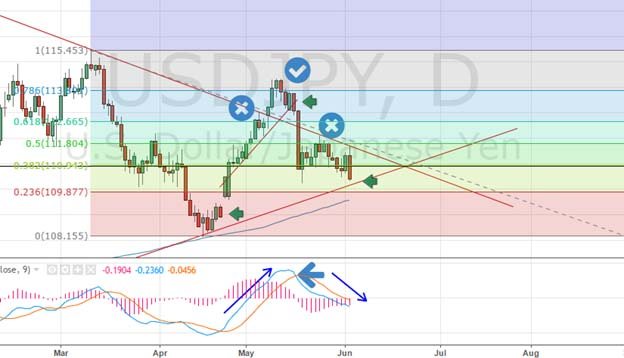
Around mid-April the price bottoms out and bounces up from the long-term upwards trending support line. The price stabilises and the MACD indicator produces an upward cross. The combination of these important signals might convince a trader to jump in long at the first green arrow.

As the price moves up with momentum, it becomes clear that the limits of the short-term range are in place and Fibonacci lines can be drawn over the chart.

The first challenge to the upwards price momentum occurs at the first blue cross set at the 0.618 Fibonacci level. A trader might plausibly argue that the move has run its course and can go no further than the long term downwards trending resistance line. However, the MACD indicator says otherwise and signals the US dollar still has legs. In this case, indicators working hand in hand, we can see that a correct exit sign has yet to be produced and a wiser trader would hold the position.

The price then breaks out up past resistance and hits the 0.718 Fibonacci level where it stalls. This is the level before the currency fully retraces and presents a formidable trial.  At this point momentum and MACD starts to stabilise. The price falls slides below a minor support line and the MACD throws up a downwards cross.

CombiningFibonacci, MACD and resistance/support we obtain a solid exit point, which is also ashort entry signal indicated by the second green arrow. The wise trader then swaps the buy position for a sell.

Finally, as the price heavily drops back into the long-term triangulating range it immediately bounces up to hit the long term downwards trending resistance line indicated by the second blue cross and the 0.50 Fibonacci level. The calm trader would hold the short position as the MACD indicator foretells further selling pressure. After a couple of days, the price continues its journey south towards the upwards support line which is another exit (and potentially entry) signal indicated by the third green arrow. If the MACD crosses over at this point, it would then confirm the swing.

The Fibonacci Retracements at 23.6%, 38.2%, 50% and 61.8% stem from ratios found within the Fibonacci sequence. The 50% retracement is not based on a Fibonacci number. Instead, this number stems from Dow Theory's assertion that the Averages often retrace half their prior move and represents an important level.

Fibonacci works well with momentum indicators such as the relative strength index (RSI) because it helps to identify levels at which the price might turn up or down from overbought or oversold regions.

Take for example the daily USD/CHF chart below:
USDCHF

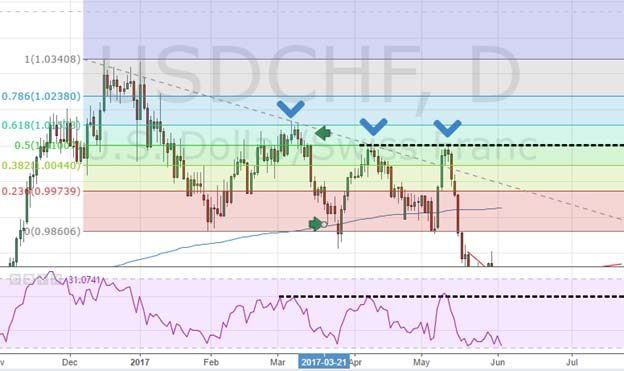
In this chart, we can see that the price rose to the 0.618 Fibonacci level, hitting at the same time an overbought point indicated by the RSI signal line touching 0.60. The price stalls at this level and starts to double back producing a sell signal.

The position is closed at the point at which RSI goes to oversold coinciding with the price dropping to the formidable 200 day moving average. It should be noted that following this trade, the price can be perceived as range bound with strength limited by the 0.50 Fibonacci level and weakness supported at the 0% Fibonacci level.

In summary, we can see that Fibonacci percentages are best used in combination with other technical indicators. In fact, most analysts would say that it is quite ineffective by itself. Fibonacci levels should never be seen as exact points to enter or exit positions and therefore other technical indicators must provide important context. Fibonacci levels on a chart should be viewed as approximate areas at which the market considers its next move and not as a clear cut mathematical marker.


All essays, research and information found above represent the analysis and opinion of Leverate only. As such it may prove wrong and be a subject to change without notice. Opinions and analysis were based on data available to the author of the respective essays at the time of writing. Although the information provided above is based on careful research and sources that are believed to be accurate, Leverate does not guarantee the accuracy or thoroughness of the data or information reported. The opinions published above are neither an offer nor a recommendation to purchase or sell any securities. Leverate is not a Registered Securities Advisor. By reading Leverate’s reports you fully agree that they will not be held responsible or liable for any decisions you make regarding any information provided in these reports. Investment trading and speculation in any financial markets may involve risk of loss.e risk of loss.

Editors’ Picks

EUR/USD climbs to daily highs near 1.1820

EUR/USD climbs to daily highs near 1.1820

EUR/USD now picks up pace and advances to the area of daily peaks north of the 1.1800 barrier at the end of the week. The pair’s decent move higher comes against the backdrop of a generalised lack of direction in the FX galaxy and the mild offered stance in the US Dollar.

GBP/USD trims losses, retests 1.3460

GBP/USD trims losses, retests 1.3460

After briefly challenging its key 200-day SMA near 1.3440, GBP/USD now manages to regain some balance and revisit the 1.3460 zone on Friday. Cable’s pullback comes as the selling pressure on the Greenback gathers traction, reigniting some recovery in the risk-linked space.

Japanese Yen gives back half of early gains against USD ahead of US PPI data

Japanese Yen gives back half of early gains against USD ahead of US PPI data

The Japanese Yen (JPY) surrenders half of its early gains against the US Dollar (USD) during the European trading session on Friday. The USD/JPY pair rebounds to near 155.90 as the JPY falls back, but is still 0.15% down.


Editors’ Picks

EUR/USD: Fed calm, ECB steady, but the Dollar still leads

EUR/USD: Fed calm, ECB steady, but the Dollar still leads Premium

EUR/USD is still struggling to find real traction. The pair has tried to stabilise, but momentum keeps fading, leaving the door open to further weakness.

Gold: Falling US yields, geopolitics help XAU/USD hold ground

Gold: Falling US yields, geopolitics help XAU/USD hold ground Premium

Gold (XAU/USD) gained traction and climbed above $5,200, ending the fourth consecutive week in positive territory. The next round of US-Iran talks and crucial macroeconomic data releases from the US will be watched closely by market participants in the short term.

GBP/USD: Will Pound Sterling defend key 1.3450 support ahead of US jobs data?

GBP/USD: Will Pound Sterling defend key 1.3450 support ahead of US jobs data? Premium

The Pound Sterling (GBP) entered a bearish consolidation phase against the US Dollar (USD), after having tested critical support near the 1.3450 level on several occasions.

Bitcoin: Another month of losses, and it’s been five

Bitcoin: Another month of losses, and it’s been five

Bitcoin (BTC) price is stabilizing around $68,000 at the time of writing on Friday, but the Crypto King is poised to close February on a fragile footing, marking its fifth consecutive month of losses since October and a rare start to the year with back-to-back monthly corrections.

US Dollar: At a crossroads; Fed steady, tariffs in flux

US Dollar: At a crossroads; Fed steady, tariffs in flux Premium

The US Dollar’s (USD) upward momentum from the previous week seems to have encountered a tough nut to crack in the 98.00 region, as measured by the US Dollar Index (DXY).

RECOMMENDED LESSONS

5 Forex News Events You Need To Know

In the fast moving world of currency markets where huge moves can seemingly come from nowhere, it is extremely important for new traders to learn about the various economic indicators and forex news events and releases that shape the markets. Indeed, quickly getting a handle on which data to look out for, what it means, and how to trade it can see new traders quickly become far more profitable and sets up the road to long term success.

Top 10 Chart Patterns Every Trader Should Know

Chart patterns are one of the most effective trading tools for a trader. They are pure price-action, and form on the basis of underlying buying and selling pressure. Chart patterns have a proven track-record, and traders use them to identify continuation or reversal signals, to open positions and identify price targets.

7 Ways to Avoid Forex Scams

The forex industry is recently seeing more and more scams. Here are 7 ways to avoid losing your money in such scams: Forex scams are becoming frequent. Michael Greenberg reports on luxurious expenses, including a submarine bought from the money taken from forex traders. Here’s another report of a forex fraud. So, how can we avoid falling in such forex scams?

What Are the 10 Fatal Mistakes Traders Make

Trading is exciting. Trading is hard. Trading is extremely hard. Some say that it takes more than 10,000 hours to master. Others believe that trading is the way to quick riches. They might be both wrong. What is important to know that no matter how experienced you are, mistakes will be part of the trading process.

Strategy

Money Management

Psychology

Best Brokers of 2025