Why is the crypto market down today?

The crypto market is down today as Bitcoin and altcoins corrected after Fed FOMC minutes hinted at further interest rate hikes if high inflation persists.
The crypto market is down today, as market volatility increased and investors digest the Federal Reserve’s minutes which indicate that interest rate hikes could extend for longer than most investors expect.
The downturn comes after the Feb. 14 consumer price index (CPI) print showed higher-than-expected inflation, along with increased regulatory enforcement from the United States Securities and Exchange Commission (SEC).
U.S. crackdown leads to increased crypto outflows
The primary downside catalyst of the day appears to be investors’ concerns over enforcement action against the crypto industry. The recent SEC crackdown on Paxos and Binance and enforcement action centralized exchanges offering staking-as a service, was followed by $32 million in digital asset outflows on Feb. 20.
The SEC started the recent string of enforcement actions by going after Kraken’s earn program on Feb. 9. In the $30 million settlement announcement, the SEC said it had charged Kraken with “failing to register the offer and sale of their crypto-asset staking-as-a-service program,” which the commission claims qualified as a sale of securities. In addition to the monetary fine, Kraken agreed to cease earn program operations.
Nexo also recently decided to end its centralized staking program. While some are arguing that the staking ban is another nail in crypto’s coffin, Coinbase CEO Brian Armstrong has vowed to fight the action if brought to court.
On Feb. 13, the SEC issued a notice to Paxos, a stablecoin issuer, claiming that BUSD is an unregistered security. Following the SEC announcement, on the same day, New York regulators ordered Paxos to stop issuing BUSD, which is the third-largest stablecoin in the crypto market.
Binance has stated they intend to continue supporting BUSD despite the order against Paxos. American lawyers believe the securities argument against BUSD is complicated due to potential profit from arbitrage, hedging and staking opportunities.
While some decentralized staking protocols may benefit from the recent enforcement action, the crypto regulatory environment is still unclear and uncertainty often leads to market volatility. While the DeFi market’s total locked value (TVL) surpassed $50 billion on Feb. 17 for the first time in 6-months, the crackdown on staking uncertain consequences for the crypto industry.
For the past few year, the cryptocurrency industry and regulators have along either due to various misconceptions or mistrust over the actual use case of digital assets. After the FTX implosion, some feel U.S. lawmakers are angry with the crypto industry. The most recent battle is centered on how centralized exchanges (CEX) can use customer funds.
On Feb. 13 Gary Gensler, the SEC Chair, issued the following warning,
“If this field has any chance of survival and success, it’s time-tested rules and laws to protect the investing public. Don’t have your hand in the customer’s pocket, using their funds for your own platform.
The lack of clarity and transparency on this matter weighs on growth and innovation within the sector, and many analysts believe that the mainstreaming of cryptocurrencies cannot happen until a more universally agreed-upon set of laws is enacted. The Financial Stability Board (FSB) believes that many stablecoins will fall short of meeting the forthcoming onerous regulation.
The Commodity Futures Trading Commission (CFTC) has also called for clearer regulation, but the pace of these changes is unknown. On Jan. 28, the Biden Administration released a roadmap for cryptocurrencies that suggests preventing pension funds from investing into high-risk investments.
Interest rate hikes and the expectation of a soft economy weigh on risk assets
Crypto prices are still highly correlated with the Dow and S&P 500. After the January CPI print showed inflation higher than expected with a 0.5% increase, the FOMC minutes confirmed that the Fed will continue to raise interest rates as long as they view it necessary.
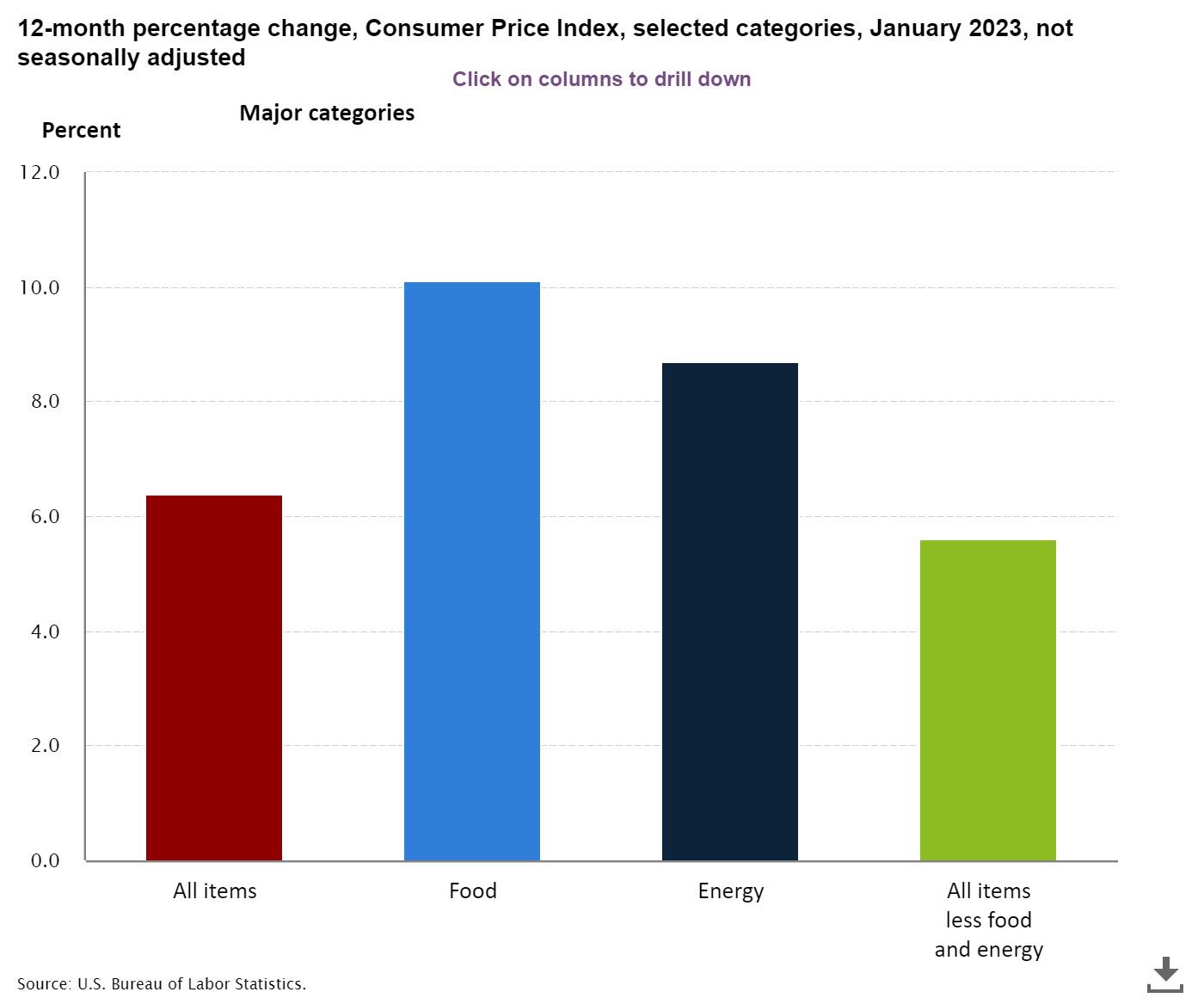
January CPI chart. Source: The U.S. Bureau of Labor Statistics
Adding to the tender sentiment surrounding inflation, most major banks still expect the U.S. to experience a sharp recession at some point in 2023.
According to U.S. Bank analysis, further interest rate hikes are likely and investor sentiment remains low in the current economy:
“The U.S. Consumer Price Index and Producer Price Index both exceeded expectations in January, reinforcing the view that the Fed will continue to tighten monetary policy to return inflation to its long-term goal of 2%. Headline consumer inflation rose 0.5% relative to December and 6.4% in the past year. Core consumer inflation, excluding volatile food and energy prices, also exceeded expectations, rising 0.4% over an upwardly revised December and 5.6% compared to a year ago.
Traders book profits after Bitcoin’s stellar January performance
Bitcoin and the crypto market has witnessed a strong start to 2023, seeing billions of USD Coin flow into BTC to generate a 6-month high of $24,800 on Feb. 16. Even struggling Bitcoin miners saw massive growth, with revenues rising by 50% to $23 million, signaling a recovery for the beleaguered industry.
While Bitcoin had the second-best January on record, it’s possible that the enforcement actions from the SEC and headwinds from macro markets contributed to the current crypto price correction and brief decoupling from U.S equities.
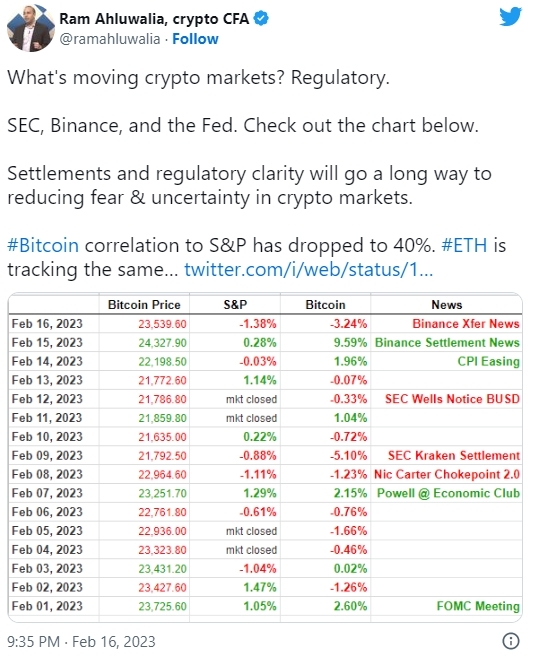
Data shows that Bitcoin’s price 7-day volatility on Feb. 20 reached the highest level since the FTX collapse.
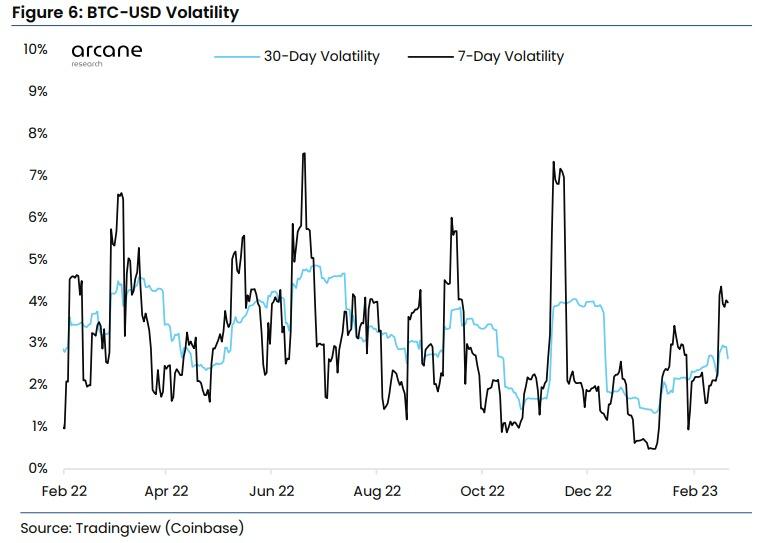
Bitcoin price volatility. Source: Arcane Research
The increase in volatility comes after crypto prices have outperformed major U.S. indices. Top crypto investors believe more sell-offs are on the horizon and Bitcoin analysts push warnings of the long-term downtrend continuing as macro headwinds will continue to impact crypto prices.
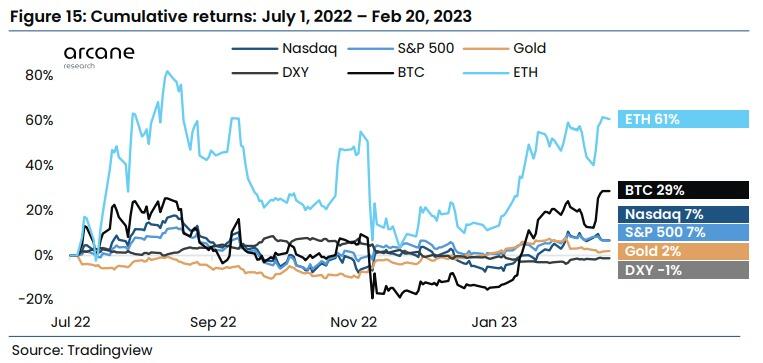
Bitcoin, Ether and major U.S. indices comparison. Source: Arcane Research
In the meantime, investors’ appetite for risk is likely to remain muted, and potential crypto traders might consider waiting for signs that U.S. inflation has peaked, or for the Fed to signal that smaller-sized interest rate hikes are on the cards. A more transparent roadmap for crypto industry regulation would also help to improve sentiment across the sector.
Author
Cointelegraph Team
Cointelegraph
We are privileged enough to work with the best and brightest in Bitcoin.