US Bitcoin ETFs could pull in over $50B in 2025, Bitwise says

US spot Bitcoin exchange-traded funds (ETFs) had nearly $5 billion worth of inflows over January, which could put them on track to see over $50 billion in inflows this year, says Bitwise investment chief Matt Hougan.
“So far, so good: Spot Bitcoin ETFs pulled in $4.94 billion in January, which annualizes to ~$59 billion,” Hougan wrote in a Feb. 1 X post. “For context: In all of 2024, they brought in $35.2 billion.”
He added that there is “significant month-to-month volatility in flows” but said the Bitcoin (BTC $93,686) ETFs would “end the year north of $50b.”
In December, Hougan and Bitwise’s head of research, Ryan Rasmussen, predicted that Bitcoin ETF inflows in 2025 would surpass those of 2024. The pair said the funds ended 2024 with $33.6 billion in inflows, while analysts at the time of their launch in January 2024 expected them to only bring in up to $15 billion.
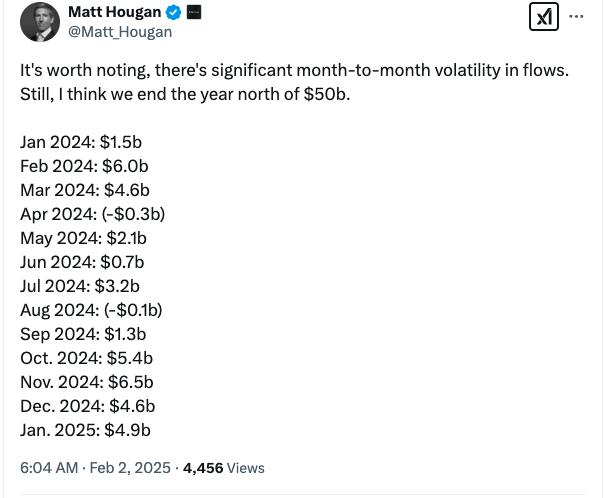
Source: Matt Hougan
BlackRock, Fidelity lead inflows in January
BlackRock’s iShares Bitcoin Trust ETF (IBIT) saw the highest net inflows over January, pulling in a total of $3.2 billion, followed by the Fidelity Wise Origin Bitcoin Fund (FBTC), which had a net inflow of nearly $1.3 billion over the same period, according to data from Farside Investors.
Bitwise’s fund, the Bitwise Bitcoin ETF (BITB), had the fifth-largest net inflow over January of the 11 ETFs, taking in over $125 million, behind the Grayscale Bitcoin Mini Trust ETF (BTC), which took in around $398.5 million.
Related: Bitwise’s Bitcoin and Ethereum ETF clears first SEC hurdle
In Hougan and Rasmussen’s December report, the pair said 2025 will see larger Bitcoin ETF inflows, as institutional investors will want to “double down” and raise the amount they allocate to the funds.
The duo added that an ETF’s first year is “typically the slowest,” noting that gold ETFs had $2.6 billion in flows during their inaugural year in 2004, which more than doubled to $5.5 billion over 2005.
Hougan and Rasmussen also said the world’s largest wirehouses “have yet to unleash their army of wealth managers,” who’ve mostly been denied access to Bitcoin ETFs and predicted that too would change this year, exposing the funds to potentially trillions of dollars.
Author

Cointelegraph Team
Cointelegraph
We are privileged enough to work with the best and brightest in Bitcoin.