Too early to say Ethereum L2s are ‘cannibalistic’ to revenue: Sygnum Bank

Fears that Ethereum layer-2 scaling solutions are eating into the mainnet’s revenue and could impact price may be a bit premature, says an industry analyst.
“It is much too early to tell whether Ethereum[‘s] strategy of scaling through layer 2s is cannibalistic or will lead to net growth,” Katalin Tischhauser, Head of Research at crypto bank Sygnum Bank told Cointelegraph in a recent interview.
Tischhauser’s use of “cannibalistic” refers to layer 2s taking “business” away from the Ethereum mainnet — which has contributed to a substantial fall in Ethereum fees over the last few years.
But while the Ethereum mainnet losing revenue share to layer 2s was bound to happen, optimizing scalability in this manner could see the base layer bring in revenue in ways that were not previously possible, Tischhauser said.
The long term view is that the NET effect will be growth for the Ethereum L1 because the cheap L2s can catalyze new types of transactions previously not possible.
“L2s still need to settle the final state on the L1, so if the L2 growth is substantial, the net effect should be Ethereum growth,” Tischhauser added.
Crypto Fees data shows Ethereum daily fees hover between $1 million to $5 million — far less than the $30 million that was consistently reached throughout 2021 and 2022.
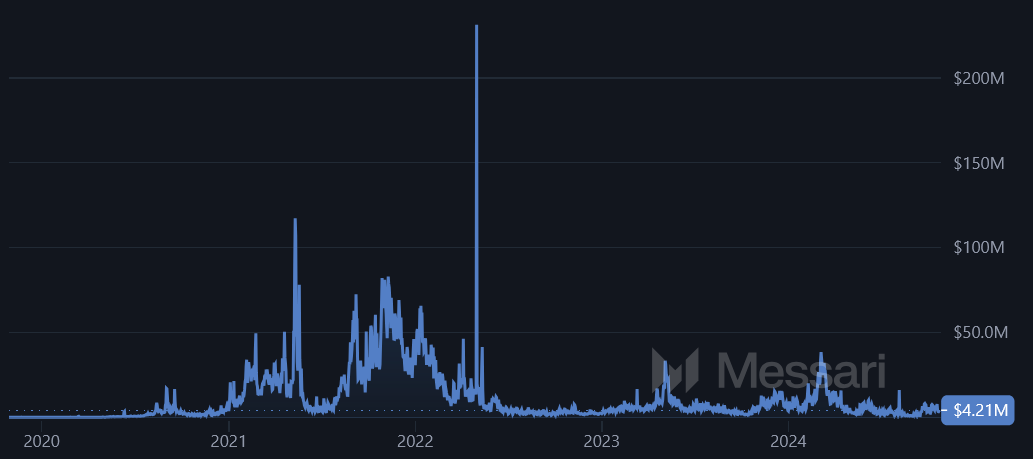
Daily change in Ethereum fees since 2020. Source: Messari
Concerns over Ethereum’s revenue resurfaced on Oct. 10 when decentralized exchange Uniswap — one of Ethereum’s largest fee drivers — revealed it would pivot to its new layer 2 Unichain.
A full pivot would see Ethereum validators lose between $400 million and $500 million in annual revenue.
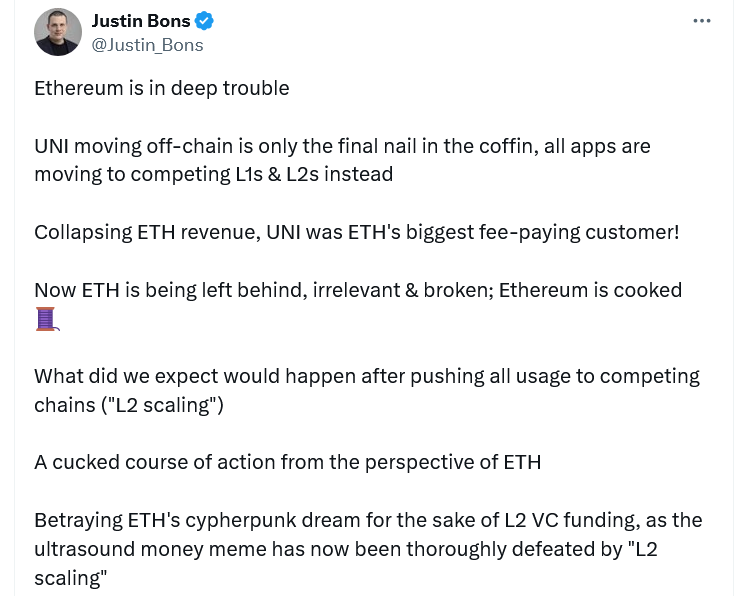
Source: Justin Bons
Continued scaling to layer 2s could stunt Ether’s (ETH $2,497.83) price appreciation, according to VanEck’s Head of Digital Asset Research, Matthew Sigel.
Upon finding out the ratio of transaction revenue between Ethereum and layer 2s has been 10:90 over the last four months, Sigel lowered VanEck’s $22,200 Ether price prediction by 2030 to $7,300 in the event that the 10:90 ratio remains the same.
Tischhauser said sentiment over Ethereum has been “terrible” partially due to the revenue drop and is likely being reflected in Ether’s poor performance relative to Bitcoin (BTC $67,756 ), Solana (SOL $174.21) and other crypto assets.
Ethereum also continues to face fierce competition from other layer-1 blockchains offering cheaper fees and faster finality, Leena ElDeeb, Research Analyst at crypto asset management firm 21Shares told Cointelegraph.
However, Apollo Capital’s Chief Investment Officer Henrik Andersson believes Ethereum’s scaling strategy has actually helped it remain the leading layer-1 blockchain.
“Without progress, like we have seen on the L2 front in the last couple of years, Ethereum would quickly lose mindshare,” Andersson told Cointelegraph.
By making Ethereum great, you will ultimately generate a lot more revenue long term as users would have otherwise left for other chains.
Andersson thinks “there’s a chance” Ether will be viewed as the “higher beta crypto bet” over the next six months and narrow its falling price ratio with Bitcoin.
Ether could even push for a new all-time high sometime in 2025 or soon after, Andersson predicted.
Ether is currently trading at $2520, 48.4% off its all-time high price of $4,878 set on Nov. 10, 2021.
Author

Cointelegraph Team
Cointelegraph
We are privileged enough to work with the best and brightest in Bitcoin.