Tokenized stocks transfer volume jumps 170X as RWA market cap plateaus
- The tokenized stocks monthly transfer volume soars to $9 billion in June, up from $53 million in June 2025.
- The total real-world assets active market capitalization flattens around $27 billion, indicating slowing adoption.
- Ethena founder says projects that offer familiar products on real-world interfaces will drive crypto adoption.

The tokenized stocks market is quietly expanding, as monthly transfer volume climbed to $9 billion in June, a staggering jump from just $53 million in the same month a year earlier. This represents over a 170-fold surge, highlighting how rapidly on-chain trading of traditional equities is becoming mainstream.
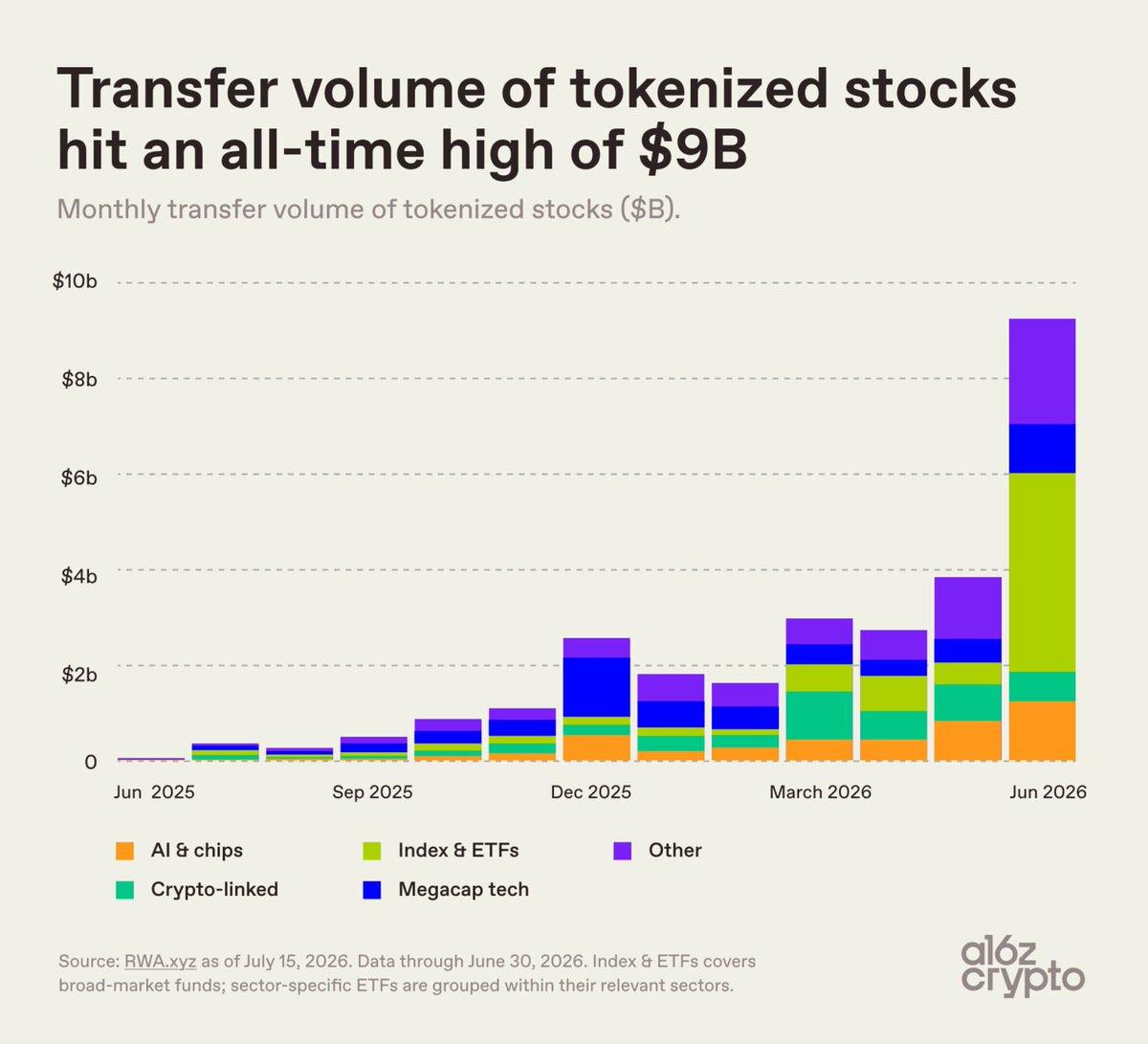
Tokenized stocks activity soars but lags traditional market
The surge in tokenized stocks transfers points to rising demand from traders seeking exposure to popular equities, without leaving familiar crypto rails. Crypto exchanges offer round-the-clock trading, settlement, fractional ownership, including direct access from self-custody assets.
Despite the surge in transfer volume, the headline growth is not translating into broader expansion of the emerging real-world assets (RWAs) sector, whose active market capitalization appears to have plateaued around $27.3 billion. According to Defi Llama, the total on-chain RWA market capitalization averages roughly $30 billion across 183 asset issuers.
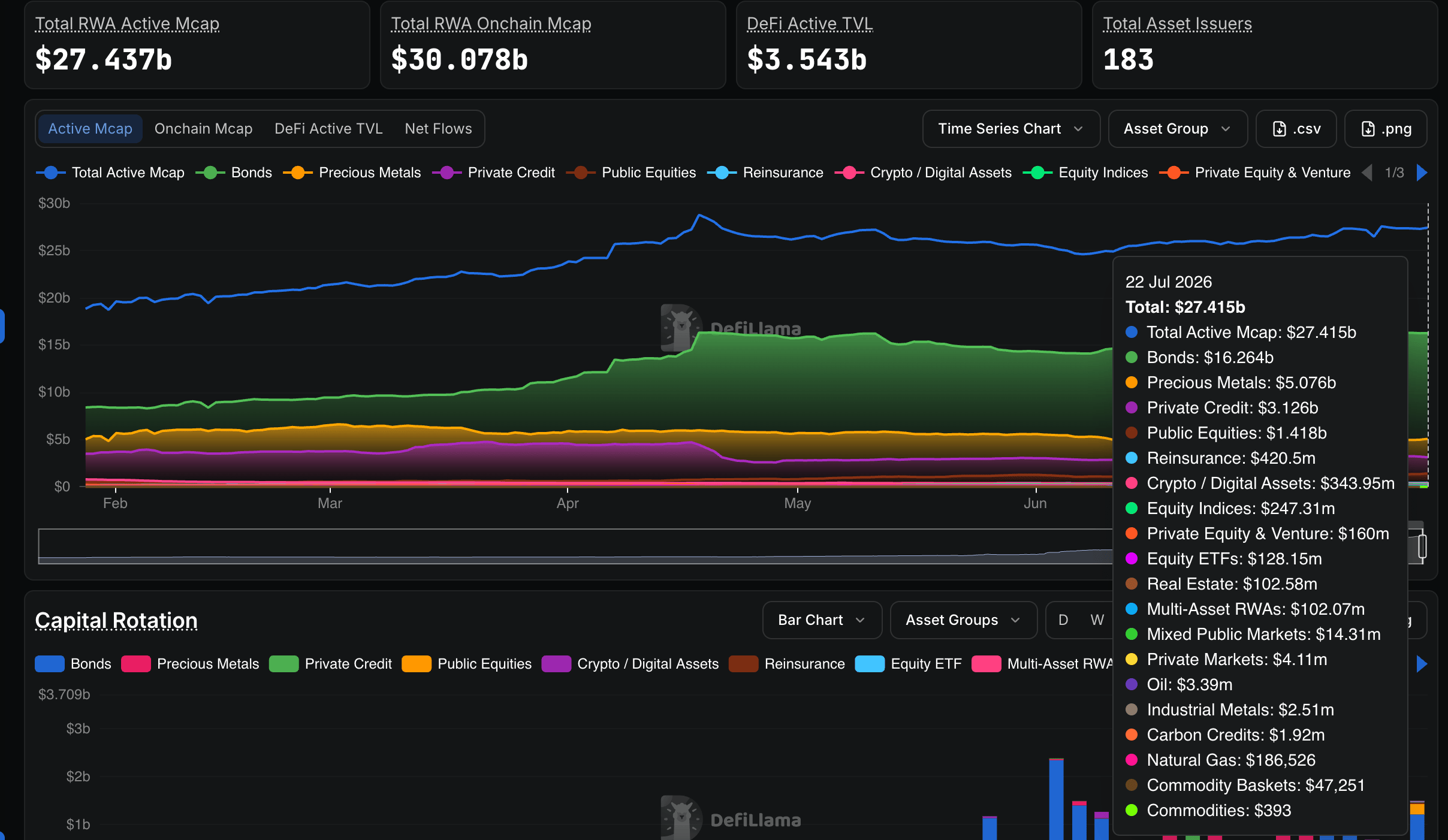
Following the notable growth in transfer volume in the last year, the plateau indicates increased trading of existing capital but slower new inflows. In other words, adoption remains at a snail's pace, revealing that the bridge between traditional and crypto markets is far from being operationalized.
Ethena founder Guy Young shared his perspective on the next phase of growth in an interview with CoinShares on the sidelines of Consensus Hong Kong 2026, suggesting that widespread adoption will come from projects offering familiar products and real-world interfaces, making it easier for mainstream users rather than requiring them to adapt to completely new systems.
“You need to go and meet users where they are in the real world, with a form factor they are used to. Expecting the whole world to load up a MetaMask account and get comfortable working on a desktop application is just not the way most people are going to interact with these products,” Young said.
Young argued that regulation remains a major hindrance, slowing the adoption of crypto-related investment assets. The lack of consistent frameworks between regulators in Europe and the United States (US) puts builders in “a strange position where the product itself is global by nature.”
Bitcoin, altcoins, stablecoins FAQs
Bitcoin is the largest cryptocurrency by market capitalization, a virtual currency designed to serve as money. This form of payment cannot be controlled by any one person, group, or entity, which eliminates the need for third-party participation during financial transactions.
Altcoins are any cryptocurrency apart from Bitcoin, but some also regard Ethereum as a non-altcoin because it is from these two cryptocurrencies that forking happens. If this is true, then Litecoin is the first altcoin, forked from the Bitcoin protocol and, therefore, an “improved” version of it.
Stablecoins are cryptocurrencies designed to have a stable price, with their value backed by a reserve of the asset it represents. To achieve this, the value of any one stablecoin is pegged to a commodity or financial instrument, such as the US Dollar (USD), with its supply regulated by an algorithm or demand. The main goal of stablecoins is to provide an on/off-ramp for investors willing to trade and invest in cryptocurrencies. Stablecoins also allow investors to store value since cryptocurrencies, in general, are subject to volatility.
Bitcoin dominance is the ratio of Bitcoin's market capitalization to the total market capitalization of all cryptocurrencies combined. It provides a clear picture of Bitcoin’s interest among investors. A high BTC dominance typically happens before and during a bull run, in which investors resort to investing in relatively stable and high market capitalization cryptocurrency like Bitcoin. A drop in BTC dominance usually means that investors are moving their capital and/or profits to altcoins in a quest for higher returns, which usually triggers an explosion of altcoin rallies.
Author

John Isige
FXStreet
John Isige is a seasoned cryptocurrency journalist and markets analyst committed to delivering high-quality, actionable insights tailored to traders, investors, and crypto enthusiasts. He enjoys deep dives into emerging Web3 tren