Ethereum Price Forecast: ETH tumbles as rate hike bets rise
- Ethereum retreats toward $2,400 support as headwinds intensify in the broader crypto market.
- US Nonfarm Payrolls rose by 162K in August, triggering higher rate-hike odds.
- Ethereum remains broadly bullish despite the correction, supported by uptrending dynamic moving average support.

Ethereum (ETH) is correcting lower toward support at $2,400 on Friday as volatility rises in the broader cryptocurrency market. The largest smart contract token faced rejection after rising to $2,546 earlier, hinting at profit-taking and investors adopting a cautious stance amid macroeconomic uncertainty.
Still, Ethereum’s outlook remains grounded in risk-on sentiment, as reflected in the Fear & Greed Index, which sits at 74 in the Greed territory on Friday, up from 65 the previous day.
Capital inflows returned on Thursday, with Ethereum spot Exchange-Traded Funds (ETFs) attracting $148 million in deposits, offsetting outflows recorded on the previous day. Meanwhile, cumulative inflows stand at $13 billion, with net assets under management at $16 billion, according to SoSoValue.
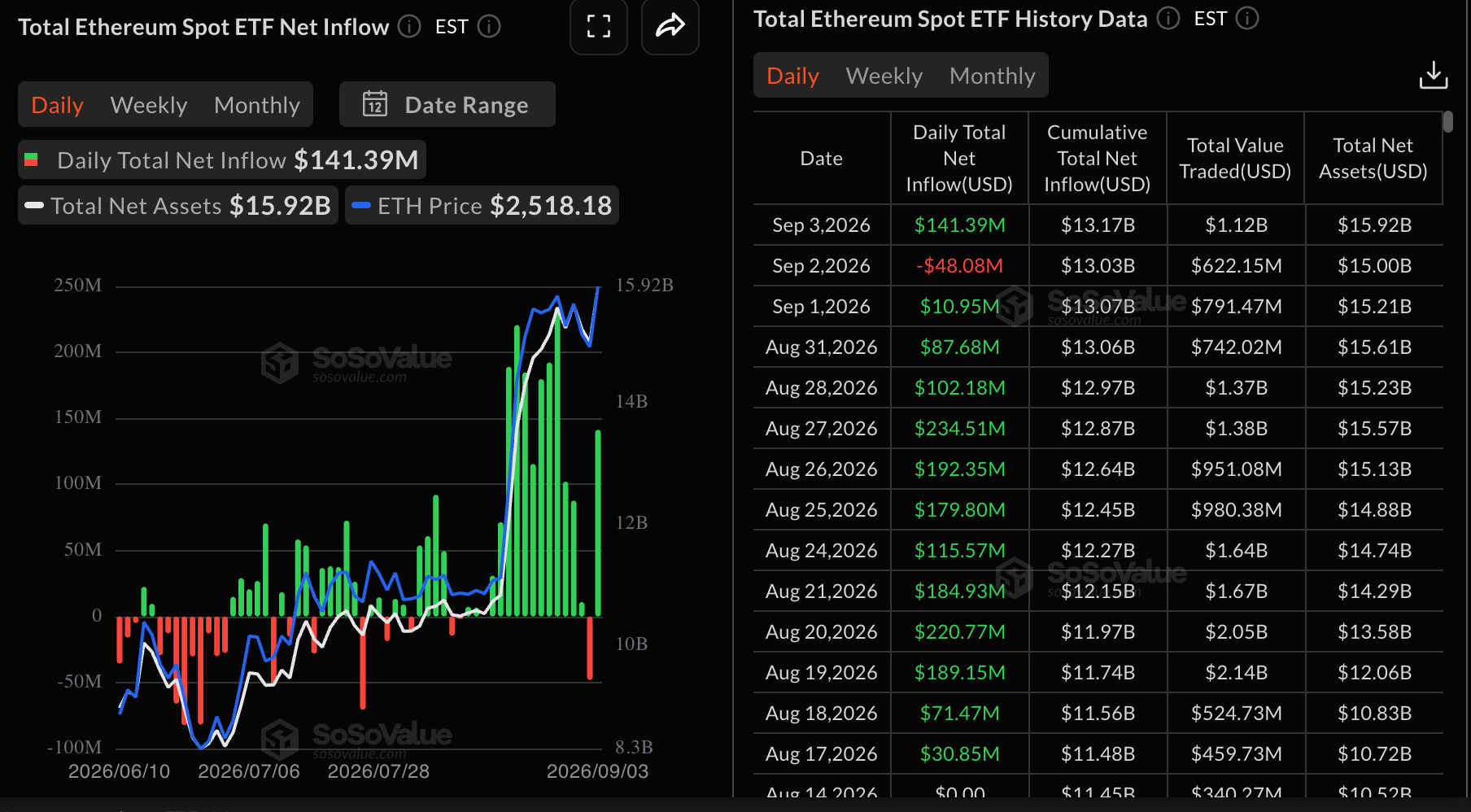
Ethereum risks extending slide as rate hike bets rise
United States (US) Nonfarm Payrolls (NFP) posted a strong increase of 162K in August, according to the latest Bureau of Labor Statistics (BLS) report. The outsized gain represents a sharp rebound from July’s modest 21K increase and decisively surpasses consensus estimates of 56K, highlighting the continued resilience of the US labor market.
Other details show the Unemployment Rate remained unchanged at 4.1%, meeting expectations, while Labor Force Participation ticked up to 61.6%. Average Hourly Earnings, a key gauge of wage inflation, moderated to 3.1% YoY from 3.2%, indicating a gradual easing in wage pressures.
The resilient labor market has seen traders reassess the probability of the Federal Reserve (Fed) raising interest rates to the 3.75%-4.00% range, which currently sits at 60% on Friday, up from 49% the previous day, according to the FedWatch tool.
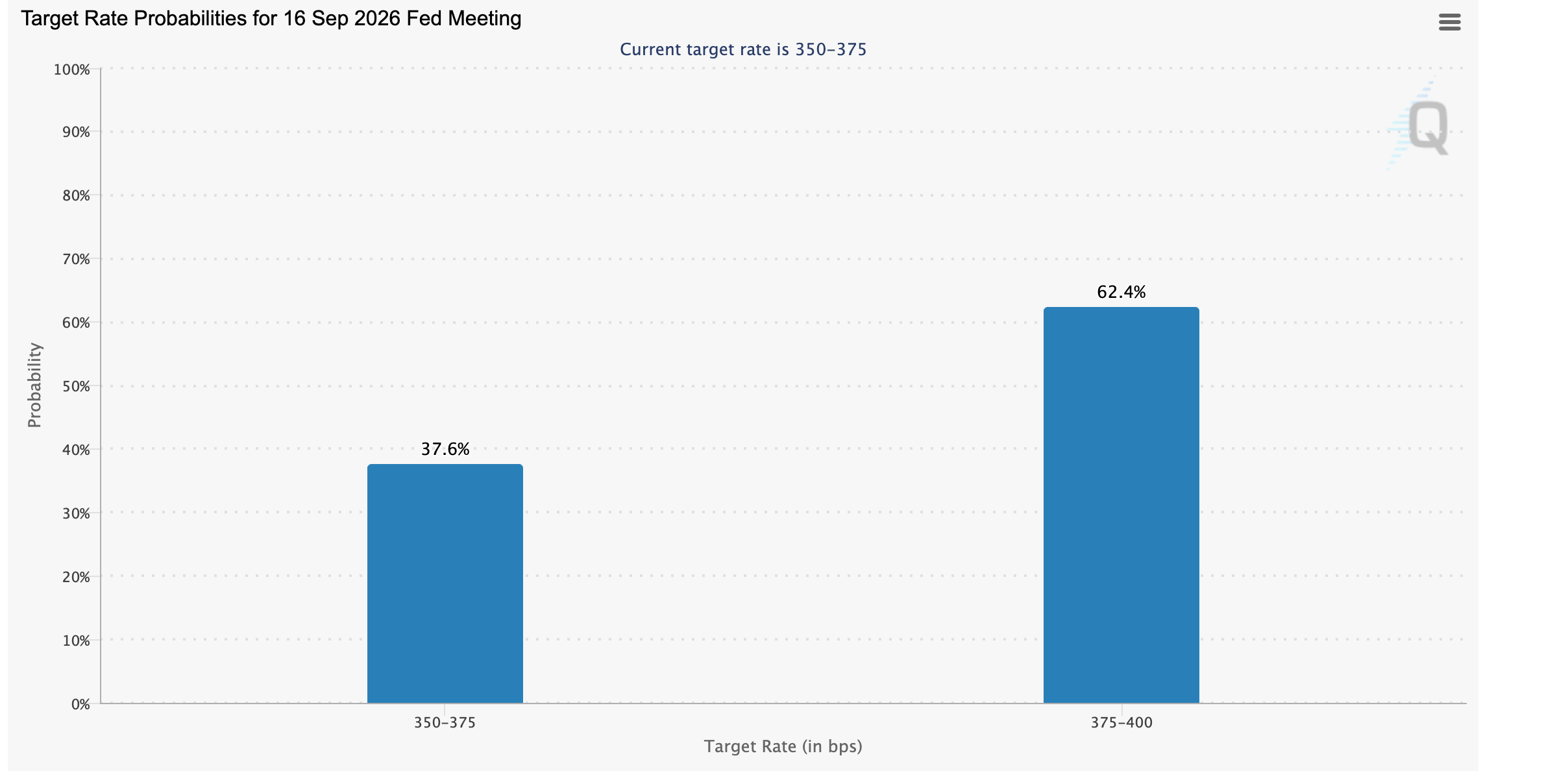
Tighter monetary policy is likely to weigh on risk assets like Ethereum, pushing investors into safer havens such as government bonds. This macro backdrop likely underpins the current pullback in ETH, as market participants reevaluate exposure amid shifting rate expectations.
Technical analysis: Ethereum slips amid broader bullish outlook
Ethereum trades at $2,438 after trimming gains from the daily high of $2,547. Despite the correction, the pair holds a bullish near-term bias as price remains well above the 50-day, 100-day and 200-day Exponential Moving Averages (EMAs), clustered between roughly $2,070 and $2,175, which collectively suggest a firmly supported medium-term uptrend.
The Relative Strength Index (RSI) at 61 on the daily chart remains positive without reaching overbought territory, while the latest Moving Average Convergence Divergence (MACD) reading has slipped into negative territory, hinting that bullish momentum is slowing even as the broader structure stays constructive.
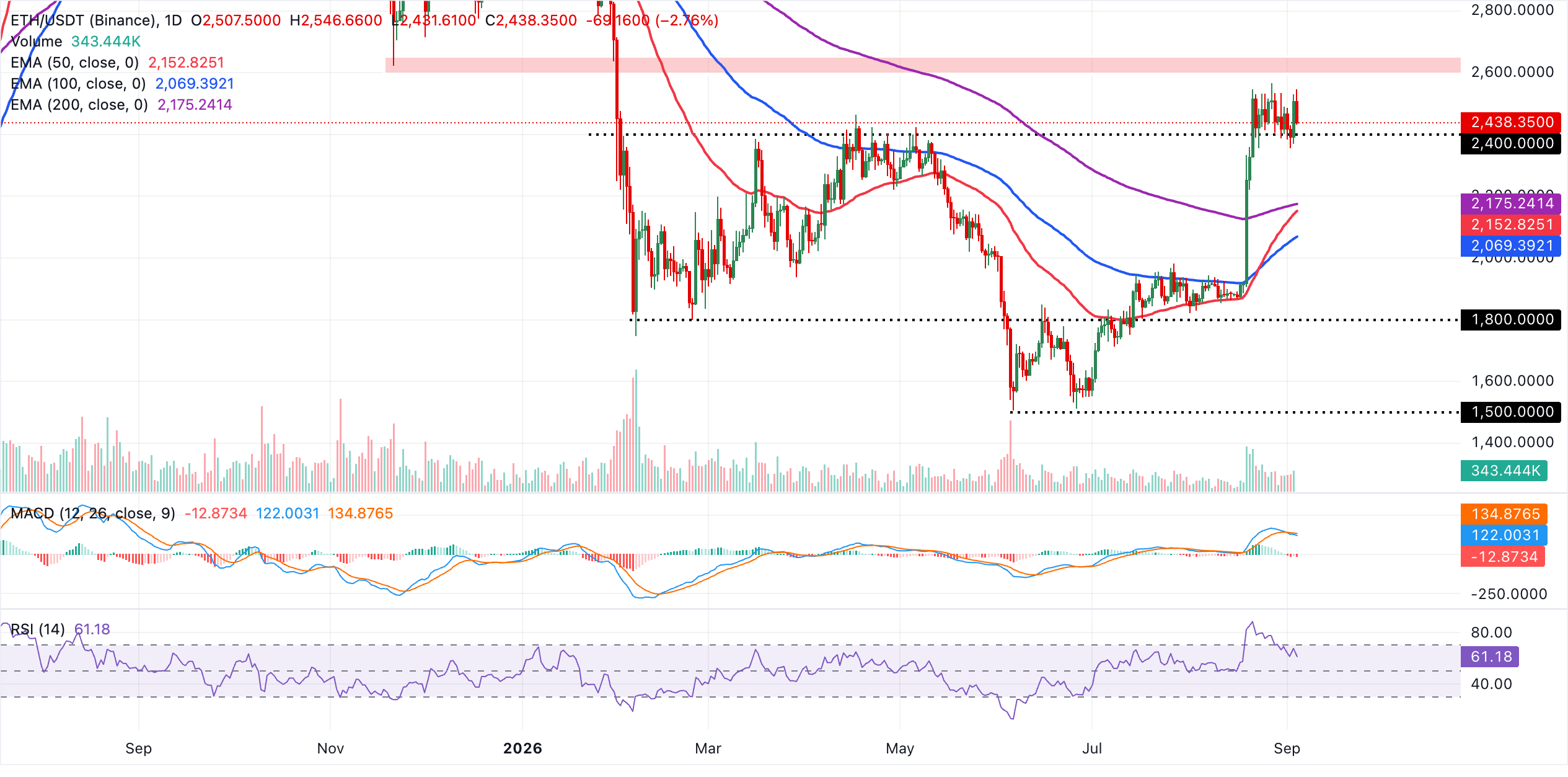
Initial support emerges at the 50-day EMA around $2,153, reinforced by the 200-day EMA near $2,175, creating a dense demand zone that could attract dip-buying if price retreats from current levels. A deeper pullback would expose the 100-day EMA at approximately $2,069 as the next significant floor, where failure would signal a more meaningful loss of bullish control despite the prevailing uptrend.
(The technical analysis of this story was written with the help of an AI tool. Know more.)
Ethereum FAQs
Ethereum is a decentralized open-source blockchain with smart contracts functionality. Its native currency Ether (ETH), is the second-largest cryptocurrency and number one altcoin by market capitalization. The Ethereum network is tailored for building crypto solutions like decentralized finance (DeFi), GameFi, non-fungible tokens (NFTs), decentralized autonomous organizations (DAOs), etc.
Ethereum is a public decentralized blockchain technology, where developers can build and deploy applications that function without the need for a central authority. To make this easier, the network leverages the Solidity programming language and Ethereum virtual machine which helps developers create and launch applications with smart contract functionality.
Smart contracts are publicly verifiable codes that automates agreements between two or more parties. Basically, these codes self-execute encoded actions when predetermined conditions are met.
Staking is a process of earning yield on your idle crypto assets by locking them in a crypto protocol for a specified duration as a means of contributing to its security. Ethereum transitioned from a Proof-of-Work (PoW) to a Proof-of-Stake (PoS) consensus mechanism on September 15, 2022, in an event christened “The Merge.” The Merge was a key part of Ethereum's roadmap to achieve high-level scalability, decentralization and security while remaining sustainable. Unlike PoW, which requires the use of expensive hardware, PoS reduces the barrier of entry for validators by leveraging the use of crypto tokens as the core foundation of its consensus process.
Gas is the unit for measuring transaction fees that users pay for conducting transactions on Ethereum. During periods of network congestion, gas can be extremely high, causing validators to prioritize transactions based on their fees.
Author

John Isige
FXStreet
John Isige is a seasoned cryptocurrency journalist and markets analyst committed to delivering high-quality, actionable insights tailored to traders, investors, and crypto enthusiasts. He enjoys deep dives into emerging Web3 tren