South Carolina dismisses its staking lawsuit against coinbase, joining Vermont


South Carolina has become the latest US state to dismiss its lawsuit against crypto exchange Coinbase over its staking services, which had accused the crypto exchange of offering unregistered securities.
The lawsuit was officially dismissed in a joint stipulation between the crypto exchange and the South Carolina Attorney General’s securities division on March 27.
“South Carolina just joined Vermont to dismiss its unfounded staking lawsuit against Coinbase,” the firm’s chief legal officer, Paul Grewal, said in a March 27 X post.
“This is not just a victory for us, but for American consumers and we hope it's a sign of things to come in the few states left that restrict staking.”
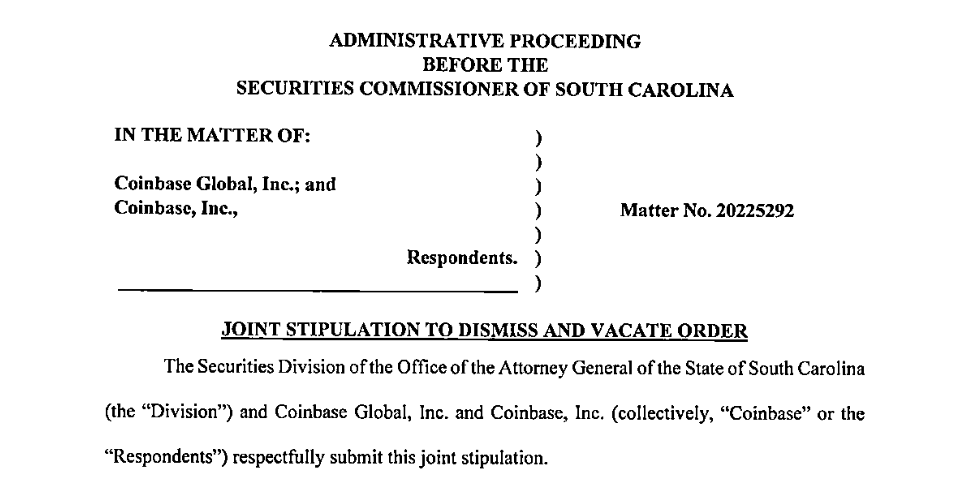
South Carolina Attorney General and Coinbase’s joint stipulation. Source: South Carolina Attorney General
South Carolina and Vermont were two of 10 US states that took legal action against Coinbase's staking services on June 6, 2023 — the same day that the federal securities regulator filed its lawsuit against the crypto exchange.
The Securities and Exchange Commission officially dismissed that lawsuit on Feb. 27, 2025.
The other eight US states that filed enforcement action similar to South Carolina were Alabama, California, Illinois, Kentucky, Maryland, New Jersey, Washington and Wisconsin.
Grewal said he hoped to see other states follow suit, and that South Carolina residents lost an estimated $2 million in staking rewards as a result of the lawsuit.
“The 52 million Americans who own crypto deserve commonsense consumer protections and clear rules,” he said. “We applaud South Carolina for standing up for justice and hope the remaining states with bans on staking will take notice.”
South Carolina introduces Bitcoin reserve bill
Meanwhile, a state lawmaker has just introduced the “Strategic Digital Assets Reserve Act of South Carolina” on March 27, which could see the state treasurer allocate up to 10% of certain state funds to cryptocurrencies such as Bitcoin.
Unlike most US state crypto reserve bills, North Carolina’s House Bill 4256, introduced by Rep. Jordan Pace, mentioned Bitcoin on several occasions for the Strategic Digital Assets Reserve that the bill seeks to establish.
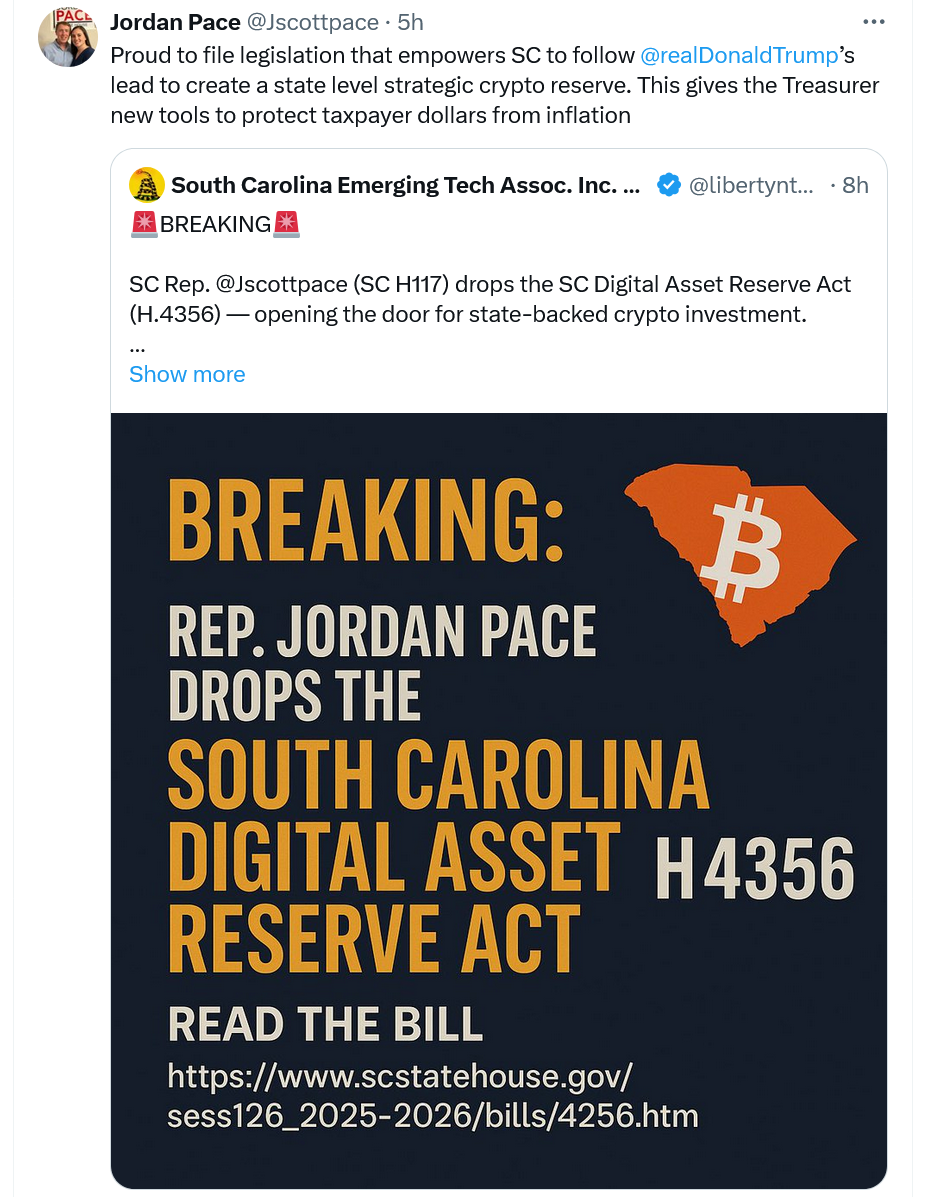
Source: Jordan Pace
The bill allows South Carolina’s treasurer, currently Curtis Loftis, to establish a Bitcoin reserve that exceeds no more than 1 million Bitcoin — a high ceiling that the US federal government is also looking to reach or exceed with its recently established Strategic Bitcoin Reserve.
The treasurer would be able to add Bitcoin to South Carolina’s General Fund, the Budget Stabilization Reserve Fund any other investment fund that they manage.
While no mention of stablecoins, non-fungible tokens, Ether or any other crypto tokens was made, the House bill said the Strategic Digital Assets Reserve wouldn’t be limited to Bitcoin.
According to Bitcoin Law, 42 Bitcoin reserve bills have been introduced at the state level in 19 states, and 36 of those 42 bills remain live.
Earlier this month, US President Donald Trump signed an executive order to create a Strategic Bitcoin Reserve and a Digital Asset Stockpile, both of which will initially use cryptocurrency forfeited in government criminal cases.
Author
Cointelegraph Team
Cointelegraph
We are privileged enough to work with the best and brightest in Bitcoin.