Ripple Price Prediction: Can XRP sustain rally as Judge rejects SEC-Ripple joint motion?
- Judge Analisa Torres denies the SEC and Ripple’s joint request for an indicative ruling to dissolve the $125M penalty injunction.
- Judge Torres cited procedural issues, emphasising the need for a compelling case to justify withdrawing her ruling.
- XRP’s price shows strength, rising slightly above support at $2.40, although its upside potential remains uncertain.

Ripple (XRP) price trades broadly sideways at around $2.41 on Friday, rising slightly after a minor correction from this week’s peak of $2.65 to support $2.34. XRP's uptrend, sustained over the last few weeks, aims for $3.00. However, this rally could face potential drawdowns following the United States (US) District Judge Analisa Torres' rejection of Ripple Labs and the Securities and Exchange Commission’s (SEC) joint request for an indicative ruling. The parties had reached a settlement agreement on May 8, pending judicial approval.
SEC-Ripple joint request for an indicative ruling denied
Judge Analisa Torres of the US District Court Southern District of New York has rejected a joint request by Ripple and the SEC for an indicative ruling that would have seen the token issuer pay only $50 million as a penalty instead of the $125 million imposed by the Court in 2024.
#XRPCommunity #SECGov v. #Ripple #XRP Judge Torres has denied the parties’ motion for an indicative ruling. “If jurisdiction were restored to this Court, the Court would deny the parties’ motion as procedurally improper.” pic.twitter.com/4s95ILvzsy
— James K. Filan 🇺🇸🇮🇪 (@FilanLaw) May 15, 2025
The lawsuit filed by the SEC in December 2020 alleged that Ripple “engaged in the unlawful offer and sale of securities in violation of Section 5 of the Securities Act.” According to the July 12, 2023 ruling, “the Court granted in part and denied in part the parties’ demand for summary judgment.”
Judge Torres ruled that the sale of XRP on the open market or cryptocurrency exchanges did not constitute a security. However, Ripple had a case to answer for its direct institutional sale of XRP tokens.
Ripple was penalised $125 million, significantly below the SEC’s initial request of $2 billion for violating, in part, the Securities Act. The money was deposited in an interest-bearing account, but Ripple and the SEC appealed the ruling, with the cross-appeals pending judgment before the Second Circuit.
Ripple and the SEC agreed on May 8 to seek to settle the lawsuit in both the District Court and the Second Circuit. The parties mutually agreed that Ripple pays $50 million to the SEC upon the Court’s vacation of the injunction against Ripple Labs, subsequently lowering the penalty by 60%.
On dismissing the joint request for indicative ruling, Judge Torres cited procedural issues, adding that the District Court must “determine whether the proposed consent decree is fair and reasonable with the additional requirement that the public interest would not be disserved in the event the court” moves to grant the motion effectively ending the lawsuit.
Despite the denial, Judge Torres outlined a clear path that must be followed by the SEC and Ripple to ensure the agreement is fair and reasonable. According to crypto lawyer John Deaton, the Court must ascertain that the thousands of legal hours and judicial manpower committed to the case in the last five years did not go to waste.
Ripple’s Chief Legal Officer, Stuart Alderoty, said after the ruling that Ripple will work with the SEC to revisit the matter. Alderoty clarified that the ruling does not jeopardise Ripple’s past wins, as XRP is not a security.
Nothing in today’s order changes Ripple’s wins (i.e. XRP is not a security, etc). This is about procedural concerns with the dismissal of Ripple’s cross-appeal. Ripple and the SEC are fully in agreement to resolve this case and will revisit this issue with the Court, together. https://t.co/vBQdBD3FNe
— Stuart Alderoty (@s_alderoty) May 15, 2025
XRP’s uptrend holds steady despite the ruling
XRP’s price gains slightly over 1% on Friday, trading around $2.41 at the time of writing. The token’s short-term technical outlook is structurally bullish with the Moving Average Convergence Divergence (MACD) sitting above the mean line. At the same time, the MACD line (blue) gap above the signal line (red) upholds the buy signal confirmed on May 8. A buy signal manifests when the MACD line crosses above the signal line.
XRP’s position above three up-trending moving averages, ranging from the 50-day Exponential Moving Average (EMA) at $2.27, the 100-day EMA at $2.25, to the 200-day EMA at $2.03, signals a strong bullish momentum.
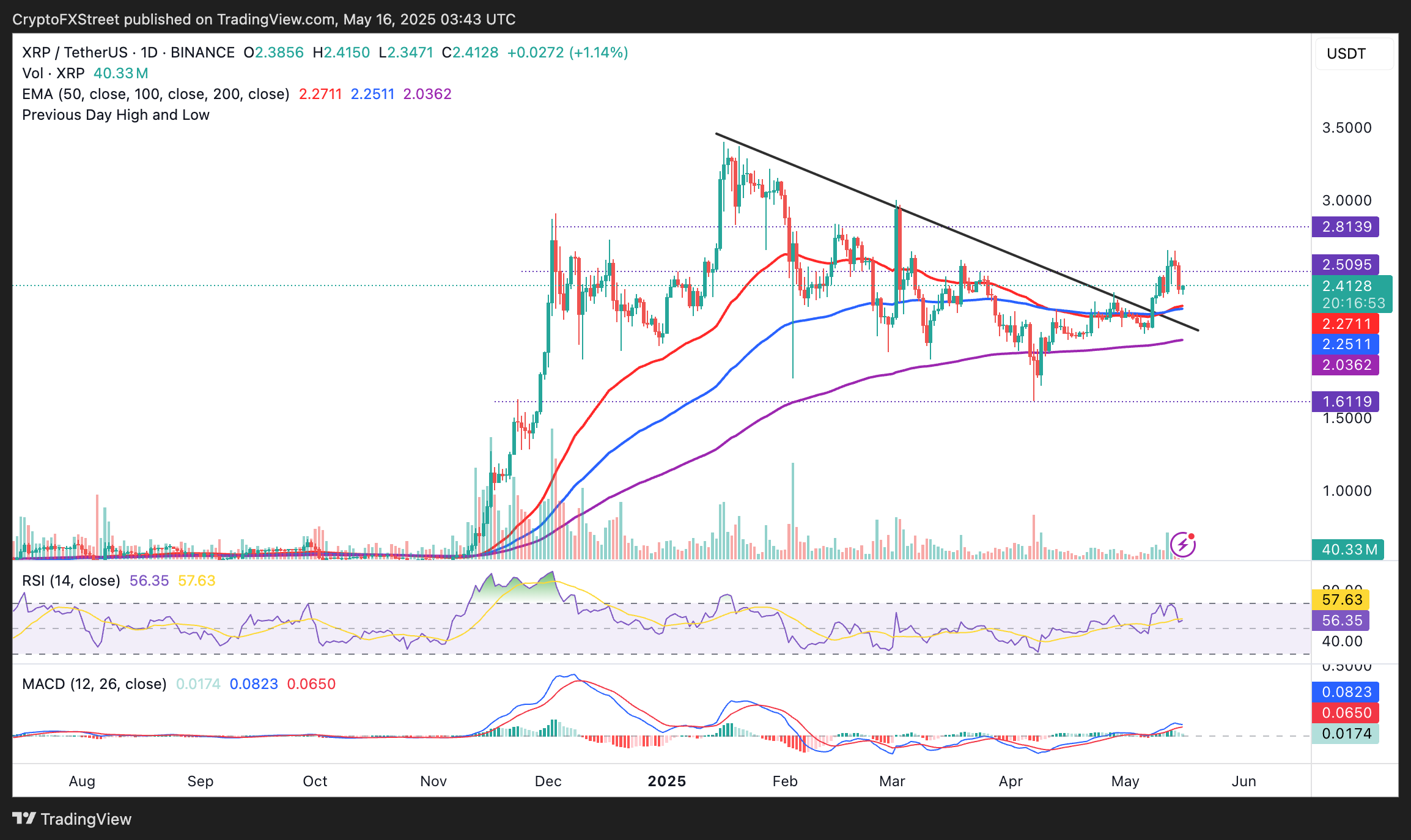
XRP/USDT daily chart
For now, the uptrend’s target at $3.00 remains in sight, with traders likely to look for a daily close above $2.40, the immediate support. A break above the weekly peak of $2.65 would encourage traders to buy XRP, as confidence improves for a breakout to $3.00.
However, XRP is not out of the woods, and extended declines toward the 200-day EMA support at $2.00 cannot be ruled out yet. The Relative Strength Index (RSI) indicator at 56.36 reflects the drawdown from $2.65 in the last few days. If headwinds overshadow demand, XRP could explore lower levels as the RSI indicator slides below the midline at 50 towards the oversold region.
Cryptocurrency prices FAQs
Token launches influence demand and adoption among market participants. Listings on crypto exchanges deepen the liquidity for an asset and add new participants to an asset’s network. This is typically bullish for a digital asset.
A hack is an event in which an attacker captures a large volume of the asset from a DeFi bridge or hot wallet of an exchange or any other crypto platform via exploits, bugs or other methods. The exploiter then transfers these tokens out of the exchange platforms to ultimately sell or swap the assets for other cryptocurrencies or stablecoins. Such events often involve an en masse panic triggering a sell-off in the affected assets.
Macroeconomic events like the US Federal Reserve’s decision on interest rates influence crypto assets mainly through the direct impact they have on the US Dollar. An increase in interest rate typically negatively influences Bitcoin and altcoin prices, and vice versa. If the US Dollar index declines, risk assets and associated leverage for trading gets cheaper, in turn driving crypto prices higher.
Halvings are typically considered bullish events as they slash the block reward in half for miners, constricting the supply of the asset. At consistent demand if the supply reduces, the asset’s price climbs.
Author

John Isige
FXStreet
John Isige is a seasoned cryptocurrency journalist and markets analyst committed to delivering high-quality, actionable insights tailored to traders, investors, and crypto enthusiasts. He enjoys deep dives into emerging Web3 tren