XRP declines to around $0.53, Ripple co-founder extends support to Kamala Harris in US election
- Ripple co-founder and executive chairman Chris Larsen extends support to Vice President Kamala Harris in the US Presidential election.
- Former Ripple board member Gene Sperling left the White House in August to join Kamala Harris’ 2024 presidential campaign.
- XRP dipped to a one-month low of $0.5323 on Friday.

Ripple (XRP) co-founder Chris Larsen joined 88 other business leaders in supporting Vice President Kamala Harris in the upcoming US Presidential election, per a CNBC report. The payment-remittance firm recently received the Securities & Exchange Commission’s (SEC) consent on a stay on the monetary portion of the final ruling in the SEC vs. Ripple lawsuit.
XRP slipped to $0.5323, a one-month low for the altcoin’s price.
Daily digest market movers: Ripple co-founder and former board member backs Kamala Harris
- SEC vs. Ripple lawsuit updates, actions of co-founder, and former board member and on-chain metrics are the key market movers for XRP on Friday.
- Ripple co-founder Chris Larsen joined key business leaders and expressed support for Kamala Harris’ Presidential campaign, signing a letter to endorse Harris for president.
- A former Ripple board member, Gene Sperling, left the White House to join Vice President Harris’ 2024 Presidential campaign in August.
- As the November elections draw close, leaders in the crypto community are backing pro-crypto candidates.
- Several crypto community members backed former US President Trump for his promise to put an end to Gary Gensler’s crusade against crypto. In this regard, Ripple CEO Brad Garlinghouse said on Tuesday in Seoul that he will make a “gentleman’s bet” that the SEC Chair’s tenure is up irrespective of who wins the US Presidential election, according to The Korea Herald.
Technical analysis: XRP corrects to one-month low at $0.5323
XRP is in a multi-month downtrend. The altcoin dipped to $0.5323 early on Friday, a one-month low, and recovered slightly afterwards. Still, XRP looks set to post losses for a second consecutive week, losing around 2% this week so far.
If the downtrend persists, XRP could extend losses by another 4.72% and sweep liquidity at $0.5188, the lower boundary of the imbalance zone in the XRP/USDT daily chart. Once there, buyers could take control to let the altcoin attempt a recovery towards a key resistance at $0.6217. This marks a key level that XRP has tested as resistance several times since July.
The Moving Average Convergence Divergence (MACD) momentum indicator shows red histogram bars under the neutral line, suggesting the bearish momentum prevails.
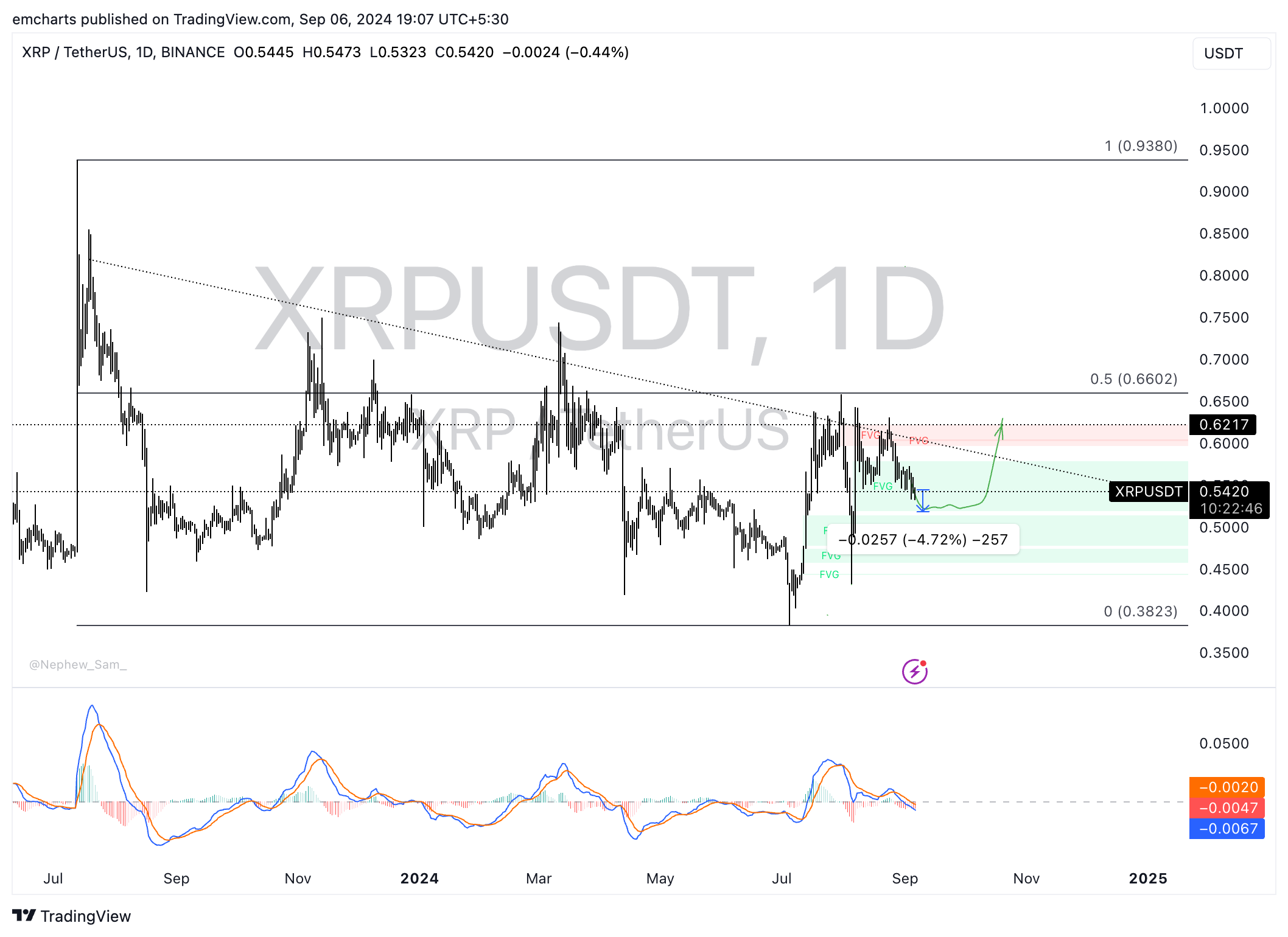
XRP/USDT daily chart
Still, a daily candlestick close above the upper boundary of the Fair Value Gap (FVG) at $0.5785 could invalidate the bearish thesis. In this scenario, XRP could rally towards the mentioned $0.6217 resistance level.
Ripple FAQs
Ripple is a payments company that specializes in cross-border remittance. The company does this by leveraging blockchain technology. RippleNet is a network used for payments transfer created by Ripple Labs Inc. and is open to financial institutions worldwide. The company also leverages the XRP token.
XRP is the native token of the decentralized blockchain XRPLedger. The token is used by Ripple Labs to facilitate transactions on the XRPLedger, helping financial institutions transfer value in a borderless manner. XRP therefore facilitates trustless and instant payments on the XRPLedger chain, helping financial firms save on the cost of transacting worldwide.
XRPLedger is based on a distributed ledger technology and the blockchain using XRP to power transactions. The ledger is different from other blockchains as it has a built-in inflammatory protocol that helps fight spam and distributed denial-of-service (DDOS) attacks. The XRPL is maintained by a peer-to-peer network known as the global XRP Ledger community.
XRP uses the interledger standard. This is a blockchain protocol that aids payments across different networks. For instance, XRP’s blockchain can connect the ledgers of two or more banks. This effectively removes intermediaries and the need for centralization in the system. XRP acts as the native token of the XRPLedger blockchain engineered by Jed McCaleb, Arthur Britto and David Schwartz.
Author

Ekta Mourya
FXStreet
Ekta Mourya has extensive experience in fundamental and on-chain analysis, particularly focused on impact of macroeconomics and central bank policies on cryptocurrencies.