POL price lags breakout as stablecoin provider AlloyX launches tokenised money market fund on Polygon
- POL struggles to move above key moving averages despite bullish sentiment in the wider crypto market.
- Asia-based stablecoin provider AlloyX has launched a compliant, tokenized money market fund exclusively on Polygon.
- Hong Kong’s Standard Chartered Bank will provide custody services, delivering on-chain institutional-grade yield.

POL price edges lower, trending against bullish odds in the broader cryptocurrency market on Thursday. Attempts to push beyond a short-term supply range between $0.2405 and $0.2438 hit a roadblock, increasing downside risks toward support at $0.2104.
Adoption developments suggest that POL still has an opportunity for a larger upside run. The odds of this potential bullish outlook could increase if the United States (US) Federal Reserve (Fed) meets market expectations and cuts interest rates by 25 basis points in October. Lower rates are often catalysts for the crypto market in general, as traders increase risk exposure to riskier assets.
AlloyX launches tokenized MMF on Polygon
AlloyX, one of the leading stablecoin providers in Asia, has launched a compliant tokenized money market fund (MMF) exclusively on the Polygon blockchain. Hong Kong’s Standard Chartered Bank has been chosen as the sole custodian for the MMF, which aims to deliver institutional-grade yields on-chain via a digital asset called the Real Yield Token (RYT).
According to Polygon, RYT allows investors access to the MMF assets “while unlocking onchain yield through Polygon-native strategies.” The token operates daily settlements and publishes selected data on-chain to ensure transparency.
Additionally, Polygon and AlloyX will collaborate on a wide range of Decentralized Finance (DeFi) initiatives and strategic integrations.
“The launch adds momentum to Polygon’s role as the preferred chain for global payments and tokenization. Long-term stability, low cost, and near-instant finality make Polygon stand out as financial markets pivot toward on-chain settlement,” Polygon stated.
Technical outlook: Assessing POL’s technical outlook
POL struggles below the key moving averages, including the 100-day Exponential Moving Average (EMA) at $0.2405, the 50-day EMA at $0.2438 and the 200-day EMA at $0.2581.
If bulls don’t manage to flip the 50-day and 100-day EMAs into immediate support levels, it would be difficult to sustain the recovery that started last week, following the persistent decline through September.
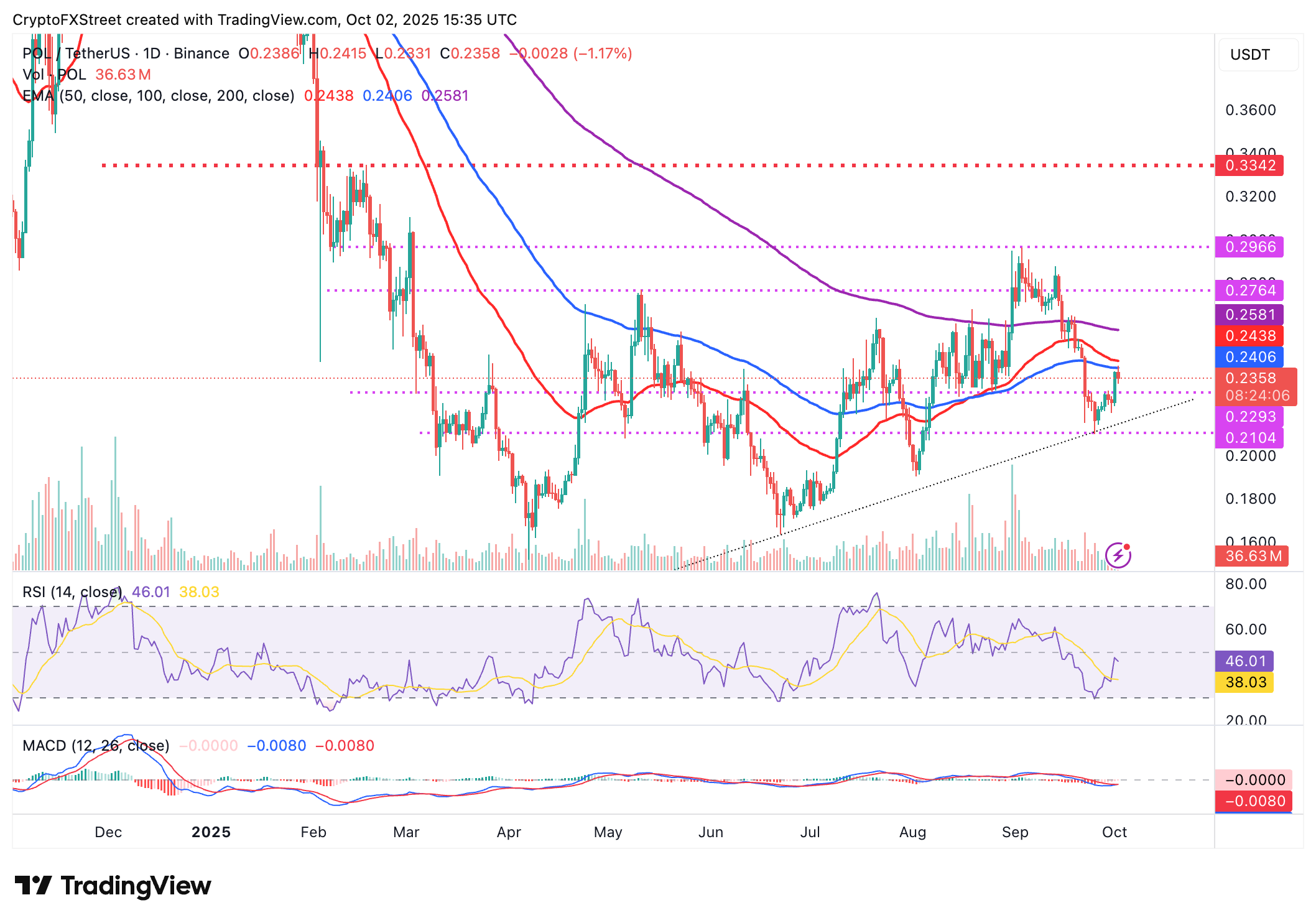
POL/USDT daily chart
The Relative Strength Index (RSI), which had risen to 46, is beginning to show weakness, suggesting that bullish pressure is easing. This, coupled with potential profit-taking, could lead to POL correction toward the short-term support at $0.2293 and the next demand area at $0.2104.
If bulls push POL above the immediate 100-day, 50-day, and 200-day EMAs, the narrative could flip bullish, supported by adoption developments. Key targets are the resistance tested at $0.2966 in early September and $0.3342 in February.
Cryptocurrency prices FAQs
Token launches influence demand and adoption among market participants. Listings on crypto exchanges deepen the liquidity for an asset and add new participants to an asset’s network. This is typically bullish for a digital asset.
A hack is an event in which an attacker captures a large volume of the asset from a DeFi bridge or hot wallet of an exchange or any other crypto platform via exploits, bugs or other methods. The exploiter then transfers these tokens out of the exchange platforms to ultimately sell or swap the assets for other cryptocurrencies or stablecoins. Such events often involve an en masse panic triggering a sell-off in the affected assets.
Macroeconomic events like the US Federal Reserve’s decision on interest rates influence crypto assets mainly through the direct impact they have on the US Dollar. An increase in interest rate typically negatively influences Bitcoin and altcoin prices, and vice versa. If the US Dollar index declines, risk assets and associated leverage for trading gets cheaper, in turn driving crypto prices higher.
Halvings are typically considered bullish events as they slash the block reward in half for miners, constricting the supply of the asset. At consistent demand if the supply reduces, the asset’s price climbs.
Author

John Isige
FXStreet
John Isige is a seasoned cryptocurrency journalist and markets analyst committed to delivering high-quality, actionable insights tailored to traders, investors, and crypto enthusiasts. He enjoys deep dives into emerging Web3 tren