Optimism price outperforms Arbitrum despite close similarity amid ongoing Ethereum Layer-2 wars
- Optimism price has outperformed Arbitrum, sustaining an uptrend with signs of a prolonged bullishness.
- However, OP and ARB have shown close similarity in various aspects, raising questions about why the price mismatch exists.
- With both ecosystems counting the days to their unlocks, allocations prove relatively too close, pointing to a strong similarity.

Optimism (OP) and Arbitrum (ARB) tokens are the leading contenders in the Ethereum Layer-2 wars, with their total value bridged and the number of daily users showing a close race. While some distinguishing dynamics are here, other metrics on both networks have pointed to close similarity, explaining why these two ETH L2 tokens have often been mentioned together.
Also Read: Top 3 Price Prediction Bitcoin, Ethereum, Ripple: Liquidity picture may not improve anytime soon.
Optimism beats Arbitrum price despite project similarities
Optimism (OP), one of the most promising Ethereum Layer-2 tokens next to Arbitrum (ARB), has displayed varying price actions despite close similarities between their technology, promised future, and tokenomics. An exploration of the two largest L2 optimistic rollups, Optimism and Arbitrum, details why they record stiff competition.
Beforehand, however, the principle operational dynamics for the two altcoins is that the “two solutions use the optimistic roll-up technology, making it possible for them to combine multiple transactions off the Ethereum and store a compressed version back on the ETH L1.
Nevertheless, the two tokens have shown close similarity in terms of allocating their vested tokens during unlock events.
Comparing Token Allocation$ARB VS $OP
— Token Unlocks (@Token_Unlocks) August 20, 2023
Investors :$ARB > 17.5%$OP > 21.1%
Community & Reserved :$ARB > 55.6%$OP > 55.2%
Founder & Team :$ARB > 26.9%$OP > 23.6%
Circulating Supply$ARB > 12.75%$OP > 16.69%
Do these tokens really look similar? Think again! pic.twitter.com/KzJCK5ndPk
With a relatively close difference between the number of tokens intended for allocation to their respective stakeholders, OP and ARB may be poised for similar moves when the impact of the token distribution on price action manifests.
Specifically, both L2s plan to allocate their vested tokens to founders and teams, community and reservation. This development may not lead to sustained selling pressure because holders will not be in a rush to sell. However, for where investors are the recipients, there is expectation to sell, with the ensuing seller momentum likely to influence prices.
According to expert guides on capitalizing on Token Unlocks for profit:
Tokens are distributed to the protocol’s treasury or for further project development, which usually means that they will stay in the ecosystem and will not be sold immediately for a profit. Meanwhile, tokens unlocked and distributed to partners, advisors, or early investors on a large stake risk creating higher selling pressure.
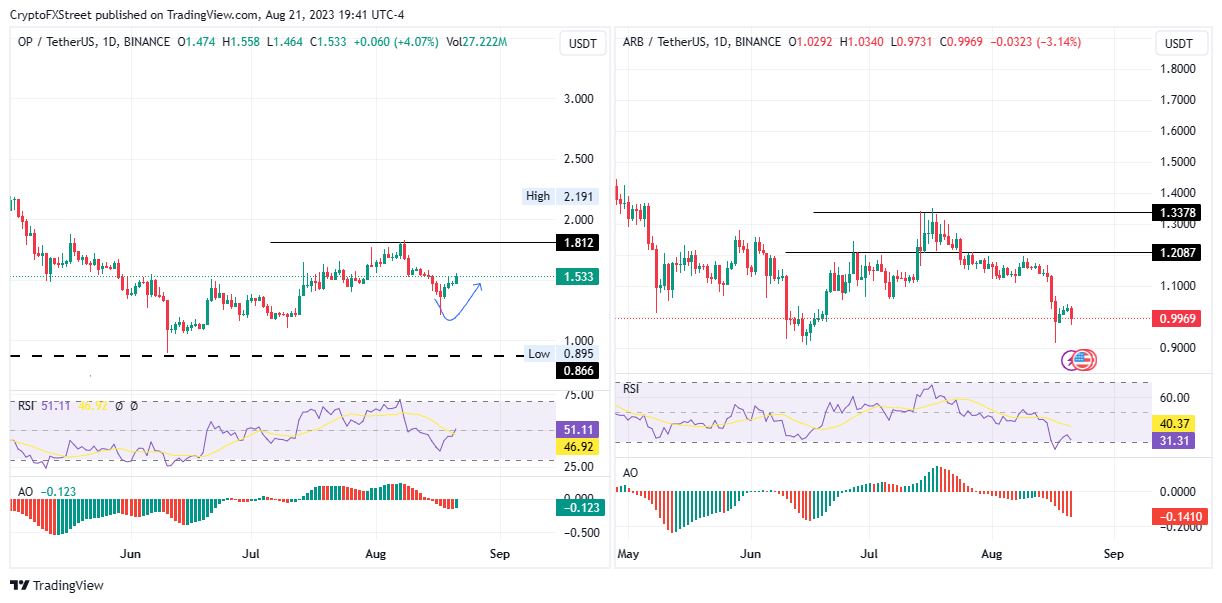
OP/USDT 1-day chart, ARB/USDT 1-day chart
Meanwhile, the Optimism price shows signs of a sustained uptrend, unlike the Arbitrum price, which has slumped around 5%. This disparity comes as ARB’s token unlocks many days out, while the OP holders only count days for the vested tokens to be unleashed.
Investors should therefore brace for a possible move in Optimism price, owing to the speculative nature of the crypto market that appears to be rising market prices before the unlock event.
Ethereum development FAQs
What is the next big Ethereum software update?
After the Merge, the Ethereum community is looking at the Sharding upgrade next, which has been slated for sometime later in the year. The development can be summarized in four words, “scalability through more efficient data storage.” The software update will increase the capacity of the blockchain, widening the amount of data that can be stored or accessed. At the same time, all services running atop the Ethereum blockchain will enjoy significantly reduced transaction fees.
What is the difference between hard fork and soft fork?
A fork is the splitting of a blockchain after developers agree and proceed to implement upgrades. The decision comes after these developers reach a consensus for a software upgrade. The ensuing part will see one part continue with the status as is, while the other one will proceed with new features combined with the former ones. A hard fork basically entails permanent divergence of a new side chain from the original one, while a soft fork is doing the same, only difference being that it is temporary.
What is EIP-4844?
EIP-4844 is an improvement proposal for the Ethereum network. The upgrade promises reduced gas fees, which is a valuable offering considering the high transaction cost that continues to daunt crypto players. It has been a long-standing concern for the Ethereum network. The proposal is also referred to as “proto-Danksharding,” with an unmatched ability to increase the speed of transactions on the Ethereum blockchain. At the same time, it helps to reduce the transaction cost as everything becomes decentralized.
What is gas in the context of Ethereum?
Gas token is a new, innovative Ethereum contract where users can tokenize gas on the Ethereum network. This means they can store gas when it is cheap and start to deploy the gas once the market has shifted to the north. The use of Gas token helps to subsidize high gas prices on transactions, meaning investors can do everything from arbitraging decentralized exchanges to buying into initial coin offerings (ICOs) early.
Author

Lockridge Okoth
FXStreet
Lockridge is a believer in the transformative power of crypto and the blockchain industry.