Number of devs increased during crypto winter: Electric Capital report

Ethereum continues to be the dominant blockchain for developer activity, however, a few other chains continued to make ground.
The notion that bear markets are good for builders appears to be true with the total number of monthly active Web3 developers increasing 5.4% to more than 23,300 over the last 12 months despite a near 70% drop in crypto prices.
According to a Jan. 16 report from Electric Capital, “full-time” developers — categorized as those who contribute to 76% of Github commits — also increased 15.2% to over 7000, while “one-time” builders fell 6.2% to over 3,500 during the same time period between December 2021 and December 2022
Despite the crypto market capitalization beginning its long plunge from from its all-time high (ATH) of $2.9 trillion in Nov. 2021, monthly developer activity only began to fall in Jun. 2022 after the metric reached its record high of nearly 26,500.
This fall was partly attributed to the fall in developer activity in the Terra ecosystem following its catastrophic collapse in May. 2022.
Monthly active developer count over time compared to crypto’s market capitalization. Source: Electric Capital.
The next three months from June to September saw a 26% fall in weekly active Web3 developers.
2022 did however see 61,127 new Web3 developers come into the industry — the most ever recorded and a 25.8% increase from 2021.
In fact, more new Web3 developers deployed their first line of open-source crypto code in the past year (109,723) than between 2014 and 2020 (101,054).
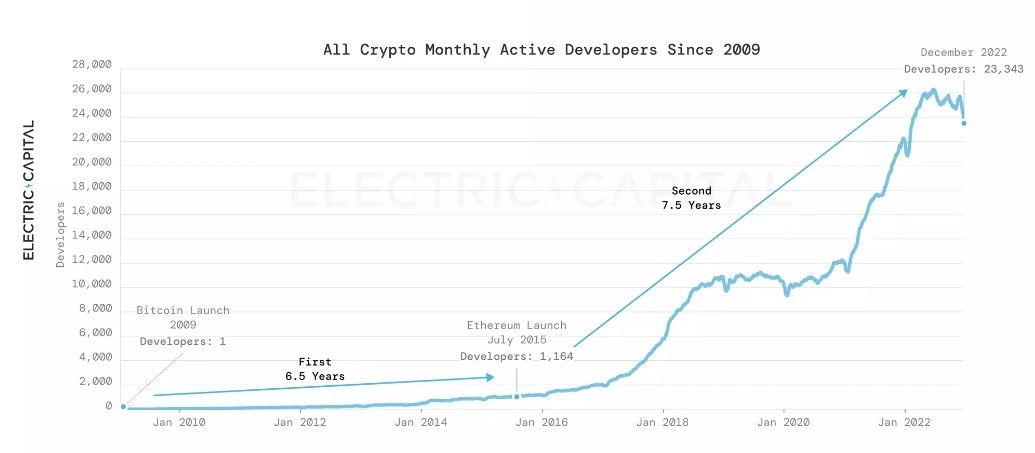
Monthly active developer count since Bitcoin was launched compared to when Ethereum and its smart contract functionalities were introduced. Source: Electric Capital.
Ethereum continues to dominate developer activity, having increased its full-time developer count by 9% to 1,873 — which is more than the next three highest ecosystems combined — Polkadot (752), Cosmos (511) and Solana (383).
Developer counts on non-Ethereum chains are catching up though. The Cosmos and Solana networks increased 34% and 36% respectively, while Starknet is among one of the mid-sized ecosystems to have made a solid run in 2022 with a 214% increase in developer count.
The report also found that following Terra’s collapse only 28 (9%) of the original Terra developers stuck around for Terra 2.0 while 143 developers (42%) called it quits and migrated to other ecosystems.
Many of the former Terra developers migrated to Cosmos, 42 of 143, the most of any other ecosystem.
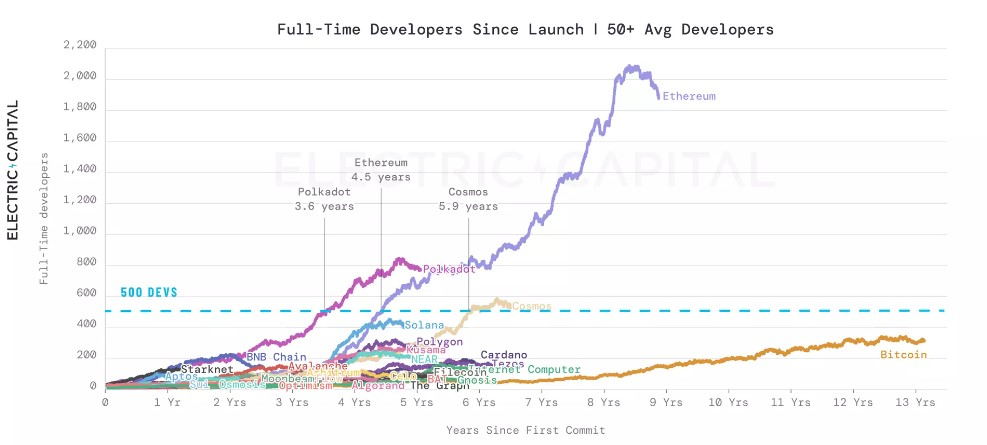
The number of full-time developers from each ecosystem since their launch date. Source: Electric Capital.
Electric Capital explained there are many more Web3 developers than accounted for in the report as some projects are close-sourced.
Author

Cointelegraph Team
Cointelegraph
We are privileged enough to work with the best and brightest in Bitcoin.



