Institutional and cross-border demand in emerging markets fuels privacy coin rally

Privacy-focused cryptocurrencies experienced a surge in popularity in Q4 2025, driven by a recent fundamental market pivot toward ZK-technologies and a substantial increase in trading activity in emerging markets. ZСash and Monero led the sector’s growth, with both assets showing increased trading volume and renewed interest among whales. In particular, ZEC recorded a monumental run from $38 in August to $734 in late November, while XMR has recorded over 113% year-to-date growth.
In parallel with their impressive market performance, new findings from the Global Privacy Asset Report 2025, released by MEXC Research, revealed a regional pattern in privacy coin trading activity. According to the report, 81% of the global privacy asset trading volume originated from MENA, CIS, and Southeast Asia in the second half of the year. Local users tended to use such cryptocurrencies for cross-border transfers and everyday transactions, due to currency instability and limited access to banking services in their countries.
The report highlighted the sector’s rapid expansion as one of the standout trends of 2025. The privacy-focused market recorded a 335% year-to-date growth, outpacing the broader crypto industry’s 20% gain. Total market capitalization exceeded $34 billion, placing privacy coins in one line with trending assets such as DeFi and meme coins.
Data from MEXC Research’s Global Privacy Asset Report indicate that the CIS region accounted for the largest share of transactions (38%), followed by MENA (29%) and Southeast Asia (14%). In contrast, Latin America accounted for a comparatively smaller share (4%). This regional distribution revealed user preference for privacy tokens in countries with slow, costly, or heavily regulated traditional financial infrastructure. In these markets, privacy coins facilitate fast, low-visibility transactions with an average transaction size of around $1,600.
The privacy coin momentum is coinciding with restrictive regulatory developments in many Western jurisdictions. New policies that enforce travel-rule financial disclosures and updated reporting standards for stablecoin transactions have shifted liquidity away from stablecoins for day-to-day transactions. The MEXC Research report revealed that one in five privacy-coin traders rotated funds from stablecoins into privacy-focused assets, contributing to a notable increase in Q3–Q4 trading activity across XMR, ZEC, and DASH.
Institutional participation is another important factor in the rise of privacy coins. Transaction volume increased by more than 210% in Q4 alone, with 11% of the total volume occurring in the MENA region. The demand is rapidly accelerating for decentralized settlement channels that offer strong liquidity without intrusive oversight amid increased global oversight of stablecoin transactions, tighter requirements for funding sources, and the growing sanctions lists for large businesses and active capital holders.
The MEXC report emphasized that several macro factors may continue to support the expansion of privacy coins heading into 2026. It cited rising de-dollarization pressures, regional currency controls, and renewed investment in privacy-focused blockchain infrastructure as possible factors that could further extend the current market momentum of privacy tokens. Technical developments across major ZK protocols and greater institutional engagement could also further support the sector’s growth as the markets adjust to evolving regulatory and economic conditions.
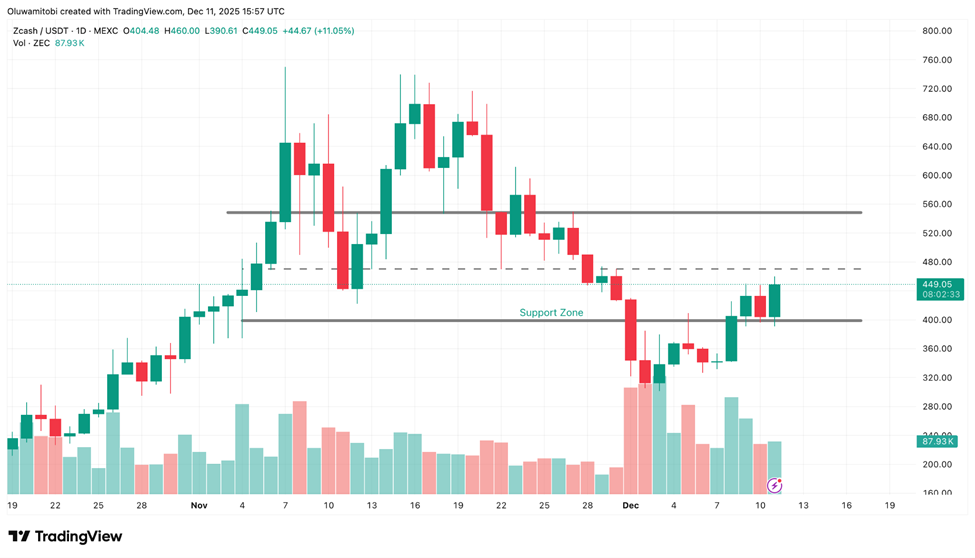
Monero, on the other hand, is aiming to reclaim $420, which could pave the way for a retest of the overhead resistance at around $440.
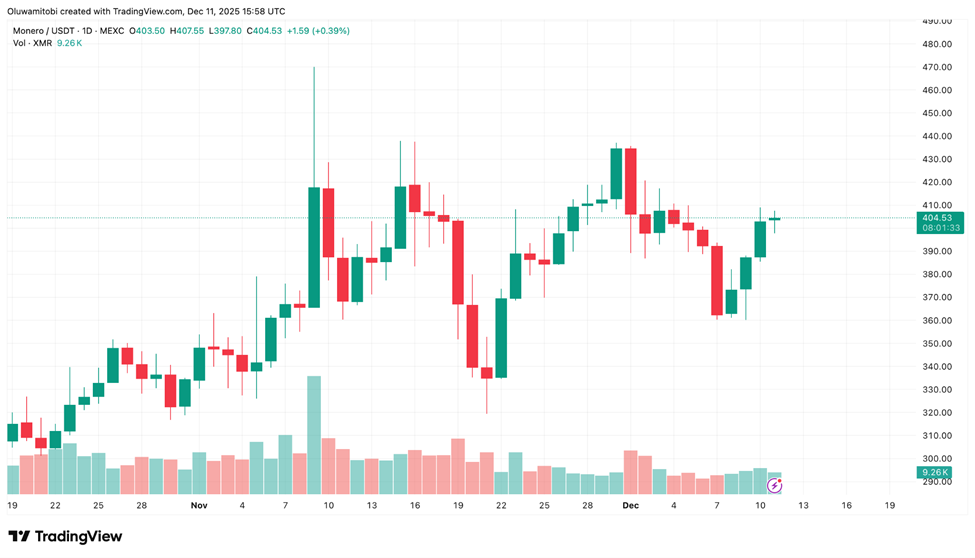
Accumulation by large holders may be a driver of higher resistance levels for ZEC. At the same time, XMR’s positioning near key breakout zones continues to attract attention from traders monitoring the privacy sector’s next directional move.
Author

Julia Magas
Independent Analyst
Julia Magas is an analyst and writer specializing in cryptocurrency and fintech market trends. Her work has been featured in leading financial publications such as Nasdaq, InvestorPlace, Cointelegraph, and Investing.