Ethereum demand and decreasing issuance driven by thriving NFT markets

Activity on Ethereum is heating up as the NFT market continues to grow. Volumes on OpenSea, the largest NFT marketplace on Ethereum, have grown by over 3,000x year over year reaching over $3.3 billion in August. This boom in the NFT market is having significant effects both on the demand and supply of Ethereum.
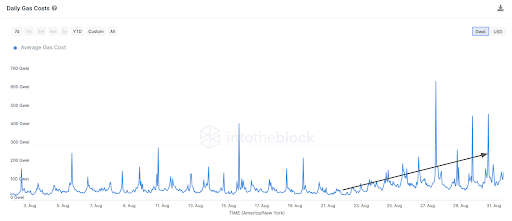
Given the limited capacity of transactions on Ethereum at the moment, the first order consequence of the NFT boom is that fees to transact on Ethereum have risen significantly.
As of August 31, 2021 via IntoTheBlock’s network insights
Gas fees on Ethereum have quickly gone from under 20 gwei 10 days ago to over 300 gwei on multiple occasions throughout the last few days. This brings the cost to make a simple Uniswap transaction to approximately $65 at an average gas fee of 100 gwei.
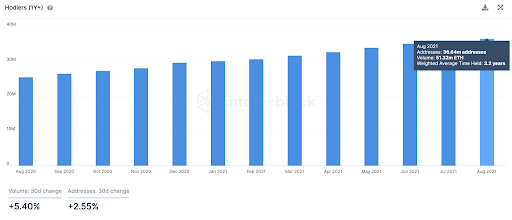
While this prices out usage of the Ethereum blockchain, ETH holders do not seem concerned. As a matter of fact, the number of hodlers, or addresses that have been holding for over 1 year, continues to reach new highs.
As of August 31, 2021 via IntoTheBlock’s Ethereum concentration insights
Over 62% of all addresses holding ETH have been invested in the asset for over a year. This points to the strong conviction in Ether long-term in spite of — or perhaps because of — the high fees to use the network.
The reason why many Ether holders might not be worried about pricing out usage short-term boils down to the recent implementation of EIP-1559 and launch of layer 2 scaling solutions. With the implementation of EIP-1559 taking place three weeks ago, part of transaction fees are now burned, effectively removing the corresponding ETH from circulation.
Therefore, the increased demand for NFTs on Ethereum has also led to a decrease in its net issuance as more ETH gets burned. This has led Ether’s annual issuance rate to fall under Bitcoin’s for the first time.
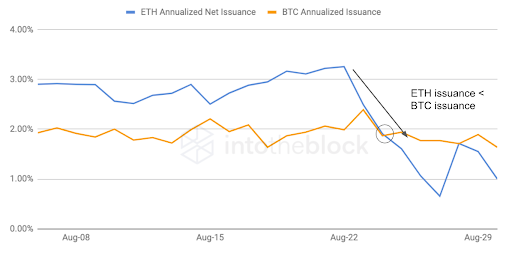
The decreasing issuance rate for Ether sheds light on the way it is valued. Previously ETH had no mechanism in place to manage inflation at a sustainable rate. Now that EIP-1559 has been implemented and the upcoming merge is expected to further reduce issuance, Ether has demonstrated it is taking steps that are working towards a provably lower and potentially deflationary supply.
Historically Ether has been valued akin to “digital oil”, moving closer in relation to fundamental metrics like transaction volume and fees than Bitcoin. Arguably, Bitcoin’s fixed supply and decreasing issuance with the halving plays a big role here, allowing it to develop a monetary premium and be valued like a store of value.
While Ether’s supply will adjust more dynamically to demand, EIP-1559 is already leading to a lower issuance rate. This has even led to 23 different hours when more ETH was burned than issued.
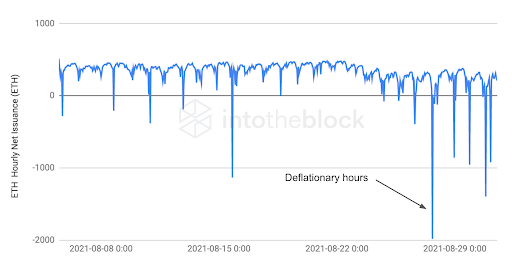
Overall, this highlights how both supply and demand-side economics on Ethereum are being positively affected by the recent boom in NFTs. Ultimately, this is leading to more long-term hodlers and is likely to fuel ETH’s price as demand increases while supply issuance drops.
Author

IntoTheBlock Team
IntoTheBlock
IntoTheBlock Team consists of a tribe of data scientists, crypto experts and AI geeks.




