Binance could face legal risks after facilitating Russians to move crypto worth $428 million via P2P platform
- Binance exchange reportedly faces additional legal risks in the US for helping Russians send money overseas.
- According to a report in the Wall Street Journal, the exchange violated US sanctions against Russia by helping its citizens move money.
- The exchange has defended itself, saying it “follows global sanctions rules and has no banking relationships anywhere for its peer-to-peer service.”
- Meanwhile, Russian President Putin says the US dollar is losing its global role in an “objective and irreversible” process.

Constrained relationships between the United States and Russia over geopolitical reasons have reportedly put the largest cryptocurrency exchange by trading volume, Binance, in a possible legal bind. Based on a report in the Wall Street Journal, the exchange helped Russians move money, thereby violating the law.
Binance reportedly in a legal bind for dealing with Russians
Binance exchange helped Russians move approximately $428 million, even monthly, by using its peer-to-peer (P2P) function. In doing so, the exchange may have violated the sanctions that the US has against Russia, intended to weaken the country’s economy with hopes of impeding Russia’s military enforcement against Ukraine.
However, Binance has denied the claims, articulating its adherence to “global sanctions rules.” More specifically, the exchange has denied having any banking associations anywhere for its P2P service. Nevertheless, the claim comes as the exchange battles US regulators, with the US Securities and Exchange Commission (SEC).
Earlier in the year, Binance and CEO Changpeng Zhao were accused of breaking financial laws in the US. According to the Commodities Futures and Trading Commission (CFTC), the exchange promoted its US business despite needing to register correctly with authorities. Further, the commission claimed Binance broke several financial laws in the US, including laws established to prevent money laundering.
Like in the current case relating to Russia, Binance had also denied the CFTC’s claims, saying, “It had made significant investments to ensure that US users were not active on the platform, including blocking users identified as American citizens or residents, or who had a US mobile number.”
If it were not for the strained relationship between the US and Russia, exchanging millions of dollars for Russians would not be an issue. The constrained ties go as high as the presidency, with Russia’s President Vladimir Putin at the forefront of BRICS in the de-dollarisation campaign.
BNB price bears the brunt
Meanwhile, Binance Coin (BNB) price continues to withstand the worst FUD around the Binance ecosystem. At the time of writing, the altcoin is exchanging hands for $208.78. Chatter speculates that a slump below the $200.00 mark could spell doom for the Binance ecosystem.
If $BNB breaches this support level, it could spell trouble for the market.
— Crypto Rover (@rovercrc) August 22, 2023
According to multiple sources, $BNB has been liquidating their $BTC holdings to maintain the $BNB price.
This is due to a substantial liquidation risk faced by #Binance if the price drops below $200. pic.twitter.com/patt8fR5DM
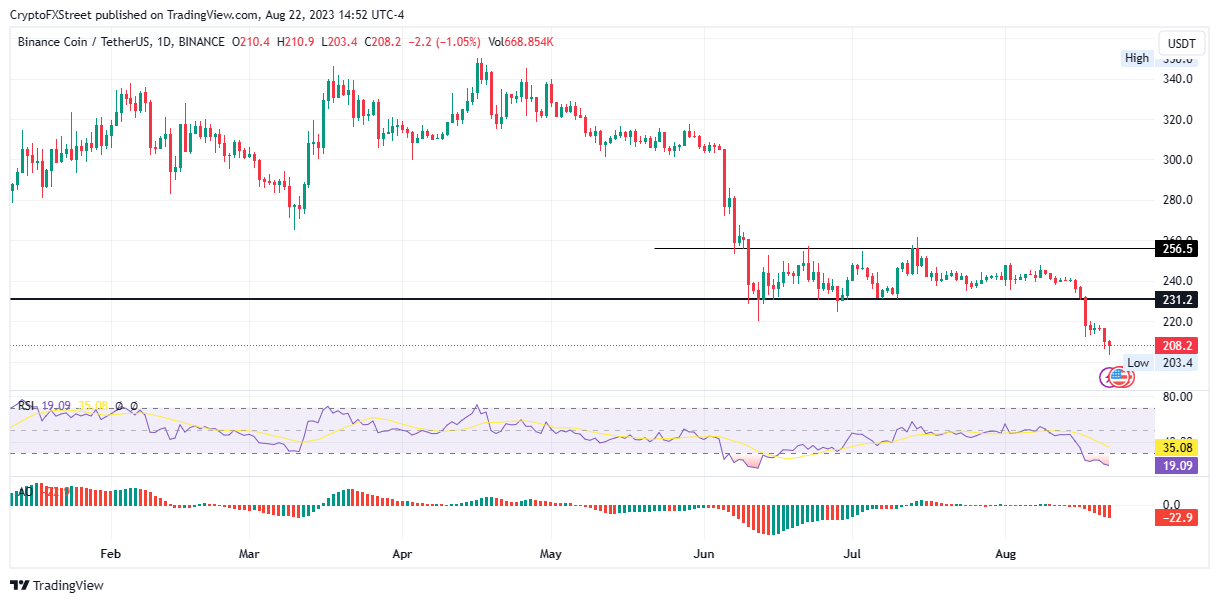
BNB/USDT 1-day chart
Also Read: Binance Coin kickstarts its 35% crash, liquidating BNB bridge hacker’s position on Venus Protocol
Cryptocurrency metrics FAQs
What is circulating supply?
The developer or creator of each cryptocurrency decides on the total number of tokens that can be minted or issued. Only a certain number of these assets can be minted by mining, staking or other mechanisms. The algorithm of the underlying blockchain technology defines this. Since its inception, a total of 19,445,656 BTCs have been mined, which is the circulating supply of Bitcoin. On the other hand, circulating supply can also be decreased via actions such as burning tokens, or mistakenly sending assets to addresses of other incompatible blockchains.
What is market capitalization?
Market capitalization is the result of multiplying the circulating supply of a certain asset by the asset’s current market value. For Bitcoin, the market capitalization at the beginning of August 2023 is above $570 billion, resulting from the more than 19 million BTC in circulation multiplied by the Bitcoin price around $29,600.
What is trading volume?
Trading volume refers to the total number of tokens for a specific asset that has been transacted or exchanged between buyers and sellers within set trading hours, for example, 24 hours. It is used to gauge market sentiment, this metric combines all volumes on centralized exchanges and decentralized exchanges. Increasing trading volume often denotes the demand for a certain asset as more people are buying and selling the cryptocurrency.
What is funding rate?
Funding rates are a concept designed to encourage traders to take positions and ensure perpetual contract prices match spot markets. It defines a mechanism by exchanges to ensure that future prices and index prices periodic payments regularly converge. When the funding rate is positive, the price of the perpetual contract is higher than the mark price. This means traders who are bullish and have opened long positions pay traders who are in short positions. On the other hand, a negative funding rate means perpetual prices are below the mark price, and hence traders with short positions pay traders who have opened long positions.
Author

Lockridge Okoth
FXStreet
Lockridge is a believer in the transformative power of crypto and the blockchain industry.