|

Cardano hidden reversal gives ADA longs early buy opportunity before $2

  • Cardano price converts into a bull market on its Point and Figure chart.
  • Price action charts lead time-based charts, giving significant leading advantages to price action traders.
  • Substantial rise towards the $2.00 value area up ahead.

Cardano price recently broke out above the bear-market angle on its $0.02/3-box reversal Point and Figure chart. That move has resulted in Cardano converting to a bull market.

Cardano price shows bulls now in control, but many participants are still waiting for confirmation

Cardano price action has shifted into a condition that can significantly advantage traders utilizing a price action chart versus a time-based chart like Japanese candlesticks. For example, on the $0.02/3-box reversal Point and Figure chart, Cardano recently converted into a bull market by breaking the prior bear market trend line (red diagonal line).

Traders who use Japanese candlestick charts exclusively are likely to enter their long trades on Cardano price too early and near the top of a swing. In Point and Figure Analysis, a pullback after converting from a bull market to a bear market (and vice versa) is often immediate. A theoretical trade setup can now occur knowing that the pullback is likely.
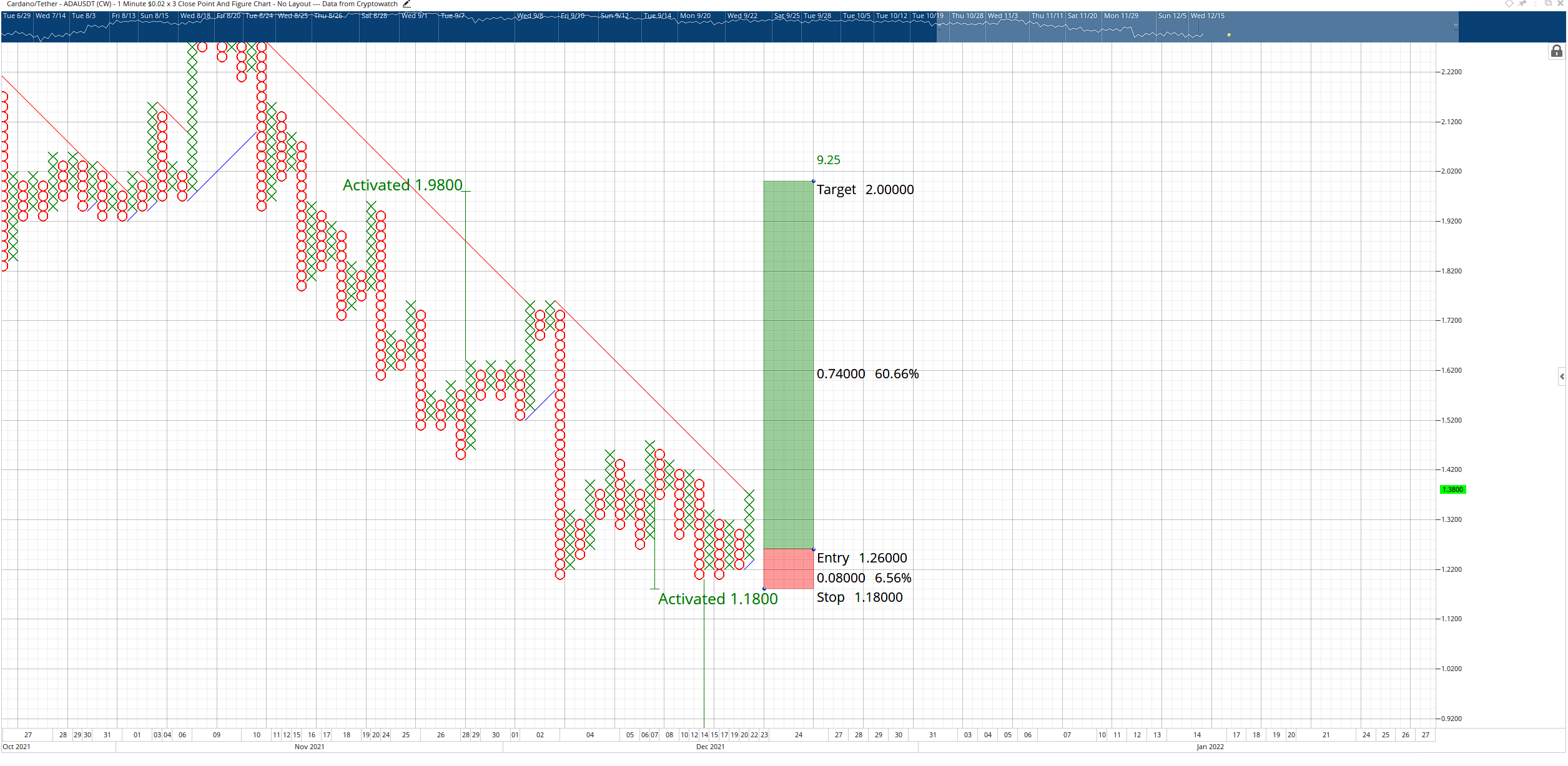
ADA/USD $0.02/3-box Reversal Point and Figure Chart

The theoretical long trade for Cardano price is a buy limit order between $1.32 and $1.26, a stop loss at $1.18, and a profit target at $2.00. This trade is between a 4.86:1 and 9.25:1 reward for the risk depending on the entry. A three-box trailing stop would help protect against any implied profit post entry.

The trade is invalidated if Cardano has a close at or below the $1.18 value area. In that scenario, the $1.00 level becomes tenuous and could fail. Cardano could reach as low as $0.40 in that scenario.

Author

Jonathan Morgan

Jonathan Morgan

Independent Analyst

Jonathan has been working as an Independent future, forex, and cryptocurrency trader and analyst for 8 years. He also has been writing for the past 5 years.


More from Jonathan Morgan
Share:

Editor's Picks

Pepe Price Forecast: PEPE signals trend reversal amid a short squeeze

Pepe price is up nearly 30% in the last 24 hours, outperforming most top cryptocurrencies and hinting at further upside potential. Derivatives data suggest a short squeeze of more than $2 million during the same period, forcing traders to buy back positions in the meme coin. The technical outlook for PEPE indicates an upside bias as bullish momentum strengthens.

Crypto Overview: Bitcoin tops $85,000 post-CLARITY Act failure – TAO and FET lead gains

Bitcoin price trades above $85,000 maintaining a constructive tone amid positive institutional inflows, Strategy’s first BTC purchase since August, and alternative regulatory expansions following the CLARITY Act's failure. AI tokens such as Bittensor (TAO) and FET have emerged as top performers over the last 24 hours.

Ripple and Stellar outlook: Momentum improves as bulls target further gains

Ripple (XRP) and Stellar (XLM) stabilize after extending their gains by nearly 9% at the start of the week. Improving momentum indicators support XRP and XLM bullish price action and hint at further rally. Meanwhile, traders should remain cautious as mixed derivatives data could limit upside as both tokens try to sustain their recent upswing.

Ethereum Price Forecast: ETH rallies above $2,700 as investors shrug off bearish sentiment

Ethereum climbed above $2,700 on Monday after investors defended the realized price level despite negative sentiment over the Clarity Act's failure and the Federal Reserve rate hike. After the Clarity Act failed to advance in the Senate, ETH dipped below $2,400 last week. But right below that price is the top altcoin's realized price, or average on-chain cost basis, at $2,310.

Bitcoin: BTC shrugs off CLARITY Act setback and hawkish Fed
Bitcoin (BTC) price action has remained resilient this week, trading above $78,000 at the time of writing on Friday, heading toward a key resistance zone. Institutional demand shows early signs of weakness, with spot Exchange Traded Funds (ETFs) on track for a second straight week of outflows, with over $420 million recorded through Thursday amid escalating Middle East tensions.