Bitcoin scalability skyrockets as Lightning Network nodes surpass 25,371
- The Lightning Network expands in capacity by over 70% in less than two months, fueling Bitcoin's scalability.
- The number of nodes on the Lightning Network is likely higher since it is estimated that 27.8% of all Lightning Network channels are unadvertised.
- Lightning Network solves the security, decentralization and scaling challenge on the Bitcoin blockchain.

The Lightning Network, Bitcoin's scaling solution, has witnessed a surge in growth in capacity. It has climbed from 1,800 to 2,300 BTC in nearly two months. The network's capacity has doubled since 2020, scaling Bitcoin's blockchain further.
Lightning Network intends to scale beyond 1 billion adopters
The Bitcoin Lightning Network's growth is explosive since the beginning of 2021. Based on data from TxStats.info, an independent project with the collaboration of Coin Metrics and BitMEX Research, the lightning network mainnet has grown in terms of Bitcoin held and a number of open channels.
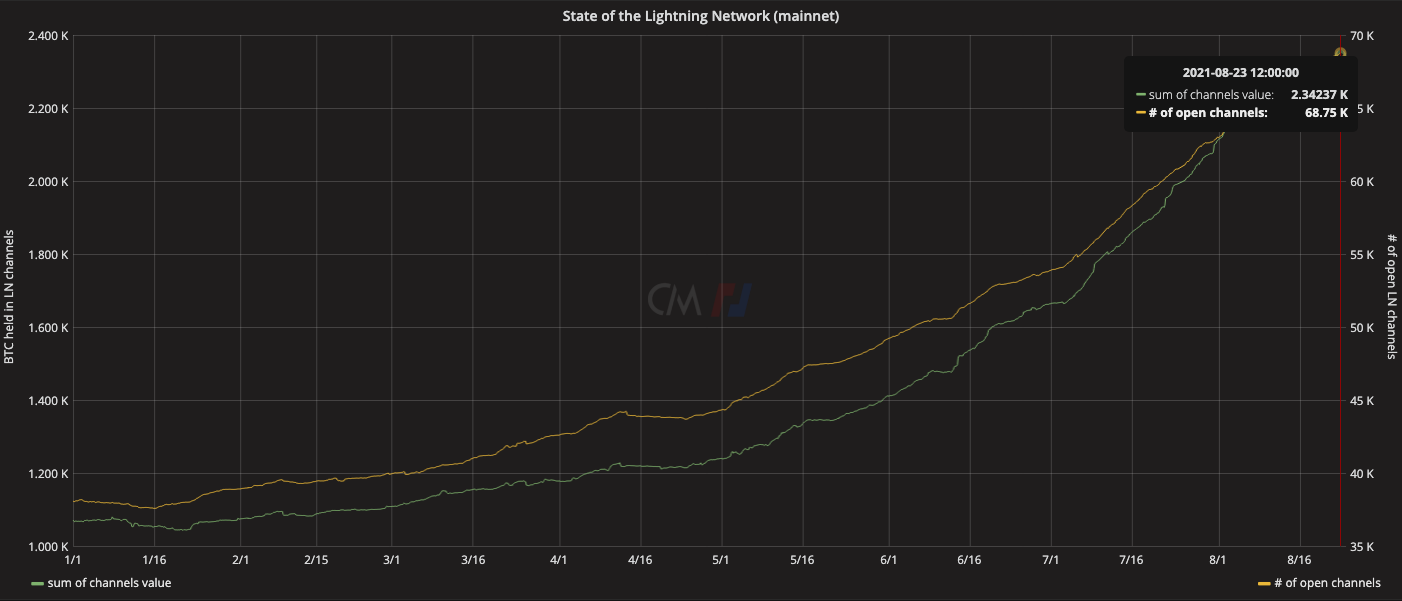
State of the Lightning Network.
Lightning Network channels allow two parties to transact on the Bitcoin blockchain through the layer-two solution. When a transaction is initiated between a sender and a receiver (two nodes in the Lightning Network), a channel is opened. The transaction is processed in a completely different manner compared to the one on Bitcoin's blockchain.
Either one of the two users can open a channel, and their funds will then be locked on the Bitcoin network and made available on the second layer or Lightning Network. Once both users have completed the transactions, they can close the channel, and that is when the transaction will be settled on the Bitcoin blockchain with the closing BTC balance of both users.
Much of the rise in the number of open channels and nodes on the Lightning Network is attributed to the last two months. In nearly 60 days, the number of open channels has hit 66,839, up 36% since June 2021 and 76% year to date.
#LightningNetwork https://t.co/Q0CaYRhLWD observed:
— Lightning Network statistics ⚡ (@LNstats) August 22, 2021
25,357 nodes (14,719 with active channels)
66,762 channels
2,322.355 BTC capacity ($114,887,296)
median node capacity: 0.002 BTC ($114.07)
past 24h:
+60 nodes +531 channels +9.018 BTC ($446,099)#Lightning #LN #bitcoin $BTC
Lightning Network nodes, or "gateways" to the network, monitor the underlying Bitcoin blockchain and interact with other nodes to fulfill transactions. Currently, the number of visible nodes on the network is 25,371.
The Lightning Network may be larger than the visible nodes like an iceberg since nodes may operate privately in "unadvertised" channels, and statistics capture only public channels. It aims to scale use cases that draw more people to the Bitcoin network through international remittances, gaming and the metaverse.
Ethereum founder Vitalik Buterin's "Scalability Trilemma" states that you cannot optimize for security, decentralization and scalability at the same time. One can only optimize for two out of three properties, so the solution to achieving the third is adding layer two.
In the case of Bitcoin, the Lightning Network acts as layer two to offer Bitcoin's base layer scalability. The BTC network solves the challenge of decentralization and security.
A Lightning Network critic on Twitter, behind the handle @brian_trollz, shared his critique on the network's properties in a recent Medium post. He states:
What is the reality of Bitcoin and Lightning right now? Most people are holding Bitcoin, and Lightning as a means of exchange is mostly about being payment rails between non-native Bitcoin payments. This is the cold, harsh reality.
Despite criticism from users like @brian_trollz, the Lightning Network promises to solve the Bitcoin blockchain's scaling issues. Twitter CEO Jack Dorsey has mentioned the possibility of incorporating Lightning Network on the social media platform in the recent past. Dorsey replied to a user's request to incorporate it with Twitter by saying:
Only a matter of time.
Author

Ekta Mourya
FXStreet
Ekta Mourya has extensive experience in fundamental and on-chain analysis, particularly focused on impact of macroeconomics and central bank policies on cryptocurrencies.