Bitcoin, Ethereum rebound ahead of Trump’s executive order allowing crypto assets in 401(k)s
- Bitcoin and Ethereum extend bullish momentum ahead of President Trump’s executive order.
- The executive order aims to allow private equity, real estate, cryptocurrency and other alternative assets in 401(k) retirement accounts.
- The inclusion of crypto in 401(k) retirement accounts would affirm its legitimacy and acceptance as an institutional asset class.

Cryptocurrency prices edge higher on Thursday following a report from a White House official that United States (US) President Donald Trump is set to sign an executive order that will pave the way for the inclusion of alternative assets, including crypto, in US 401(k) retirement accounts.
Bitcoin (BTC) reacted positively, extending its recovery from an intraday low of $114,259 to trade at around $116,381 at the time of writing. Ethereum (ETH) is following Bitcoin’s lead, breaching the $3,800 resistance, as the total crypto market capitalization recovers to $3.9 trillion.
Trump executive order could boost crypto legitimacy
President Trump is expected to sign an executive order on Thursday aimed at allowing cryptocurrency assets, private equity, real estate and other alternative assets in 401(k) retirement accounts, according to a White House official, as reported by Reuters.
However, critics have faulted the move, saying that it would create instability in retirement accounts.
The inclusion of assets such as Bitcoin, Ethereum, Ripple (XRP), Solana (SOL), among others, would boost the institutional acceptance of the crypto industry, which has seen a lot of interest build up from publicly-listed companies this year.
President Trump’s administration, since taking office in January, has worked to detangle the crypto industry from regulation by enforcement, ensuring stakeholders have room to innovate and grow within a healthy regulatory environment.
The US Congress recently passed three crypto bills, including the GENIUS Act, signed into law by President Trump in July, the CLARITY Act and the Anti-CBDC Act, which both head to the Senate for further deliberation.
One of President Trump’s campaign promises is to make the US a global crypto hub. The White House recently released a crypto report, with details on how the administration would foster innovation, development and ensure clarity in regulations.
Bitcoin renews bid for $120,000 as Ethereum eyes $4,000
Bitcoin price holds above key support levels, including the 100-period Exponential Moving Average (EMA) at $115,701, the 50-period EMA at $115,194 and the 200-period EMA at $114,768 at the time of writing on Thursday.
The short-term bullish structure has the backing of an upward-moving Relative Strength Index (RSI), which holds at 62, indicating that speculative demand is steadily rising.
A break above the descending trendline resistance would affirm the bullish grip, increasing the chances of Bitcoin price rising to test resistance at $118,000 and $120,000, respectively.
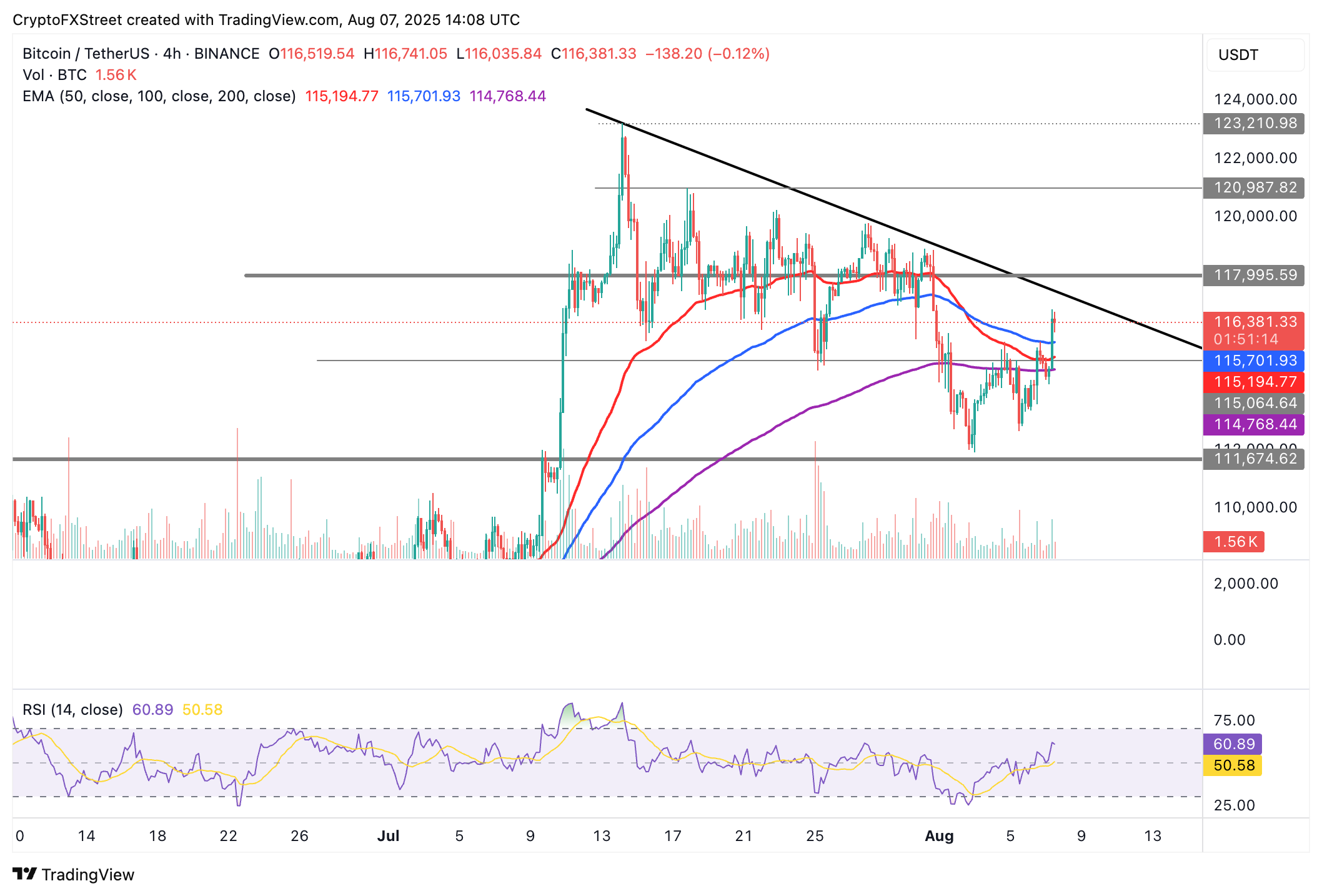
BTC/USDT 4-hour chart
As for Ethereum, bulls appear to have the upper hand, reclaiming support at $3,800. The RSI is steady at 67, suggesting that speculative demand is stable and backed by expanding spot trading volume.
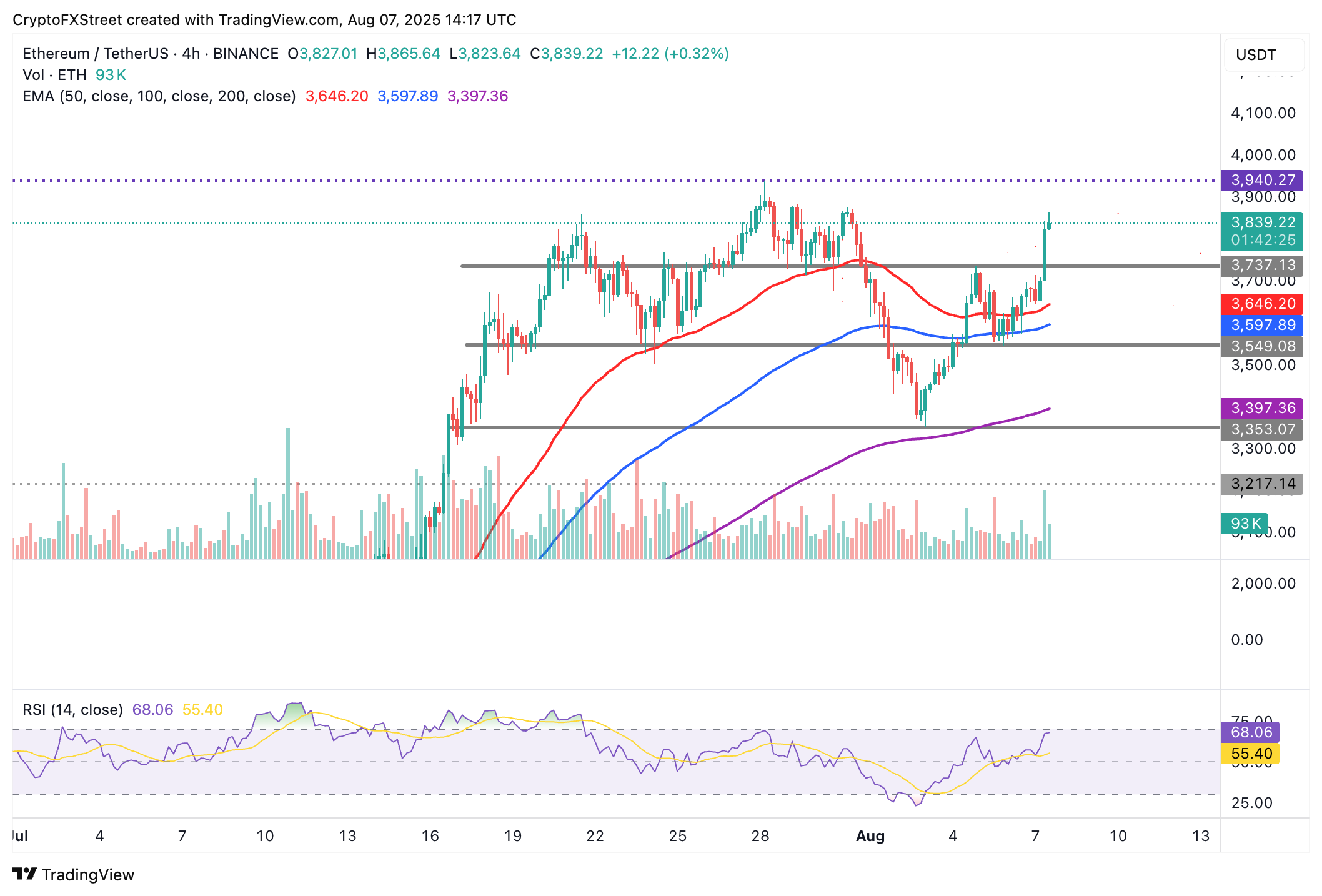
ETH/USDT 4-hour chart
Traders will look for a daily close above $3,800 to validate the uptrend’s strength while shifting their attention to the next critical milestone at $4,000. Ethereum is up 14% from its lowest point in August of around $3,500, which doubled as support last week.
Cryptocurrency prices FAQs
Token launches influence demand and adoption among market participants. Listings on crypto exchanges deepen the liquidity for an asset and add new participants to an asset’s network. This is typically bullish for a digital asset.
A hack is an event in which an attacker captures a large volume of the asset from a DeFi bridge or hot wallet of an exchange or any other crypto platform via exploits, bugs or other methods. The exploiter then transfers these tokens out of the exchange platforms to ultimately sell or swap the assets for other cryptocurrencies or stablecoins. Such events often involve an en masse panic triggering a sell-off in the affected assets.
Macroeconomic events like the US Federal Reserve’s decision on interest rates influence crypto assets mainly through the direct impact they have on the US Dollar. An increase in interest rate typically negatively influences Bitcoin and altcoin prices, and vice versa. If the US Dollar index declines, risk assets and associated leverage for trading gets cheaper, in turn driving crypto prices higher.
Halvings are typically considered bullish events as they slash the block reward in half for miners, constricting the supply of the asset. At consistent demand if the supply reduces, the asset’s price climbs.
Author

John Isige
FXStreet
John Isige is a seasoned cryptocurrency journalist and markets analyst committed to delivering high-quality, actionable insights tailored to traders, investors, and crypto enthusiasts. He enjoys deep dives into emerging Web3 tren