Bitcoin dominance stagnates after FTX bankruptcy as investors pull out of BTC
- Bitcoin dominance rate is steady at 40% in contrast to its record of sharp rises during times of stress in markets.
- On December 5, Bitcoin’s mining difficulty adjustment dropped 7.32% lower, making it the largest difficulty reduction in 2022.
- Bitcoin price yielded nearly 5% gains over the last week as traders pulled BTC off exchanges.

Bitcoin (BTC) dominance has stagnated lately as investors pull capital out of the crypto market. In previous cycles, Bitcoin’s dominance increased sharply during times of stress. However, several developments in November 2022 resulted in an exodus of investors from the market. Interestingly, the largest asset by market capitalization witnessed its highest mining difficulty reduction, 7.32%, on December 5.
Also read: Goldman Sachs to increase crypto stake at deep discount, after FTX exchange collapse
Bitcoin mining difficulty drops 7.32%: here is what it means
Bitcoin, the largest crypto asset by market capitalization and popular as a safe haven for investors during times of geopolitical crisis, witnessed a large difficulty reduction. On December 5, at block height 766,080, Bitcoin’s mining difficulty adjustment dropped 7.32%. This marks the largest mining difficulty reduction in 2022.
The current difficulty is approximately 34.24 trillion. It will remain at this point for the next two weeks or 2,016 blocks. Miners are powering off machines to survive the bear market as it eats into the profitability of mining Bitcoin.
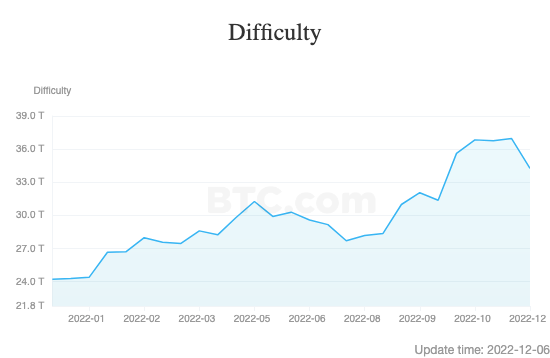
Bitcoin mining difficulty
The recent adjustment is the biggest downward shift in mining difficulty since July 2021 when several miners went offline and migrated from China to the West. Prior to its mining ban, China was the world’s largest Bitcoin mining hub.
Bitcoin’s mining difficulty self-adjusts according to the hashrate, or computing power that is online, in order to keep the time it takes to mine a BTC block roughly stable. When there are a large number of miners online, difficulty climbs and vice versa.
In the second half of 2022, Bitcoin miners have witnessed a decline in their revenue with BTC’s price collapse. Electricity prices have increased, adding to the cost of mining Bitcoin, and thus profitability has been greatly reduced.
Major producers like Core Scientific (CORZ) and Argo Blockchain (ARBK) have been hit by liquidity crunches, while Compute North filed for Chapter 11 bankruptcy. According to Luxor’s hashprice indicator, the profitability of mining has dropped by about 20% in the past month.
Bitcoin dominance stagnates at 40%, many investors quit crypto
FTX exchange’s collapse and subsequent bankruptcy induced a bloodbath in crypto in November. Samuel Bankman-Fried’s Alameda Research, a trading firm, and 190 related entities along with FTX exchange filed for Chapter 11 bankruptcy.
The exchange owes $3.1 billion to its creditors and currently remains insolvent. As the contagion spread to crypto lenders, other exchanges and crypto trading firms, many hedge funds are either on the verge of bankruptcy or already filed in November.
The FTX exchange collapse is similar to a bank run in crypto, inducing fear among market participants and driving several investors out of the cryptocurrency ecosystem entirely. During black swan events and times of geopolitical crisis, investors would turn to Bitcoin as a safe haven, and this resulted in an increase in BTC dominance.
However, this cycle the trend has changed, and Bitcoin dominance remained stagnant at 40%. In the past month, nearly $1.8 billion worth of Bitcoin left exchanges. Investors are turning to self-custody and pulling BTC off exchanges, while several others have turned their holdings to cash and exited their positions while incurring heavy losses.
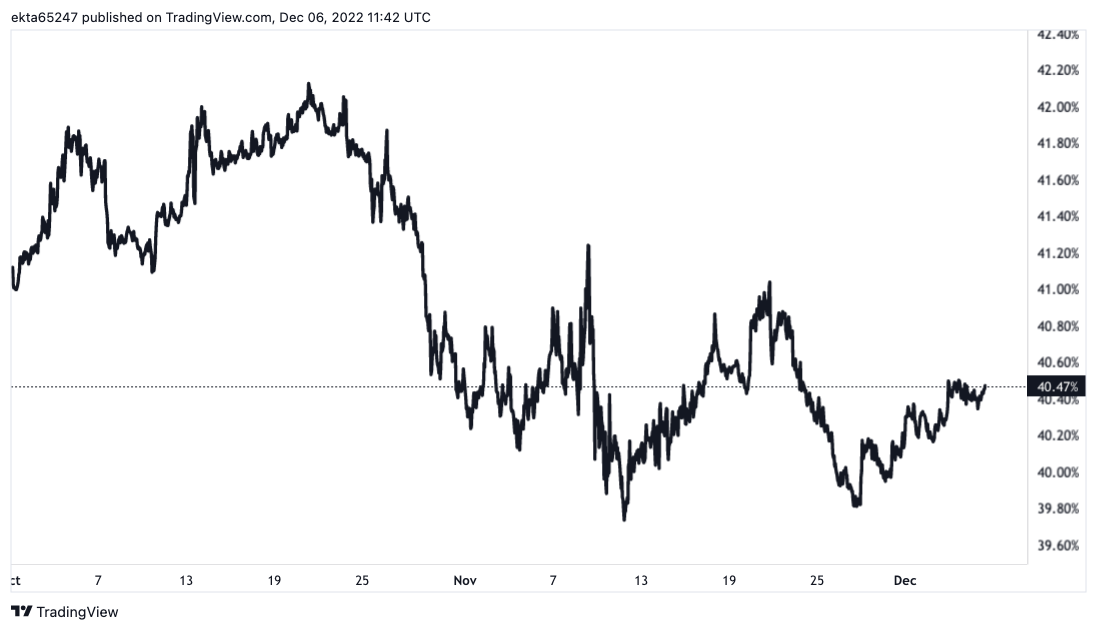
Bitcoin dominance
Wes Hansen, director of trading and operations at crypto fund Arca, told Coindesk,
BTC has not outperformed the downside in recent months, so investors no longer view it as a safe haven. More broadly, the events of November 2022 have shaken the confidence of a lot of investors in this space. In prior cycles, investors would move into BTC to protect the downside when the market fell off. But because of the size of this year's scandals and their far-reaching impacts, a lot of investors aren't moving to BTC because they're just leaving the space entirely.
Bitcoin price prepares for upcoming reversal
Bitcoin price yielded 20.3% losses for holders over the past month. An evaluation of the BTC price chart indicates that the asset cannot stay oversold for long. A reversal in Bitcoin price trend is around the corner.
As seen in the Bitcoin price chart below, there have been trend reversals in 2016 and 2019. A similar pattern has emerged in the last few months of 2022.
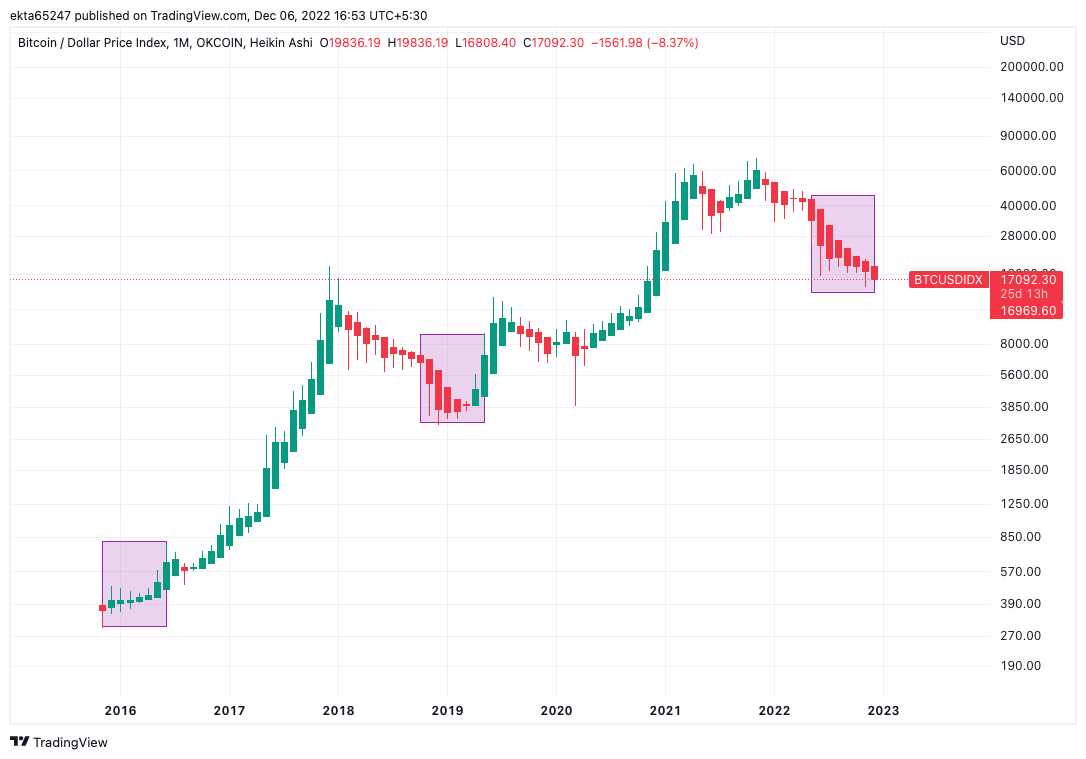
BTC/USD price index
Gert van Lagen, a crypto analyst, is bullish on Bitcoin. The expert believes a breakout past $18,100 would validate the Wyckoff accumulation thesis. Wyckoff’s theory outlines key elements in price trend development that are marked by periods of accumulation and distribution. The technical analyst predicts an extended rally in Bitcoin.
$BTC [4h] update on #Wcykoff accumulation.
— Gert van Lagen (@GertvanLagen) December 5, 2022
Currently printing a higher low at the lower resistance line (AR), i.e. resistance being flipped to support.
Ultimate validation of scheme: break above 18.1k
Invalidation: break below support. https://t.co/raSRluCG1q pic.twitter.com/SLa4tGhDi7
Author

Ekta Mourya
FXStreet
Ekta Mourya has extensive experience in fundamental and on-chain analysis, particularly focused on impact of macroeconomics and central bank policies on cryptocurrencies.