Analysts grow concerned as $2 billion in Ethereum flood exchanges
- As Ethereum gas fees surge, it is getting expensive to transact on the Ethereum blockchain.
- Lower value non-fungible tokens may be hit hard with rising Ethereum gas fees that could eliminate the bottom of the NFT market.
- $2 billion worth of Ethereum deposited to exchange wallets may belong to whales looking to take profits.

Ethereum's climb toward its May all-time high of $4,356.99 is interrupted by the ongoing consolidation. Nearly 600,000 Ether was deposited to Binance, triggering concerns of a sell-off.
Ethereum on-chain activity declines in response to rise in gas fees
The popularity of CryptoPunks, a collection of 10,000 faces of humans, aliens, apes and zombies, developed by American studio Larva Labs, set the foundation for the iconic NFT craze of 2021. Recently, payments giant Visa bought a CryptoPunk for $150,000, and the demand for the NFT collection skyrocketed.
NFTs have claimed an increasing share of Ethereum's network activity. Despite the London hard fork, the Ethereum blockchain is not entirely equipped to solve the challenge of scalability, and congestion on the network is driving transaction fees (or gas price) higher.
A cryptocurrency trader and analyst behind the Twitter handle @MoonOverlord commented on the rising gas prices and its impact on the non-fungible token ecosystem.
$ETH gas is rising, if it continues and gets too high it’ll eliminate the bottom of the NFT market because it isn’t feasible to trade. It’ll force people other to chains and platforms like Topshot, Axie, Sorare etc
— BIG DOG (@MoonOverlord) August 24, 2021
It is worth noting that traders may find it infeasible to pay high gas fees, NFT marketplace fees, and the cost of the NFT in every single purchase. This is likely to discourage NFTs from building on the Ethereum blockchain; at the same time, it may drastically reduce the demand for digital art and collectibles price in the mid to low range.
Pseudonymous NFT and DeFi investor and project advisor @iamDCinvestor is of the opinion that the most valuable digital art and collectible sets may continue trading at the same price, and the surge in gas fees will impact the lower value NFTs the hardest.
i have a theory on this: there is actually extremely low sensitivity at the highest end of the market, so the most valuable sets may continue to trade and even gain steam
— DCinvΞstor (@iamDCinvestor) August 24, 2021
but lower value NFTs will get hit hard, and that's where we see how chained together this all is
The challenge of rising transaction costs on the Ethereum network may be resolved if Ether's price was relatively lower compared to its rival blockchains.
Analysts have observed a spike in Ethereum inflow to exchanges worth nearly $2 billion. On close examination, the on-chain data revealed that wallet addresses depositing the Ether to wallets of exchanges like Binance might belong to whales looking to book profits.
An increase in inflow implies an increase in Ethereum available for sale in wallets on the exchange; this drives the selling pressure on the altcoin higher.
A spike in exchange inflow on exchanges is historically associated with a drop in the asset's price.
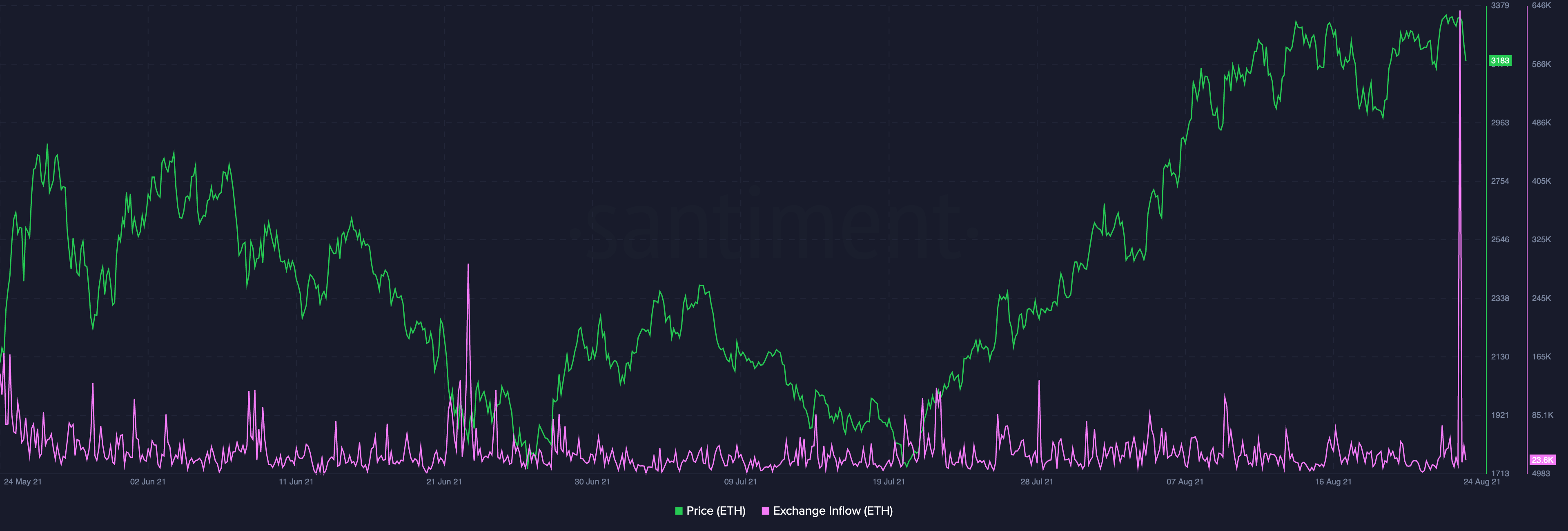
Exchange inflow (ETH).
At the same time, there is a drop in the active addresses on the Ethereum network. Analysts attribute this to the rise in fees since it is becoming expensive to transact on the Ethereum blockchain.
Overall, the increasing selling pressure on exchanges and declining address activity indicate traders taking profits at the current price level. Analysts at FXStreet have predicted that a crash below the support of $3,000 could be catastrophic for the altcoin's price.
Author

Ekta Mourya
FXStreet
Ekta Mourya has extensive experience in fundamental and on-chain analysis, particularly focused on impact of macroeconomics and central bank policies on cryptocurrencies.