You Need Flexible, Systematic Investment Systems in This Ultra-Volatile Period


Most financial advisors have a simple religion: Invest for the long term, diversify, buy and hold, and don’t try to time the markets… The truth is, that works most of the time. It would have worked very well from 1942 to 1968, and again from 1982 to early 2000. Those were the best of the two demographic bubble booms since the Great Depression.
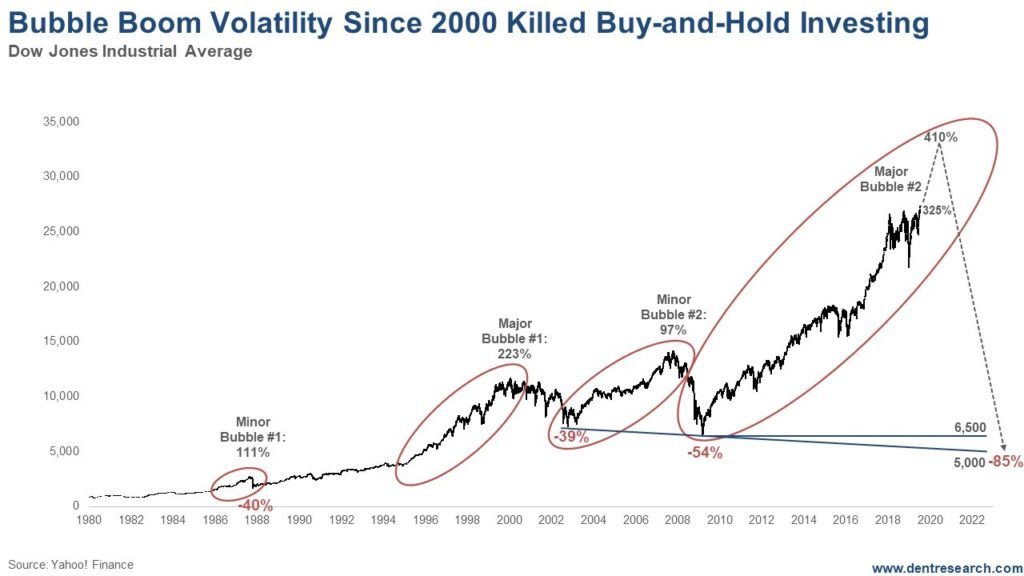
But in this last and “greatest bull market in history,” which I first called in 1988, something changed. Stocks keep going to new highs, for now… but with dollops of extreme volatility on the upside and downside. Just look at this…
The Fall Bubble Boom
Late 1982 started the Fall Bubble Boom Season in my model. The first mini-bubble from 1984 into 1987 crashed 40%, but so briefly that most couldn’t even react. Then we saw the first great tech-stock-driven bubble, culminating with the extreme internet bubble into early 2000.
From late 1982 into early 2000, buy-and-hold investing and the traditional rules would have worked just fine – with the Baby Boom Generational Spending Wave and the Information Revolution as the wind driving your sails.
Then the Dow crashed 39% in the 2000-2002 crash. The bubble-leading Nasdaq lost 93%!
Still, demographic trends continued into late 2007, as I predicted, inflating a mini-bubble. Then the Dow endured a 54% crash. Everyone asked: Is the great bull market over?
History proved it wasn’t. It also proved that 2000 was the start of a new bubble phase where we’d see higher highs and lower lows as breath taking and stomach churning as any good roller coaster worth the wait in line!
At That Point, Buy-And-Hold Investing Died.
This is why fewer everyday investors are participating in this unprecedented bull market. They’ve been scared out of the market by major crashes, which would never have happened during demographic booms like the one from 1942 into 1968. But bubble booms are an entirely different beast. One that average investors are ill equipped to tame.
So they miss much or all of the ever-increasing upside… driven away by fear of the increasingly terrifying downsides and a lack of understanding of the incredible investment strategies at their fingertips.
But that trend will come to an end as well, and very, very likely in the next crash and rebound. After that, NO more higher highs for a long time. And when that happens, investors will need to find a new investment strategy again. We’ll deal with that in 2022 forward.
For now, understand that, despite slowing demographic trends and rising debt levels, we have the greatest bubble in modern history. This is occurring in the Economic Winter Season similar to 1930-1942.
I’m projecting the Dow could go as high as 33,000 before peaking. And then what? The biggest crash yet… as much as 85% in the Dow and 89%-plus in the Nasdaq, similar to the unprecedented 1929-1932 crash.
All of this is to say that this environment is not one that everyday investors can handle alone, nor should they.
You Don’t Have To Do This Alone
That’s why I have brought together a number of disciplined, systematic investments systems, from higher to lower risk for this era. Each member of my team has developed unique systems that work in up and down markets.
The two best examples are Adam O’Dell’s Cycle 9 Alert, which is a higher-risk/higher-return strategy, and Rodney Johnson’s Fortune Hunter, which is more on the medium risk side. And now Adam’s turning his system towards the pot industry, where his backtesting has yielded almost too-good-to-believe results. You can believe them though because Adam is not one to promise the undeliverable.
What sets Adam apart from any other investment researcher I’ve ever met is his trading methodology, which is infused with the discipline of a monk and the emotional detachment of Spock.
Rodney’s system is equally unique, seeking out companies others are not… companies in their own predictable level of early emergence that go largely unnoticed.
Even with the extensive economic knowledge I have, and the leaked data I found, there is no way I could even approach doing what these two carefully-developed systems do.
And a diversified portfolio of several systems, like Adam’s and Rodney’s, is your best bet to profit during this unprecedented bubble boom and bust era, where being the lone wolf in the wilderness will ensure only one thing: a brutal goring by the bulls and bears.
Author
Harry S. Dent, MBA
Dent Research
Harry S. Dent Jr. studied economics in college in the ’70s, but found it vague and inconclusive. He became so disillusioned by the state of his chosen profession that he turned his back on it.