|

XAU/USD – Gold price trend before Nonfarm Payrolls

XAU/USD – Gold price trend before Nonfarm Payrolls

XAU/USD, H4
fxsoriginal

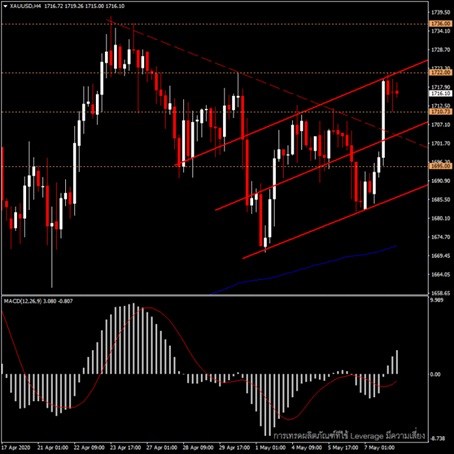
Lately, gold price has responded with lower economic numbers, because the recent economic numbers reflect the impact of the outbreak of Covid-19, and gold prices have already responded to the role of safe haven. However, last night, gold prices returned to meet with economic numbers again. The expected number of US unemployed last week was 3 million, resulting in gold prices moving up slightly before the announcement. When the number announced was 3.169 million, higher than expected, gold prices moved up to test the resistance zone at 1722.

The number of unemployment claims came out higher than expected, resulting in yesterday’s USDIndex closing below 100.00.

As for the technical perspective, in the H4 time frame from the rise of gold prices last night Until it can break through the trend line upwards (dotted line) upwards, resulting in the price frame being seen again. The first resistance is at 1722, which should be strong enough to cap the price in the Asian and European sessions but may not to be strong enough for the US market. The non-farm payroll numbers will be announced later with a forecast of up to -22 million. If the price goes up, there is a chance to see a test of the high zone at 1736, in line with the rising MACD trend which has been in positive territory since yesterday.

But if the result is the opposite, today’s first support will be at 1710, which, if breached, there is a chance to see the price move down to the lower boundary of the 1695 channel.


Share:

Editor's Picks

AUD/USD consolidates above 0.7000/two-month low; bearish potential intact

The AUD/USD pair oscillates in a narrow range during the Asian session, and moves little following the release of mixed inflation figures from China. Spot prices currently trade around the 0.7025 region, nearly unchanged for the day, and remain within striking distance of a nearly two-month low set on Tuesday. Renewed hostilities between the US and Iran temper hopes for a deal to end the over three-month-old war.

Japanese Yen languishes despite wholesale inflation accelerates in May

USD/JPY flatlines after experiencing volatility, trading around 160.40 during the Asian hours on Wednesday. The pair continues to hold its ground, reflecting a struggling Japanese Yen that has failed to find support despite a massive acceleration in wholesale inflation. Driven by surging energy costs linked to the ongoing Middle East conflict, Japan’s Producer Price Index jumped 6.3% year-over-year in May. This hot printing comfortably outpaced April’s upwardly revised 5.3% figure and surpassed market consensus of 5.5%, marking the fastest pace of wholesale price growth in three years.

Gold plummets below $4,200 amid US‑Iran tensions ahead of US CPI

Gold extends the recent breakdown momentum below a technically significant 200-day Simple Moving Average (SMA) and drops to a fresh low since March 23, further below the $4,200 mark during the Asian session. Crude Oil prices rise amid renewed hostilities between the US and Iran, fueling inflation fears and bolstering bets for more hawkish central banks.

Bitcoin remains vulnerable, Ethereum weakens further, XRP signals more downside

Bitcoin, Ethereum, and Ripple remain under pressure mid-week, as the broader cryptocurrency market struggles to regain recovery momentum after last week’s massive correction. BTC struggles below $62,000, ETH continues to weaken below $1,650, while XRP’s momentum indicators remain biased toward further downside.

US CPI data set to show inflation at three-year high in May, backing Fed hawkish tilt

The US Bureau of Labor Statistics will publish the May Consumer Price Index (CPI) data on Wednesday. The report is expected to show another step up in consumer inflation, driven by the persistently high Oil prices due to the ongoing crisis in the Middle East.

The US economy defies the rules: 100 days into the Oil shock and the recession signal is still missing

More than three months after the start of the Iran war and the resulting disruption to global energy markets, the US economy continues to display remarkable resilience. The conflict has triggered a sharp rise in Oil prices, reignited inflationary pressures and fueled widespread concerns about a potential economic slowdown.