|

WTI outlook: Crude Oil is on track for the biggest weekly gain in four years

WTI

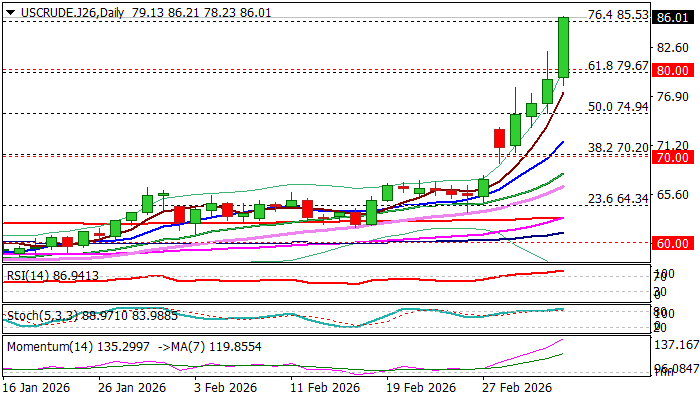
WTI Oil price jumped above $86 per barrel on Friday, extending steep ascend into fifth straight day, on track for the biggest and steepest weekly gain since early 2022, when the war in Ukraine started.

Growing fears of stronger supply disruption due to closure of Hormuz strait and signals that war may extend until September, or more worrying latest comment from President Trump that there are no time limits for the duration of the war, are expected to continue to inflate oil prices.

On the other hand, Russian oil supply remains stable (US lifted some sanction for buying Russian oil) that may partially offset negative impact.

The latest market action and deteriorating conditions suggest that oil price can hit $100 per barrel, which is still away from spikes in 2022 ($130) and 2008 ($147).

Friday’s strong acceleration surged through round-figure $80 barrier and broke technical resistance at $85.53 (Fibo 76.4% of $95.00/$54.87, 2023/2025 downtrend), violation of which to open way towards Apr 2024 double-top ($87.61) and unmask $90 barrier.

Although the price action remains well supported by favorable fundamentals (key driver), we should expect some price adjustments as daily and weekly studies are strongly overbought and some traders are likely to collect profit profits at the end of the week.

However, dips are likely to be limited to keep larger bulls intact and provide better levels to re-enter strong bullish market.

Broken barriers at $80 (round-figure) and nearby $79.67 (Fibo 61.8% of $95.00/$54.87) reverted to supports which should ideally contain dips.

Res: 86.67; 87.61; 89.38; 90.00.
Sup: 84.90; 83.50; 81.80; 80.00.
Oil

Author

Slobodan Drvenica

Slobodan Drvenica

Windsor Brokers

Industry veteran with over 22 years’ experience, Slobodan Drvenica joined Windsor Brokers in 1995 when he was an active trader for more than 10 years, managing the trading desk and own account departments.


More from Slobodan Drvenica
Share:

Editor's Picks

AUD/USD stays bid above 0.7100 on Australian trade data, Mideast optimism

AUD/USD clings to minor recovery gains above 0.7100 in the Asian session on Thursday as a new Israel-Lebanon ceasefire keeps a lid on the safe-haven US Dollar. Meanwhile, strong AustralianTrade Balane data also help the Aussie pair sustain the bounce from weekly lows.

USD/JPY hovers near the 160.00 intervention threshold on Mideast tensions

USD/JPY struggles to find acceptance above 160.00 and retreats from a one-month high in the Asian session on Thursday amid fears that authorities will step in again to prop up the Japanese Yen. Furthermore, a new Israel-Lebanon ceasefire caps the US Dollar and supports the currency pair. However, renewed US-Iran tensions keep the downside limited in the Greenback and the pair.

Gold defends 200-day SMA; upside seems capped on Iran uncertainty

Gold recovers from a one-week low near $4,425, or the 200-day SMA, in the Asian session on Thursday, as news of an Israel-Lebanon ceasefire acts as a headwind for the safe-haven US Dollar. However, renewed hostilities in the Gulf, along with stalled US-Iran peace talks, keep geopolitical risks in play and should support the USD, checking the Gold price rebound.


Bitcoin drops below $65K amid reinforced bear market signals

Bitcoin dipped further below $65,000 on Wednesday, with onchain data from Glassnode signaling a market firmly in a bear phase. The decline has pushed prices back into a key valuation range between the Realized Price and the True Market Mean. Glassnode noted that a key shift in market structure has also emerged.

Kevin Warsh takes the Fed helm: What it means for the US Dollar
The Federal Reserve moves away from the highly predictable "forward guidance" model of the Jerome Powell era to a new “Kevin Warsh environment”, characterized by less communication, more policy surprises, and an increased focus on the Fed's complex balance sheet.
Recession on paper: What really moves the Canadian Loonie now?

Statistics Canada handed the headline writers a gift and the analysts a headache. Real GDP shrank 0.1% on an annualized basis in the first quarter, and with the fourth quarter of 2025 revised down to a 1.0% contraction, that is two negative quarters in a row, the textbook definition of a technical recession and Canada's first since the pandemic.