CLARITY Act approval odds sink fast ahead of Congressional hearing
- The US House Subcommittee on Digital Assets will hold a CLARITY Act hearing in New York on Friday ahead of the August recess.
- President Trump has urged lawmakers to pass the bill, which is expected to accelerate the US goal of becoming a global crypto hub.
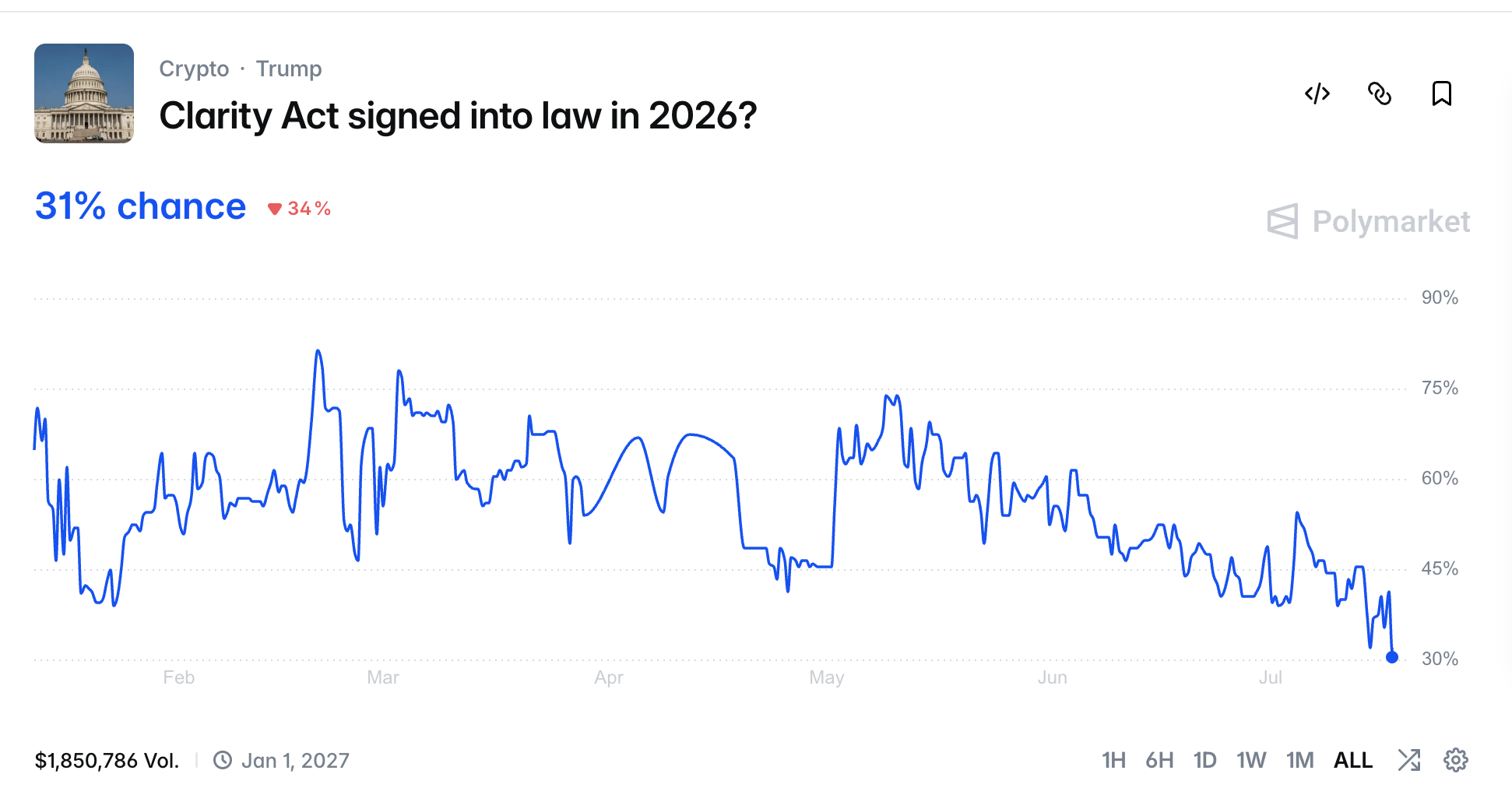
- Odds of the bill becoming law in 2026 have collapsed from 74% in May to 31% amid ethical concerns, pushback from Democrats and law enforcement.

The United States (US) House Financial Services Committee’s Subcommittee on Digital Assets, Financial Technology, and Artificial Intelligence (AI) is holding a hearing titled “Building the Future of Finance: How the CLARITY Act Unlocks Innovation” on Friday.
While the field hearing cannot directly approve the CLARITY Act, it will serve as a strategic platform to solicit expert insights and strengthen legislative momentum ahead of Congress’s August recess.
The hearing in New York will convene key figures from both the crypto and traditional financial sectors, fostering dialogue and insight.
Confirmed witnesses include Ryan Louvar, Chief Legal Officer at WisdomTree; Sarah Aberg, Chief Legal Officer at Nova Labs Inc.; Jason Somensatto, Director of Policy at Coin Center; and Randi Abernethy, Head of Clearing and Group Risk at Bullish.
Trump calls for lawmakers to pass the CLARITY Act
On Monday, US President Donald Trump urged the Senate to advance the CLARITY Act, the landmark cryptocurrency legislation, as a tribute to the late Senator Lindsey Graham, who passed away at age 71 last weekend.
Trump stated that the US must move with speed because “China, and many other countries, would like to take complete and total control of this major financial 'happening,' as well as AI.”
The CLARITY Act holds as one of the earliest comprehensive efforts to establish a regulatory framework for cryptocurrencies, with broad support from both the crypto industry and the White House.
Despite the Guiding and Establishing National Innovation for US Stablecoins Act (GENIUS Act) becoming law in July 2025 and addressing the broader payment stablecoin sector, the Clarity Act takes into account the larger US crypto market regulation. The market structure bill goes beyond stablecoins to establish how exchanges, brokers, custodians, issuers and institutional stakeholders operate.
If passed, the CLARITY Act will serve as a bridge to help crypto become a mature industry, supporting the implementation of the GENIUS Act while addressing oversight overlap between the Securities and Exchange Commission (SEC) and the Commodity Futures Trading Commission (CFTC).
The elephant in the room is no longer whether the US will regulate digital assets; it is whether Congress, not the regulators, will determine which institution provides oversight.
Why is the approval window closing
The bill has remained on the Senate Legislative Calendar since June 1, not due to ineligibility for a floor vote, but rather the lack of scheduled voting. A Forbes report indicates that the Senate has prioritized the National Defense Authorization Act, pushing the CLARITY vote toward the weeks of July 23 and July 27. These are the only two windows that fall under active discussion ahead of the August recess.
Meanwhile, the House will remain in session until July 23. When Congress returns from recess in September, lawmakers will have just three weeks of session before shifting their focus entirely to midterm campaigning.
Approval odds on Polymarket have plunged to a record low of 31% on Friday, down from 74% on May 10 and 82% on February 20. This shows that market participants are pricing in reduced odds of the CLARITY Act becoming law in 2026.
Pushback intensifies amid ethical concerns
The CLARITY Act has attracted criticism from Democratic lawmakers, including Senator Elizabeth Warren, who is pushing for the text to include guardrails preventing senior government officials and members of Congress from profiting off the crypto market. Warren’s letter to Senate Majority Leader Chuck Schumer on Monday mentioned President Trump’s 2025 financial disclosure, which showed roughly $1.2 billion in crypto-related income.
“Trump's reported $1.2 billion in crypto income changes the political dynamics. It gives Democrats a concrete basis for their amendments, so strict trading bans and mandatory disclosures for federal officials are no longer a fringe demand, they’re the likely price of passing any bill at all,” Yuliya Barabash, the Founder and Managing Partner of SBSB FinTech Lawyers, said.
Law enforcement, including the National District Attorneys Association, have also directed their concerns to the Senate leadership, citing that some sections of the bill would materially hinder criminal investigations involving digital assets.
For instance, Section 604 of the bill, referred to as the Blockchain Regulatory Certainty Act, exempts non-custodial software developers from related money-transmitter obligations.
“The future framework is unlikely to be a complete ban on officials owning crypto assets. Instead, it will likely focus on stronger transparency, stricter reporting standards, and mechanisms such as blind trusts to reduce conflicts of interest,” Dean Chen, analyst at Bitunix exchange, explains.
What the CLARITY Act means for crypto compliance teams
The implementation of the European Union’s Markets in Crypto-Assets Regulation (MiCA) marked a major step toward a unified regulatory framework for the entire block. However, crypto service providers have been racing against time to obtain approval to operate beyond the set transition deadlines, with some like Binance at risk of being denied access to the EU market.
Meanwhile, compliance teams for companies operating in the US must also prepare for oversight under the CLARITY Act to avoid legal challenges after the approval.
Chen adds that “the biggest challenge is not simply adding more regulations. It is building a framework that allows financial innovation while maintaining institutional risk controls.”
The passage of the CLARITY Act represents a key milestone toward Trump’s goal of making the US a global crypto and AI hub and preventing other jurisdictions, including China, from taking the lead. However, despite the GENIUS Act reaching its first rulemaking deadline on Saturday, bottlenecks still remain toward its implementation. The CLARIY Act is the key that could unlock America’s crypto potential.
Cryptocurrency prices FAQs
Token launches influence demand and adoption among market participants. Listings on crypto exchanges deepen the liquidity for an asset and add new participants to an asset’s network. This is typically bullish for a digital asset.
A hack is an event in which an attacker captures a large volume of the asset from a DeFi bridge or hot wallet of an exchange or any other crypto platform via exploits, bugs or other methods. The exploiter then transfers these tokens out of the exchange platforms to ultimately sell or swap the assets for other cryptocurrencies or stablecoins. Such events often involve an en masse panic triggering a sell-off in the affected assets.
Macroeconomic events like the US Federal Reserve’s decision on interest rates influence crypto assets mainly through the direct impact they have on the US Dollar. An increase in interest rate typically negatively influences Bitcoin and altcoin prices, and vice versa. If the US Dollar index declines, risk assets and associated leverage for trading gets cheaper, in turn driving crypto prices higher.
Halvings are typically considered bullish events as they slash the block reward in half for miners, constricting the supply of the asset. At consistent demand if the supply reduces, the asset’s price climbs.
Author

John Isige
FXStreet
John Isige is a seasoned cryptocurrency journalist and markets analyst committed to delivering high-quality, actionable insights tailored to traders, investors, and crypto enthusiasts. He enjoys deep dives into emerging Web3 tren