|

WTI Oil Outlook: crude oil falls further after gap-lower opening as virus concerns weigh heavily

US CRUDE OIL

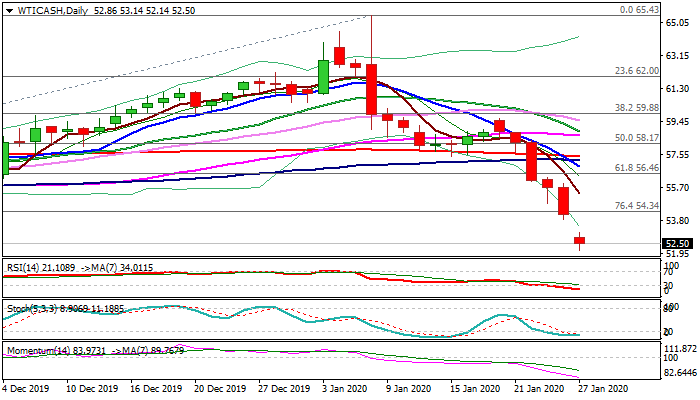
WTI oil price started the week with 130-pips gap lower and extended to the levels last traded in early Oct, pressured by concerns that virus spread could have strong negative effect on oil demand. The price holding firmly in red for the sixth straight day, with massive weekly bearish candle of last week (WTI contract was down nearly 9% for the week) weighing heavily. Bearish daily/weekly studies add to negative signals as bears eye key med-term supports at ($50.91/49 weekly higher base. Strongly oversold conditions warn, however, daily indicators continue to head south and lack any firmer signal of correction. Bearish bias is expected to remain fully in play as long as today's gap stays unfilled.

Res: 53.14; 54.34; 55.00; 55.94
Sup: 52.14; 51.40; 50.91; 50.49
WTI

Author

Slobodan Drvenica

Slobodan Drvenica

Windsor Brokers

Industry veteran with over 22 years’ experience, Slobodan Drvenica joined Windsor Brokers in 1995 when he was an active trader for more than 10 years, managing the trading desk and own account departments.


More from Slobodan Drvenica
Share:

Editor's Picks

AUD/USD pulls back from monthly high but holds above 0.7000

AUD/USD retreats from the monthly high set earlier this Thursday, sliding back to 0.7000 during the Asian session as a further escalation of tensions in the Middle East undermines the risk-sensitive Aussie. However, recent hawkish comments from RBA officials could support the Australian Dollar. Furthermore, the prevailing US Dollar selling bias, despite Fed hike bets and geopolitical uncertainties, could limit losses for the pair.

USD/JPY declines to a one-week low; eyes trading range support near 157.50 on weaker USD

USD/JPY drops to a one-week low during Thursday’s Asian session, with bears now awaiting a break below multi-week range support near mid-157.00s before placing fresh bets amid a broadly weaker US Dollar. Despite bets for a December Fed rate hike and Middle East jitters, the recent decline in US bond yields keeps USD depressed near a three-week low. Moreover, hawkish BoJ expectations and intervention risks underpin the Japanese Yen, further weighing on the currency pair.

Gold bounces off monthly low as USD selling remains unabated amid falling bond yields

Gold pares heavy intraday losses to the monthly trough, though it retains an intraday bearish tone below $4,100 during Thursday’s early European session. The US Dollar selling bias remains unabated as Federal Reserve officials recently signaled there is no urgency to raise interest rates at the upcoming October 27–28 meeting. Furthermore, US bond yields extend their retracement slide from multi-year highs, keeping USD bulls on the back foot and offering some support to the precious metal.

Dogecoin stays weak despite whales and new deal

Dogecoin price remains under pressure, trading below $0.081 despite a modest rebound earlier this week. Santiment data shows signs of accumulation, and Wednesday’s announcement of a Dogecoin Labs partnership with the Dogecoin Foundation adds a mildly bullish sentiment. Meanwhile, mixed derivatives metrics and weakening momentum indicators continue to limit the meme coin recovery.

3 Gold forecasts at $4,100: A bullish Arc rejection, a bearish Fed setup and a festival tiebreaker

Gold (XAU/USD) is trading near $4,100, and the three latest analyses cannot agree on what the level means: one sees the bounce from support as confirmation of a potential push toward $4,227, another argues every rally is vulnerable while price sits under its 20-day EMA, and the third points to India's Diwali buying season as the physical test about to meet the market.

The US Dollar fell. Gold didn't rally. That tells you everything
Gold (XAU/USD) is struggling to capitalize on a weaker US Dollar (USD), after repeatedly failing to establish itself above the $4,200 level. The precious metal remains confined to a relatively narrow trading range despite a combination of developments that would normally support higher prices.