|

WTI oil futures draw a bullish inverted head and shoulders pattern [Video]

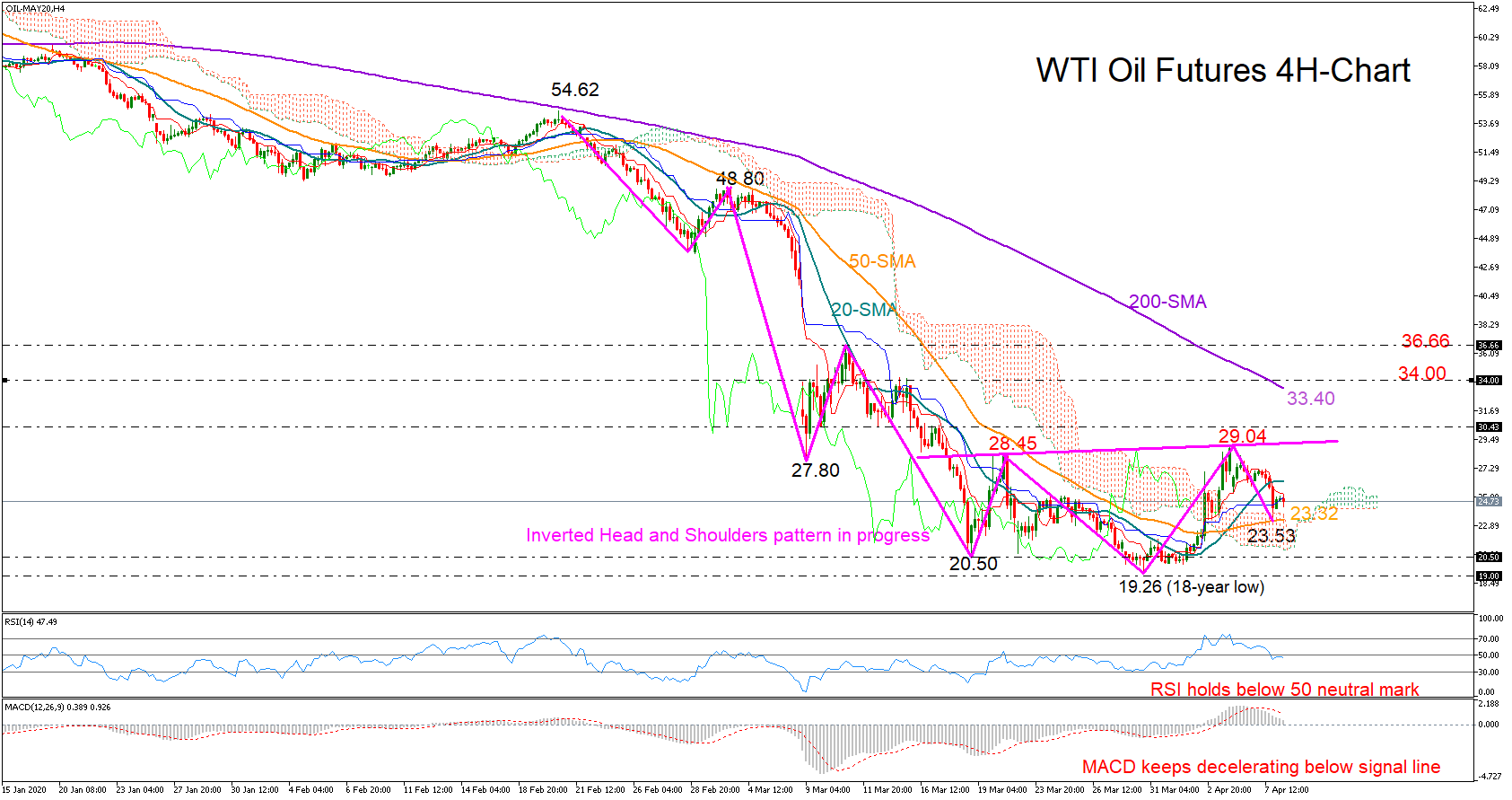
WTI oil futures (May delivery) appear to be forming an inverted head and shoulders pattern in the four-hour timeframe in a possible signal for a positive trend reversal. In the latest upturn, the price failed to overcome its previous high of 28.45 and reversed south to build the right shoulder.

The bullish cross between the 20- and 50-period simple moving averages (SMAs) is also encouraging for a trend improvement.

A decisive rebound above the 29.00 level, where the formation’s neckline is standing, could indicate the start of an uptrend, with traders increasing buying exposure probably towards the 200-period SMA and the 34.00 resistance area. Slightly higher, there is another obstacle around 36.66 that bulls need to successfully overcome to remain in charge.

That said, the momentum indicators are still in a depressing position, suggesting instead that an upside correction may come later than sooner. The RSI seems unable to jump above its 50 neutral mark, while the MACD continues to lose ground below its red signal line. Therefore, some caution may remain in the market, with the 50-period SMA at 23.32 probably grabbing immediate attention if the price further weakens. Below that, all eyes will turn to the left shoulder of 20.50, where any violation would resume fears of a downward trending market, pushing support back to the 19.26 bottom.

In short, the downtrend in WTI oil futures looks to be at risk as a progressing inverted head and shoulders pattern has appeared on the four-hour chart. Traders would wait for a confirmation above the 29.00 level. 
Oil

Author

Christina Parthenidou

Christina joined Trading Point in May 2017. She holds a master degree in Economics and Business from the Erasmus University Rotterdam with a specialization in International economics.


More from Christina Parthenidou
Share:

Editor's Picks

AUD/USD treads water above 0.7000 ahead of the RBA

AUD/USD alternates gains with losses just above the 0.7000 yardstick ahead of the opening bell in Asia on Tuesday. The pair’s decline follows the Greenback’s decent advance in a context of heightened geopolitical effervescence. Moving forward, the RBA is expected to hike its OCR to 4.60%.

USD/JPY climbs back toward 158.00 after BoJ minutes amid firm USD

USD/JPY finds dip-buyers and reverses part of Friday's slide driven by speculation that authorities will step in again to prop up the Japanese Yen. However, the BoJ's dovish Minutes cap the JPY. Meanwhile, the US Dollar regains traction as the US-Iran standoff supports crude oil prices, fueling inflation fears and reaffirming bets for an October Fed rate hike. This further supports the pair, driving it back toward 158.00.

Gold tumbles further; focus shifts to $4,100

Gold kicks in the week on the back foot, selling off to the vicinity of the $4,100 mark per troy ounce, levels last traded back in early August. The resurgence of geopolitical concerns in combination with the firmer US Dollar and rising US Treasury yields keep the yellow metal under heavy pressure on Monday.

Strategy buys 1,665 Bitcoin amid renewed geopolitical tensions
Bitcoin (BTC) dropped below $84,000 on Monday as Strategy (MSTR) announced a fresh treasury purchase of $143 million last week, boosting its holdings to 847,666 BTC. The company purchased 1,665 BTC for roughly $142.7 million, according to a filing with the Securities and Exchange Commission (SEC) on Monday.
The week ahead: A key moment for the global economy as threats rise

UK diesel hits a record, as economic concerns rise. The market expects an aggressive Fed rate hiking cycle, but is it necessary? Oil supply concerns ease, even as oil prices rise. What’s next for the AI trade.

Fed vs BoJ: Both hiked. The market only believes one of them – and the chart shows which

The Fed and the BoJ have just done something remarkably similar. Both central banks raised interest rates by 25 bps last week, both are confronting inflation risks, and both signal that future decisions will depend on incoming economic data.