Will a strong Franc prompt the SNB to intervene?
-
Swiss franc outperforms other majors in H1 2025.
-
Is it time for the SNB to resume intervention?
-
US tariffs could also impact the SNB’s policy strategy.
-
Euro/franc trades in a range, slightly above its record low.


Franc the big winner
The Swiss franc is the silent winner among the major currencies during the first half of 2025, with the euro not far behind and the US dollar suffering the biggest wounds.
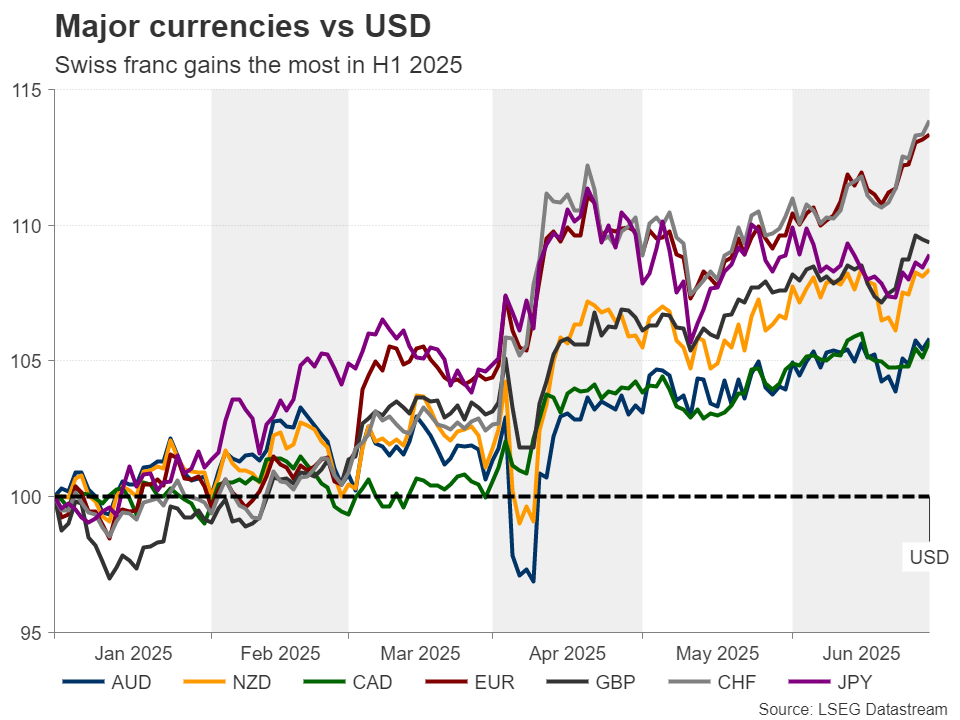
Up until recently, the gains in the franc could be explained as safe haven flows due to the uncertainty surrounding Trump’s tariff policies, but also due to the geopolitical turbulence triggered by the Israel-Iran conflict. However, even after the US begun striking trade deals with some of its allies and truce in the Middle East, the Swiss currency continued to outperform the US dollar and entered a sideways range against the euro, not far from its record highs.
Although the SNB cut interest rates to zero and helped consumer prices exit deflationary territory, headline inflation remained very close to zero, at 0.1% y/y, allowing investors to maintain a strong 30% chance of another quarter-point reduction in September, a move that would take interest rates into negative territory for the first time since June 2022.
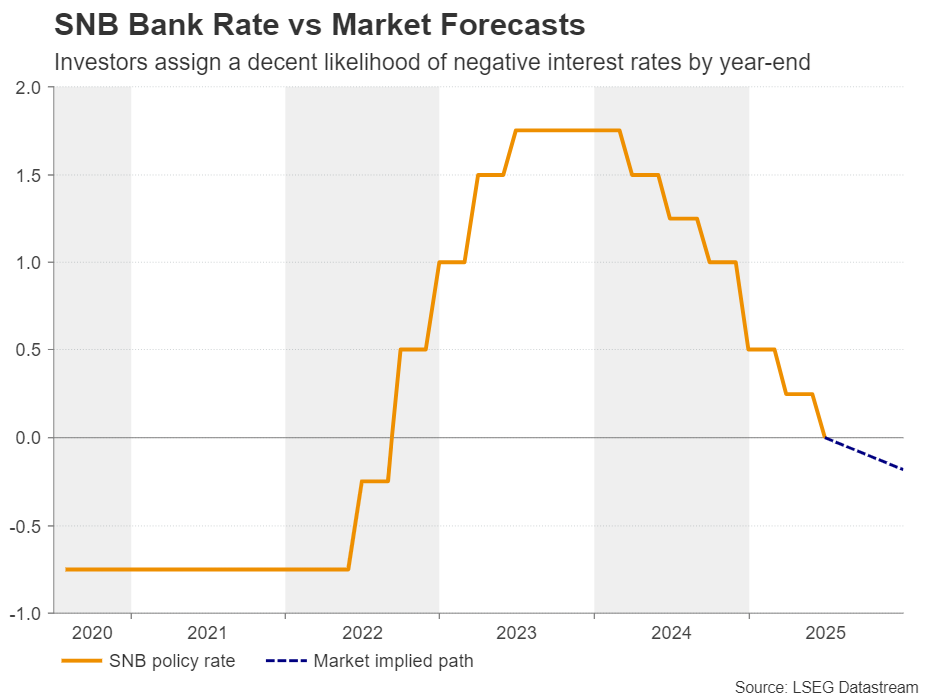
Amid such developments, the continued strengthening of the franc has not only raised some eyebrows but also questions as to whether one additional rate cut will be enough and whether the Bank will have to intervene in the FX market.
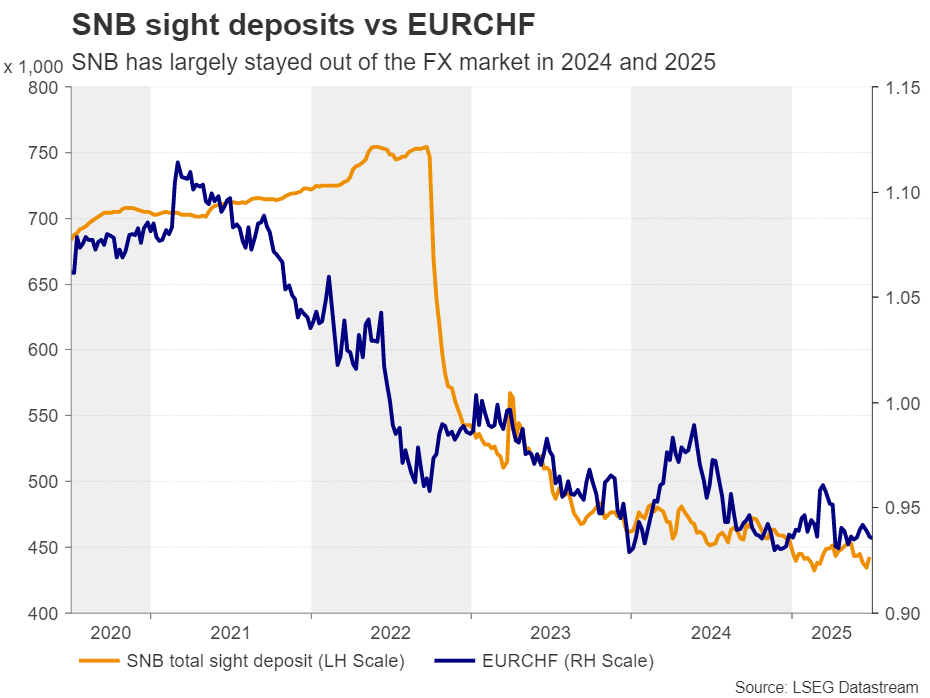
SNB has not intervened since the beginning of 2024
With the Bank’s inflation target range being between 0% and 2%, and economic growth accelerating somewhat in Q1, the likelihood of additional action seems to be low. But should the franc continue to gain, will the Bank be forced to change its plans?
The SNB has been largely staying out of the currency market for five consecutive quarters. It bought foreign exchange worth of just 49 million francs in the first three months of this year, in line with the comparably very small transactions it has been engaging through all of 2024. The Bank publishes transaction data on a quarterly basis with a quarterly delay, which means that data for the second quarter will be made public at the end of Q3.
In 2022 and 2023, the SNB was buying the franc in order to dampen domestic inflation by pushing prices of imported goods lower. Before 2022, it had been implementing the opposite strategy in order to keep a lid on the currency and revive inflation. This is what policymakers could do in case the franc continues to strengthen.
A currency manipulator, or not?
By doing so, the Bank could risk being branded by the US Treasury as currency manipulator as was the case during Trump’s first term, but Swiss finance minister Keller-Sutter said recently that the US has acknowledged that the SNB is indeed not manipulating its currency, which keeps the door open for action should it be deemed necessary. Anyhow, policymakers have been silent on whether they consider the franc overvalued, maintaining their readiness to intervene in both directions to maintain price stability.
The International Monetary Fund (IMF) warned SNB President Schlegel to think carefully before deciding to act either by intervention or by cutting interest rates further, due to the SNB’s already ballooned balance sheet and as negative inflation appeared to be a temporary development.
However, the Bank may have no option should the franc stay strong as this could risk a more lasting deflationary environment. After all, the rebound in the CPI seen in June was mainly driven by holiday-related costs, while gasoline and air transport prices fell.
US tariffs could weigh on the Swiss economy
As for Trump’s tariffs, the IMF warned that the Swiss economy could face significant downside risks if it is hit by the looming 31% duty the US initially decided before the 90-day delay that it is set to expire on July 9.
The Swiss government is hopeful that they will find common ground with the US before July 9, and if they don’t, they expect tariffs to remain at 10% should there be willingness for the negotiations to continue. However, should things fall out of orbit and the 31% duty is imposed, the likelihood of the SNB cutting interest rates into negative territory to support the economy would increase substantially.
Euro/Franc in a range; bigger downtrend remains intact
From a technical perspective, euro/franc has been trading within a sideways range between 0.9305 and 0.9425 since April 22. However, zooming out to the weekly and monthly charts, the pair remains in a long-term downtrend, with the latest short-term range being very close to the pair’s record low.
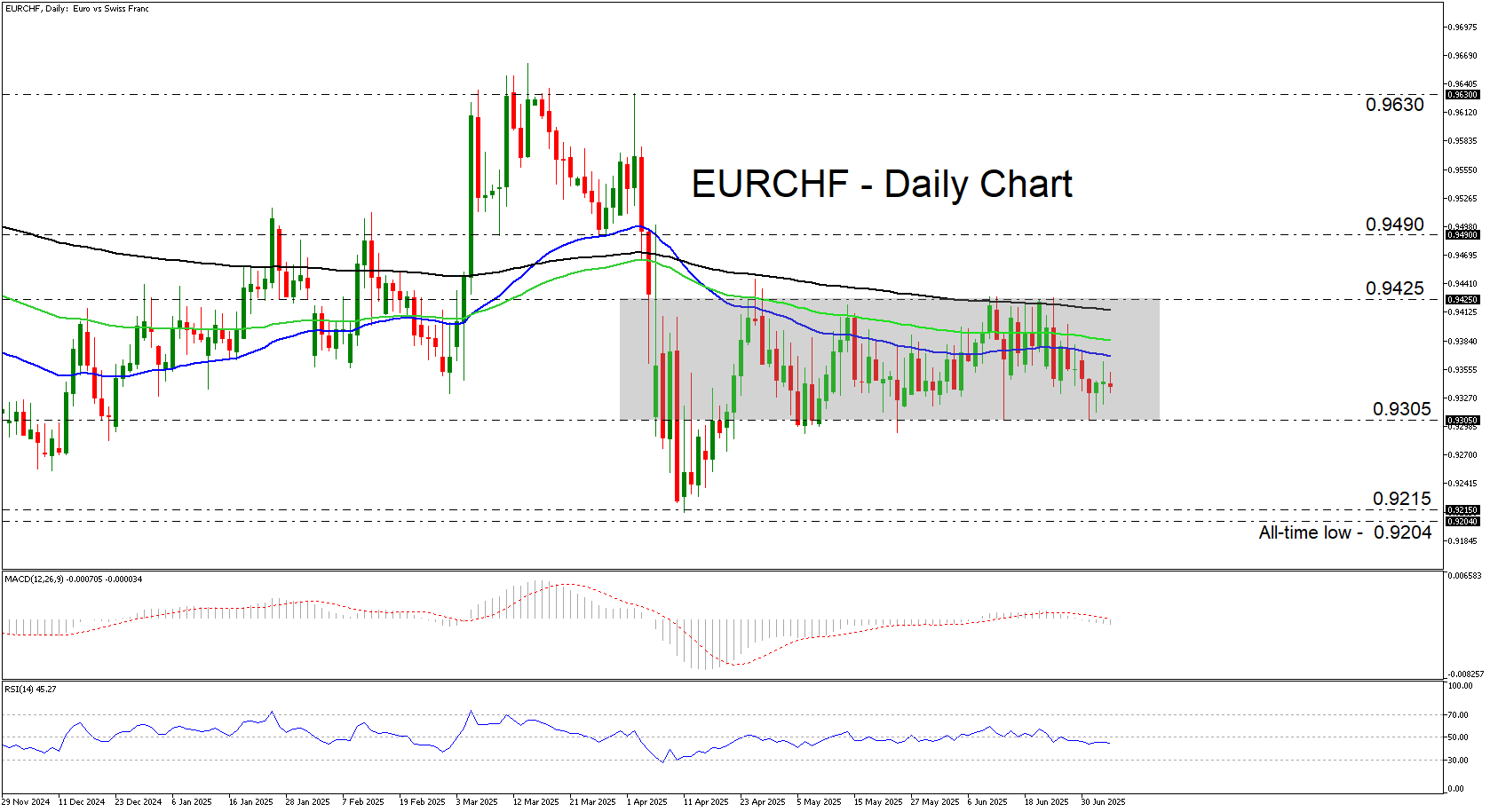
If the bears decided to push the action below the lower bound of 0.9305, they may dive all the way towards the low of April 11 at 0.9215 or the all-time low of 0.9204, reached on November 22, 2024. For the outlook to start brightening, traders may need to exit the current sideways range through its upper bound of 0.9425. Such a rebound could initially target the 0.9490 zone, the break of which could carry larger bullish implications, perhaps paving the way for the high of April 2 at 0.9630.
Author
Charalampos joined the XM Investment Research department in August 2022 as a senior investment analyst.