|

Why the Mexican peso surged against the USD?

On Wednesday, the US dollar decreased in value against other major currencies, including the Mexican peso, by over 1%, due to reports of slower than expected US inflation. This suggests that the Federal Reserve may pause its interest rate hikes. According to data from the US Labor Department, inflation in April decreased to 4.9%, which is the lowest year-over-year increase in two years and lower than market forecasts of 5%. The slower inflation was attributed to slower growth in food prices and a further decrease in energy costs.

However, core inflation remained high at 5.5%, indicating that interest rates may need to stay high for some time to control it. Fed funds futures traders are anticipating a pause before expected rate cuts in September, which might be a little optimistic, as the Fed's target range remains at 5% to 5.25%.

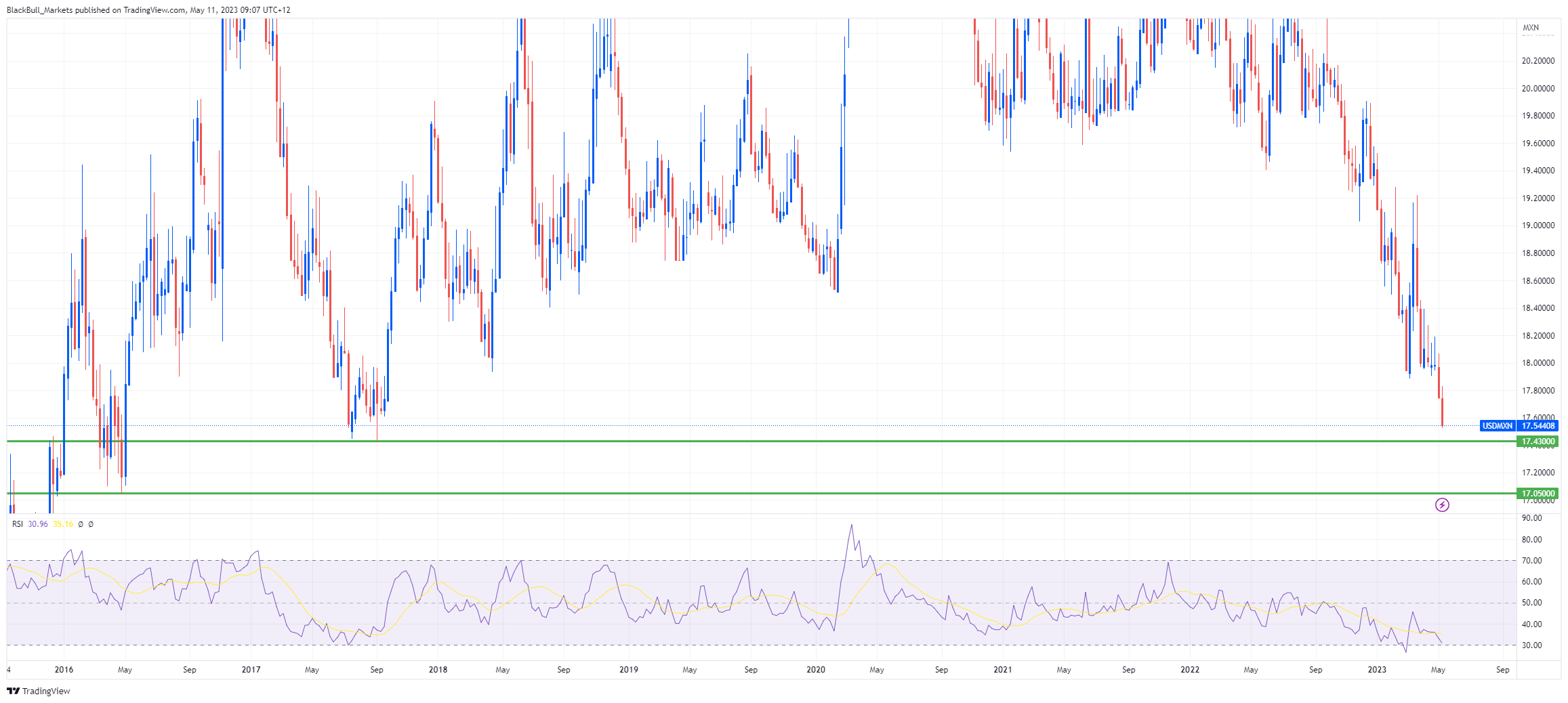
The Mexican peso gained strength to 17.544, its highest value since July 2017, as the difference between US and Mexican monetary policies became more pronounced. The RSI on the USDMXN suggests it is in an extreme oversold condition, so a pullback may be necessary. Resistance levels from 2017 for the pair may no longer be relevant, but the strongest value the peso reached in 2017 was $17.430, while the peak in 2016 was $17.050.

For fundamental context, Banxico increased rates to an all-time high of 11.25% in March, despite a decrease in annual headline inflation that was greater than expected. Mexico's proximity to the US has also made it an attractive location for foreign companies to open factories targeting the American market and diversifying production from China. Additionally, the US economy's robust state has led to a rise in remittances to Mexico from expats.
Author

Mark O’Donnell

Mark O’Donnell

Blackbull Markets Limited

Mark O’Donnell is a Research Analyst with BlackBull Markets in Auckland, New Zealand.

More from Mark O’Donnell
Share:

Editor's Picks

EUR/USD faces next resistance near 1.1930

EUR/USD has surrendered its earlier intraday advance on Thursday and is now hovering uncomfortably around the 1.1860 region amid modest gains in the US Dolla. Moving forward, markets are exoected to closely follow Friday’s release of US CPI data.
 

GBP/USD inching closer to 1.36

The Pound Sterling edged higher to 1.3640 on Thursday, recovering from an earlier pullback after stronger-than-expected US jobs data initially weighed on the pair. The Bank of England held rates at 3.75% at its February 4 meeting in a narrow 5-4 vote split, with four members preferring a 25 basis point cut to 3.50%. 

Gold falls to near $4,900 as selling pressure intensifies

Gold price faces some selling pressure around $4,910 during the early Asian session on Friday. The yellow metal tumbles over 3.50% on the day, with algorithmic traders appearing to amplify the precious metal’s sudden drop. Traders will closely monitor the release of the US Consumer Price Index inflation report for January, which will be released later on Friday. 

Ethereum investors face huge unrealized losses following price slump

US spot Ethereum exchange-traded funds flipped negative again on Wednesday after recording net outflows of $129.1 million, reversing mild inflows seen at the beginning of the week, per SoSoValue data. Fidelity's FETH was responsible for more than half of withdrawals, posting outflows of $67 million.

A tale of two labour markets: Headline strength masks underlying weakness

Undoubtedly, yesterday’s delayed US January jobs report delivered a strong headline – one that surpassed most estimates. However, optimism quickly faded amid sobering benchmark revisions.

Aster Price Forecast: Demand sparks on Binance Wallet partnership for on-chain perpetuals

Aster is up roughly 9% so far on Thursday, hinting at the breakout of a crucial resistance level. Aster partners up with Binance wallet for the second season of the on-chain perpetuals challenge.