Why markets are on tenterhooks ahead of tonight's "dead on arrival" health care vote

As an US resident, I shudder to think what other countries think about the ongoing debate over our convoluted health care system. Anyone will tell you that the current setup is a tangled hodgepodge of ad hoc fixes that no sane person or society would design if given free rein to create a health care system from the ground up. Nonetheless, the current ecosystem has countless vested interests that will fight tooth and nail to prevent any sort of change to the status quo...and that's even before politics gets involved!
Health care is, in other words, a very difficult topic to tackle as your first major policy initiative as a new president. Our Dealmaker in Chief has nonetheless "planted his flag" on the health care mound and to mix metaphors, is seemingly prepared to "go down with the ship" if that's what it takes.
The president apparently issued an ultimatum to bickering representatives that he wanted an up-and-down vote on the American Health Care Act (AHCA) before the weekend...or else the Affordable Care Act (ACA, or "Obamacare") would remain the law of the land. It's a bold position to stake out a mere 60 days into a presidency, especially for a bill that will almost certainly be dramatically modified by the Senate even if it passes the House of Representatives later today.
Of course, global markets (beyond certain insurers and medical device makers) don't particularly care about the House bill on health care per se. However, much like the last year's Italian constitutional referendum morphed into a vote of confidence in the government of Matteo Renzi, the health care vote has become a referendum on the Republican government's agenda as a whole.
The narrative goes as follows: if the Donald Trump, Paul Ryan and company are unable to push through reform on a subject that almost all Republicans agree upon in principle, then how in the world will they accomplish more controversial economic policy goals, including the much-vaunted $1T infrastructure bill or tax reform?
For traders, the question of whether the impact of the health care vote actually impacts the likelihood or timing of other economic policy decisions is immaterial; the crucial fact is that the market is trading as if it does. With valuations on all US assets (from stocks to bonds to the dollar) historically high, it may not take much to "pop" the confidence bubble and prompt a short-term correction in all of those assets.
To that end, there's some concern that character of the market is already shifting. Tuesday's "big" down day for stocks marked the first 1% drop for major US indices since last October. As the chart below shows, this streak was within days of becoming the longest such low volatility period since the mid-60s:
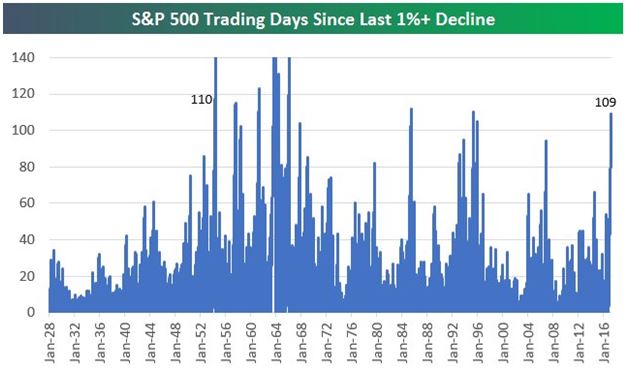
While this daily drop is historically tame (the average "worst day of the year" for the S&P 500 has been -3.7% over the last 50 years per Ryan Detrick at LPL Financial), it could portend the return of more meaningful volatility in US stocks, especially if traders start to lose confidence in Trump and company's pro-growth agenda.
Author
Matt Weller, CFA, CMT
Faraday Research
Matthew is a former Senior Market Analyst at Forex.com whose research is regularly quoted in The Wall Street Journal, Bloomberg and Reuters. Based in the US, Matthew provides live trading recommendations during US market hours, c