Why is the euro hanging on while other currencies crash?

Outlook: The too-strong dollar is starting to get scary, with records getting set all over the place. The dollar/yen is above 150 for the first time since 1990. Sterling surpassed the mid-Oct low and seems headed straight for the previous lowest low at 1.0922. And no one sees that as a floor. It can go to 1.0520 to match Jan 1985. In China, the dollar surpassed CNY 7.25 for the first time since 2008 and amid talk of some PBOC intervention.
Extremes like this and breaking “historic” levels raises risk to near-intolerable levels. The driver this time seems to be expectations for the Fed funds “peak” to rise over 5% for the first time. Even former dove Minneapolis Fed Kashkari concurs. See the Reuters chart—“overdrive” started late last spring.
At some point the “peak” idea will get priced in and remember St. Louis Bullard’s screenplay in which two massive hikes in Q4 pretty much sweeps up inflation and H1 next year will need only a little tweaking. Meanwhile, the resilience of the euro is curious and unsettling. A Bloomberg survey finds the ECB is expected to do more than imagined before, reaching 2.5% by next March (from 1.5% in an earlier poll). “That advance includes a 75 basis-point hike on Oct. 27, and another 50 basis-point step in December. The survey suggests that a downturn in the 19-nation euro-area economy won’t prompt a halt in rate increases, whose ferocity has begun to match that of the Federal Reserve, despite kicking off four months later.”
Wait a minute—if the US is going to get 5% and the eurozone is getting half that, and if these expectations are the true consensus, why is the euro hanging on while other currencies crash? The answer is “it’s not.” It moved first and got a head start on others (like the yen). Then there’s European recession already priced in. Sales of other currencies are not only against the dollar but also against the euro, so it gets an unwitting gain. And finally, over the weekend somebody is sure to come up with some “real” currency levels based on various data adjustments to show the euro is not actually firmer. On the 2-year relative basis, the euro/dollar is tracking the spread quite closely.
Nobody can name when this dollar outburst will end or what will trigger it, but experience tells us to beware forecasts of splashy reversal. It’s more likely to be a whimper than a bang.
Global Housing Crash Redux: It’s not just the US where the housing crash is frightening folks into seeing a crisis. The worldwide rise in mortgage rates is crushing demand. The Economist cites global property firm Knight Frank, which says global house prices in 55 countries last year rose at the fastest pace since 2005 but are now reversing. “In Canada and Sweden, prices have fallen by more than 8% since February. In Britain and America, they are expected to fall by up to 10% from their peak by the end of 2024.”
Well, if the average house price across 17 rich countries rose over 27% above their pre-pandemic levels, a drop by 10% still leaves the homeowners with a gain. If we admit the housing market was a bubble, this is not exactly a puncture.
Banks and borrowers are in better shape this time and a financial sector crisis is not in the cards, but “the housing downturn will be grim. Gummed-up property markets will be a drag on the jobs market, and already gloomy households will be even more miserable. Homeowners who bought recently, or who have not locked in low interest rates, will bear the most pain. There are fewer of them in America, where 30-year fixed-rate mortgages are the norm, and more in places like Sweden and New Zealand, where loan terms are shorter.”
The fallout is wide. Homebuilder stocks are falling; banks are contracting their mortgage divisions, and “Some construction firms, estate agents, mortgage brokers and surveyors say they have lost as much as four-fifths of their revenue since the Federal Reserve began raising rates in March.” Stuff like lumber, appliances and furniture are tanking.
The Economist deduces “When house prices go up, people feel wealthier, which gives them confidence to renovate their homes, buy fancier cars or simply spend more on having a good time. That makes the fortunes of property markets and the economy closely intertwined. As the housing cycle turns, the economic cycle may tag along for the ride, too.”
This is very like the newsletter we tried to debunk yesterday, albeit with the nearly royal imprimatur of The Economist. The international scope of this article only reinforces the idea that while a property bust in other countries has the potential for financial market instability, it’s a whole lot less in the US. As noted, only 4% of US households are buying a house per month, and a high percentage lock in a 30-year rate. So far, banks report lusty consumers who are not in financial distress. There are cases where the property market leads the “economic cycle,” but not, probably, this time and not in the US. For what it’s worth, former TreasSec Summers is saying the same thing on CNN.
Then a topmost question becomes contagion, that tricky thing we know too little about. If the property sector in the UK, for example, crashes and burns, with bank and other lender failures, does that infect the US? Remember that in the 2008-08 crash, it was unwise lending in the UK that led the way. But to assume contagion is to assume that the moral hazard addressed by Dodd Frank (impenetrable except for the bank stress tests) is not good enough. That in turn implies banks circumvented federal regulations and kept on lending to subprime borrowers.
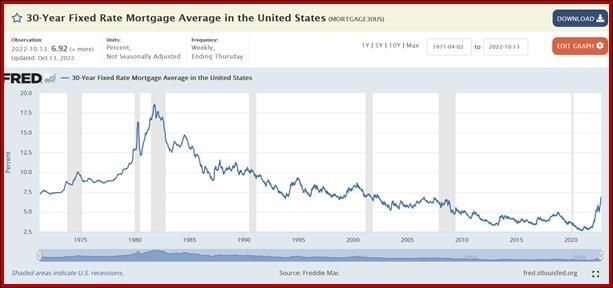
We don’t buy it. In fact, if St. Louis Fed Pres Bullard is right and rate hikes will taper off next year, by June we could see property/housing starting to recover with the new benchmark mortgage rates becoming seen as “normal.” In fact, see the long-term mortgage rate chart from FRED. What’s abnormal is the drop in rates to 2.67% in Oct 2020, something fuelled by the ever-dangerous QE that results in misallocation of resources, in this case, housing. A return to 7.7% is hardly a problem in the grand scheme of things except in the context of the abnormally low rates created by QE.
Over millenia (yes, millenia), the relationship between “land” and interest rates is an inverse correlation. The higher the interest rate, the more attractive are financial assets over more slowly-appreciating land. Equilibrium arrives at some point, however fleeting.
This is an excerpt from “The Rockefeller Morning Briefing,” which is far larger (about 10 pages). The Briefing has been published every day for over 25 years and represents experienced analysis and insight. The report offers deep background and is not intended to guide FX trading. Rockefeller produces other reports (in spot and futures) for trading purposes.
To get a two-week trial of the full reports plus traders advice for only $3.95. Click here!
This is an excerpt from “The Rockefeller Morning Briefing,” which is far larger (about 10 pages). The Briefing has been published every day for over 25 years and represents experienced analysis and insight. The report offers deep background and is not intended to guide FX trading. Rockefeller produces other reports (in spot and futures) for trading purposes.
To get a two-week trial of the full reports plus traders advice for only $3.95. Click here!
Author
Barbara Rockefeller
Rockefeller Treasury Services, Inc.
Experience Before founding Rockefeller Treasury, Barbara worked at Citibank and other banks as a risk manager, new product developer (Cititrend), FX trader, advisor and loan officer. Miss Rockefeller is engaged to perform FX-relat

















