Why is the ECB set to cut interest rates again and what does that mean

The European Central Bank (ECB) is widely expected to cut interest rates on Thursday. If it does so, it would be the seventh consecutive cut – the eighth since the central bank started the current easing cycle in June last year – and a key step towards normalizing rates after the surge seen in 2022-2023.
While economists are convinced that another interest-rate cut is a done deal, several questions arise: Will the ECB continue to lower rates even further? Is the ECB’s job regarding taming inflation done? Where will rates settle, and how will it affect the Eurozone’s economy?
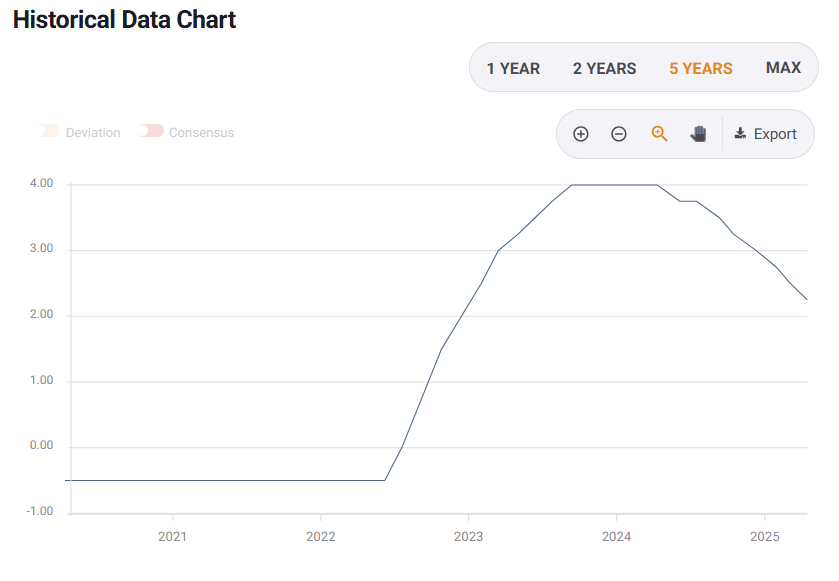
Evolution of the ECB deposit facility rate in the past five years. Source: FXStreet.
What does an ECB rate cut mean and why is it important?
Lower interest rates directly affect families and businesses in the Eurozone, a group of 20 countries in Europe that share the Euro (EUR) as a currency and one of the largest economic areas in the world.
The interest is the price to pay when borrowing money: bank loans, mortgages,... the amount of interest in all these ultimately depends on the level of the benchmark interest rates set by the ECB.
The ECB decides the level of interest rates independently, meaning that its decisions aren’t subject to approval by the European Commission or Parliament. Setting interest rates is one of the ECB’s most powerful tools: high rates can make borrowing money more expensive, while lower rates can make it cheaper and easier to get a loan approved.
So, cutting interest rates lowers the cost of borrowing and thus encourages households and businesses to take on more debt.
Will the ECB cut interest rates on Thursday, and why?
Yes, or at least that is what the majority of economists and analysts think.
This is mainly because inflation – or by how much prices are rising – is a key driver for the ECB’s actions. The central bank’s only mandate is to keep inflation under control close to its 2% target.
Having peaked at 10.6% in October 2022, inflation in the Eurozone, as measured by the Harmonized Index of Consumer Prices (HICP), stood at 1.9% in the preliminary reading for May, the lowest level since September and undershooting the ECB’s target.
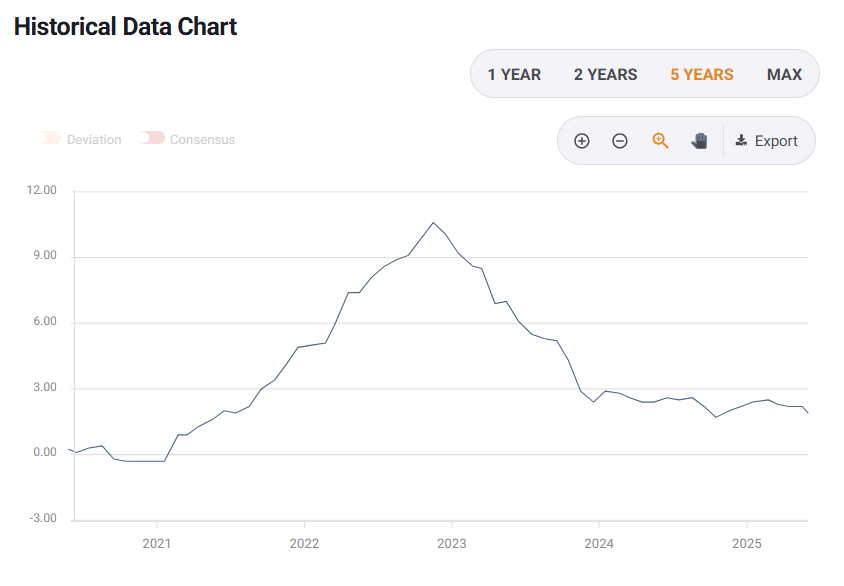
Evolution of the HICP inflation rate in the Eurozone in the past five years. Source: FXStreet.
“Chances are high that the ECB’s staff projections will already show inflation dropping below 2% this year, roughly one year earlier than predicted in the March forecasts,” said Carsten Brzeski, ING’s global head of macro research, in a note to clients sent on Friday.
Even if it sounds contradictory, US President Donald Trump’s constant tariff threats have also improved the near-term inflation outlook for the Eurozone, Brzeski argues.
Washington’s erratic trade policy has lowered Oil prices and led the Euro to strengthen against the US Dollar (USD), making imports to the Eurozone cheaper than before.
By how much the ECB is expected to cut rates?
As the Eurozone’s inflation problem looks like it is in the rear-view mirror, economists expect a cut of 25 basis points, or a quarter-percentage point.
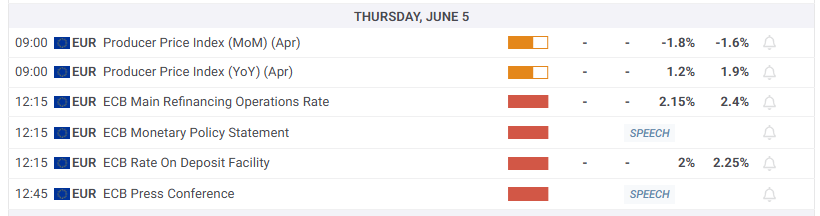
The deposit facility rate, which is the key measure, is currently at 2.25% and it is expected to be lowered to 2%. This would be the lowest level in more than two years.
“ECB members have been getting more dovish [more inclined to cut interest rates] in recent weeks, according to their speeches, which is another sign that the doves are in control at the bank,” said Kathleen Brooks, research director at XTB Research, in a note.
Bank of France Governor François Villeroy de Galhau said on May 27 that “policy normalization in the Euro area is probably not complete.” In plain words, in his view, more interest-rate cuts are to come when taking into consideration how the economy and prices are doing. FXStreet speech tracker, which gauges the tone of ECB officials on a dovish-to-hawkish scale from 0 to 10 using a custom AI model, rated Villeroy’s words as dovish.
What time is the ECB rate announcement?
The decision on interest rates will be published at 12:15 GMT, along with the statement explaining the rationale behind the move. Later, at 12:45 GMT, ECB President Christine Lagarde will take questions from the media in a press conference.
Will the ECB continue to cut rates further ahead?
It isn’t clear, and that’s a key issue for markets.
After reaching the 2% level, discussions within the ECB could become more heated between the doves (those who believe interest rates should be lowered further) and the hawks (those who think interest rates are already low enough).
Indeed, while there are plenty of reasons supporting further cuts, other factors – from the relatively good performance of the Eurozone economy so far this year to the uncertainty stemming from Trump’s trade policies – give ammunition to the other side as well.
In this regard, Christine Lagarde’s press conference on Thursday could be more interesting. "Not only because we expect some questions on the World Economic Forum story and Lagarde’s personal ambitions to live in a house with a lake view – but also because of hints at what could come next,” Brzeski from ING said.
“Unless trade tensions return with a vengeance, our suspicion is that the ECB would like to stick to a wait-and-see approach over the summer,” he said.
Author

FXStreet Team
FXStreet
Composed of a group of economic journalists and FX experts, the FXStreet content team produces and oversees all content published on FXStreet. It provides a purely journalistic approach to the Forex market.