Why Gold miners fall even after record profits
Newmont, the world's largest gold miner, reported record third-quarter adjusted net income on Thursday. On Friday, its shares fell 4.6 percent, more than twice as much as the GDX. Over the whole week, the GDXJ, the ETF for junior mining stocks, fell 9.6 percent, while gold fell 4.1 percent.
Gold itself slipped below $4,000 on Friday, and silver closed below its 2026 lows for a second day. A record quarter wasn't enough to lift the largest miner, and the reason matters to anyone who owns or follows mining stocks.
A share price looks ahead
A share price looks ahead, and a record quarter looks back. Investors pay for the profits a miner will earn, and those profits depend on two numbers: the price of gold and the cost of producing an ounce.
In the third quarter, Newmont sold gold at an average of $4,317 per ounce, and its all-in sustaining costs were $1,454 per ounce, a margin of about $2,860 per ounce. For the fourth quarter, Newmont expects all-in sustaining costs of about $1,900 per ounce, mainly because of higher sustaining capital spending, and it also cited continued inflation, including higher oil prices. With gold near $4,000, the margin would be about $2,100 per ounce. The gold price would be about 7 percent below the third-quarter average, and the margin would be about 27 percent smaller.
On Friday, the market looked past the record and at the fourth quarter.
The margin math
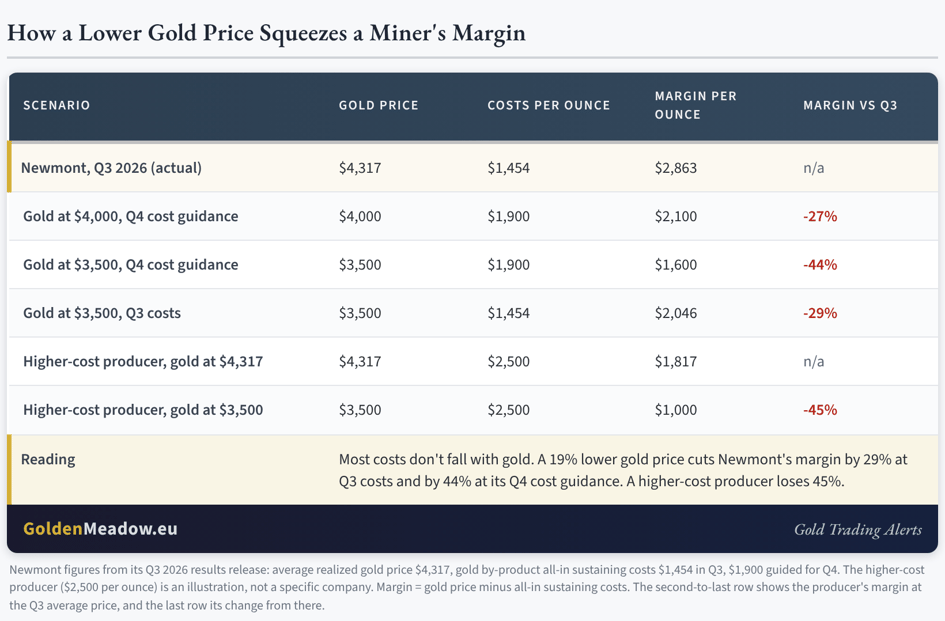
This is operating leverage. Most costs don't fall when gold falls, so each percent lost in the gold price takes a bigger percentage out of the margin. At $3,500 gold and costs of $1,900, Newmont's margin would be $1,600 per ounce, 44 percent less than in the third quarter, while gold would be 19 percent lower.
Operating leverage works in both directions. In a rally, miners' profits rise faster than gold, which is why miners tend to outperform gold on the way up. In a decline, their profits fall faster, which is why miners tend to lead gold on the way down.
Why junior miners fall harder
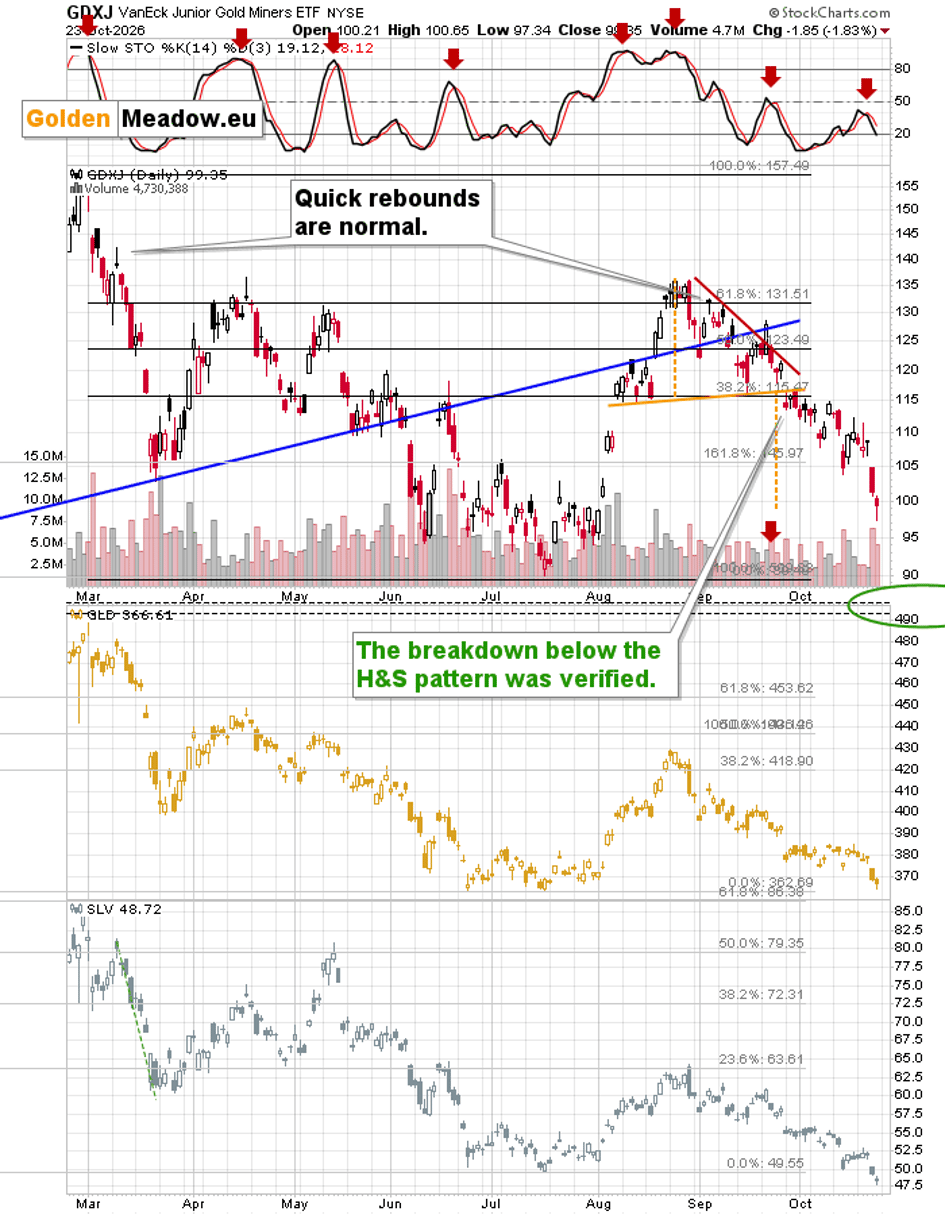
In my gold price forecast for October 2026, published on September 30, I wrote about the GDXJ: "The neckline near $117 is where a verification rebound would run into resistance, and the H&S-based target is a bit below $100, working on an 'at least' case." The GDXJ's rebound in early October stopped below $116, and on Friday, the ETF closed at $99.35.
The effect grows with costs. With costs unchanged, a drop from $4,317 to $3,500 would cut a margin based on $1,454 costs by about 29 percent, and a margin based on $2,500 costs by about 45 percent. In my view, this is part of why the junior miners, many of them higher-cost producers, fell 9.6 percent last week, while gold fell 4.1 percent.
Volume confirmed the move. On Thursday, the GDXJ fell 6.75 percent on about three times Wednesday's volume, and on Friday, it fell another 1.83 percent to $99.35 on more than twice Wednesday's volume. Wednesday's upswing came on weak volume, and the declines came on heavy volume, which is how distribution usually looks.
Higher Oil hits the miners twice
Newmont itself pointed to higher oil prices as one reason for its rising costs, and Brent rose to a six-month high of $116.72 on Friday.
Higher oil also keeps inflation expectations up. The final University of Michigan survey showed year-ahead inflation expectations at 4.7 percent and long-run expectations at 3.5 percent, up from 3.4 percent in September. Early on Friday, the CME FedWatch tool showed about an 84 percent chance of another Fed hike by the end of the year. Higher rates raise the cost of holding gold, which pays no interest.
So higher oil reaches the miners twice: through their costs, and through the rate channel, which weighs on gold.
What a real bottom would look like
On October 15, I wrote: "At real bottoms, miners lead gold higher."
Operating leverage explains why. When the market starts to price in a higher gold price, the miners' expected profits rise faster than gold, so their shares turn first. Last week showed the opposite. The GDXJ fell 9.6 percent while gold fell 4.1 percent, and Newmont fell after record results. Until the miners start rising on gold's down days, or at least falling less than gold, I think the decline in the sector has further to go.
The same leverage works at tops. On October 12, I wrote: "Silver outpaced gold on Friday and is holding up on today's down day for gold, the signature that came before this fall's short-term tops, while the miners are giving back Friday's gains about three times as fast as gold." From that day's close of $112.92, the GDXJ fell 12 percent to Friday's $99.35.
The Dollar adds pressure
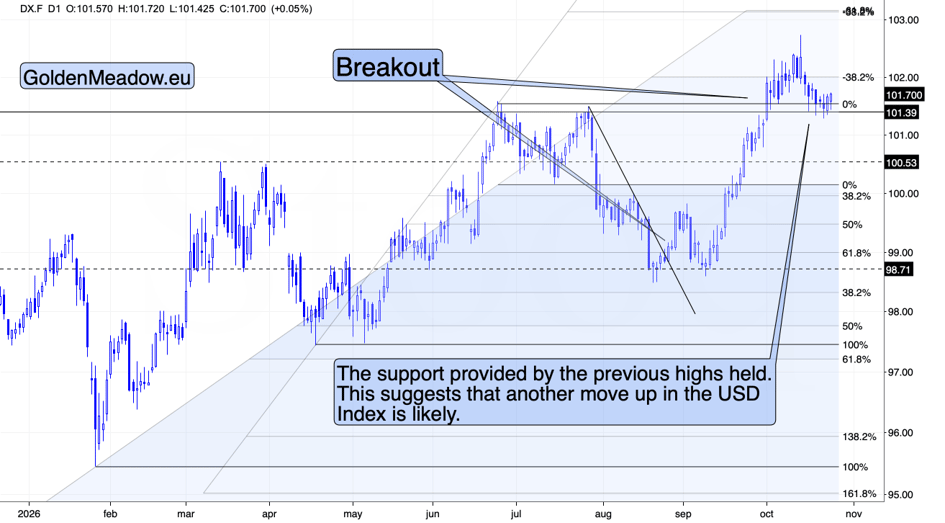
The USD Index is moving a bit higher after bottoming at its previous 2026 highs, and the previous resistance turned into support in a crystal-clear manner. The gold-USD link is traditionally negative, and after the confirmed breakout to new 2026 highs, I think the next big move in the USD Index is likely to be to the upside.
Last week, gold fell 4.1 percent while the USD Index ended flat. A dollar rally would add to the pressure on gold, and through operating leverage, even more so on the miners.
Silver
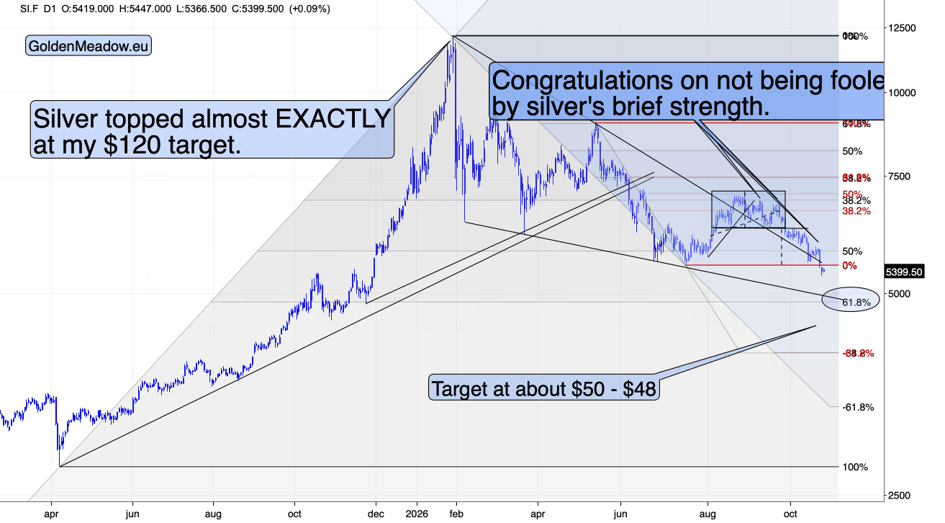
Silver price closed below its 2026 lows on Thursday, at $55.01, and lower again on Friday, at $53.95. Two daily closes below the lows are in, and a third one would confirm the breakdown.
Where this leaves us
Newmont posted record adjusted earnings and kept its production guidance, and its shares still fell 4.6 percent, because the market looked at the fourth quarter: costs up, gold down. Gold fell 4.1 percent last week without any help from the dollar, silver closed below its 2026 lows, and the junior miners fell more than twice as much as gold.
When the largest gold miner falls after record results, good news isn't helping the sector.
Want free follow-ups to the above article and details not available to 99%+ investors? Sign up to our free newsletter today!
Author

Przemyslaw Radomski, CFA
Gold Price Forecast
Przemyslaw Radomski, CFA (PR) is a precious metals investor and analyst who takes advantage of the emotionality on the markets, and invites you to do the same. His company, Sunshine Profits, publishes analytical software that any